


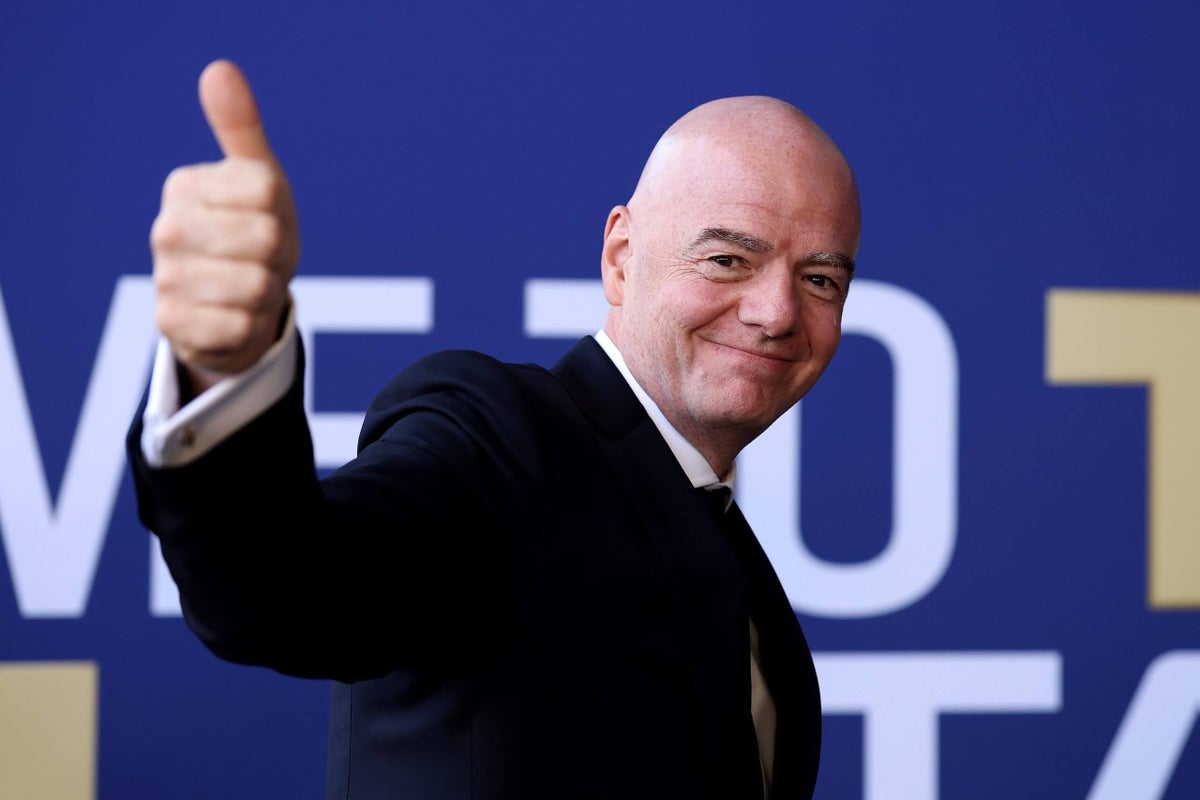
FIFA president Gianni Infantino has lashed out against scrutiny and criticism of his leadership and his organization, accusing critics of “spreading hate” and telling them to “meditate, pray or watch a football match” instead of spending their energy “hating” FIFA.
The message was posted across 15 slides on his personal Instagram account and distributed to media personnel by FIFA’s communications team. It was cross-posted to the FIFA Instagram account to more than eight million people, as well as to his own 5.7 million followers. It cited his belief the World Cup “celebrated humanity at its best,” saying billions of people worldwide watched the World Cup, and “virtually all global celebrities from music, movies, entertainment and sport attended.”
Infantino, who did not conduct a news conference after the World Cup began, nor at the end of the tournament, brushed off many of the tournament’s most controversial moments in the lead-up and during the competition itself.
In one such moment, FIFA’s tournament proceeded with fans from four competing countries — Iran, Haiti, Senegal and Ivory Coast — hampered by U.S. travel bans imposed by the Trump administration. “I think that every team can have their people, so I don’t understand why people from Africa cannot have their people,” Senegal captain Kalidou Koulibaly told The Athletic during the group stage.
FIFA’s Somali referee Omar Artan was also prohibited from entering the U.S. on the eve of the tournament, with a White House official alleging the referee had an “association with suspected members of terror organizations.”
FIFA also faces ongoing investigations by the Attorneys General of New York, New Jersey, Texas and California over its ticketing prices for the World Cup.
Iran’s national team also complained about the difficulties it experienced during the tournament, with captain Mehdi Taremi describing the competition as a “disaster” because of the restrictions on visas and movement for members of its federation.
A controversy developed mid-tournament after U.S. forward Folarin Balogun was dismissed during his team’s 2-0 round-of-32 win over Bosnia and Herzegovina, triggering an automatic one-game ban.
But just a day before the USMNT faced Belgium at Lumen Field in Seattle, The Athletic reported Balogun would, in fact, be available. This was confirmed by statements from FIFA. President Donald Trump later said he called Infantino to ask for the case to be reviewed. Balogun was made eligible to face Belgium after FIFA’s disciplinary committee suspended the sanction. The committee has not explained this decision, which triggered widespread accusations of political interference in the World Cup. Infantino denied this, but FIFA has faced public criticism from UEFA, the Belgian football federation and dozens of European Union lawmakers.
The Norwegian Football Federation intends to make a formal complaint to FIFA over Trump’s role in the suspension of Balogun’s red card. NFF president Lise Klaveness confirmed the plans, which follow her federation’s backing of December’s ethical complaint in relation to Infantino’s decision to award Trump the FIFA Peace Prize.
The inside story on why USMNT failed against Belgium
In the essay posted on his Instagram on Sunday night, Infantino wrote: “To all of you who missed watching kids, babies, grandparents, and parents come together for the beautiful game, I say sorry that the matches are now over and sorry that you missed all that joy and togetherness. Sorry that you were so consumed by hate and criticism that you missed it all.
“To those behind their pens and papers, behind their screens spreading hate and false rumors, I want to say that while you are sitting behind, we at FIFA are on the front lines organizing, working hard, and delivering the best show in the world.”
He continued: “We experienced no violence, no incidents, 100% safety and security, only joy and happiness!”
He thanked the host countries, the police forces and volunteers for ensuring safety and security.
The Instagram post, addressed to “all those who …” continued by accusing critics of “planting seeds of hate.”
He wrote FIFA “worked tirelessly to unite two countries at war,” saying “Iran entered the United States without incident or conflict.”
However, four of the 15 Iranian staff members initially denied visas to enter the U.S. were granted the right to travel into the country after appealing to the State Department. By the time of Iran’s third match against Egypt in Seattle, the team was able to fly to the site two days in advance, having previously been limited to flying the day before their first two fixtures in Los Angeles.
Homeland Security Secretary Markwayne Mullin previously said members of the Iran traveling party had tried to sneak in a person with direct ties to the Islamic Revolutionary Guard Corps, a group designated by the U.S. as a terrorist organization. An official for the Iran Football Federation called that accusation “false, fabricated and entirely baseless.”
Infantino’s post also made no mention of a legal case brought against FIFA’s attempts to prevent Iranian fans from bringing the pre-revolutionary lion and sun flag into World Cup venues.
Appearing to refer to the controversy over Balogun and criticism of referees during the tournament, Infantino said: “Your dissatisfaction with a few decisions made by the competent authorities is understandable, but please refer to public records: such decisions are common in some of the most important leagues.
“Indeed, ‘arguable’ referees’ decisions or ‘strange’ disciplinary rulings such as for instance potentially mistaken red or yellow cards or subsequent decisions not to ban players in certain situations are routine and widely accepted in some of the biggest leagues worldwide.”
He also appeared to suggest FIFA deserved praise for ensuring visas for some but not all to attend the tournament. “You mentioned the few people denied visas and overlooked the millions who were approved, from all parts of the world.”
