


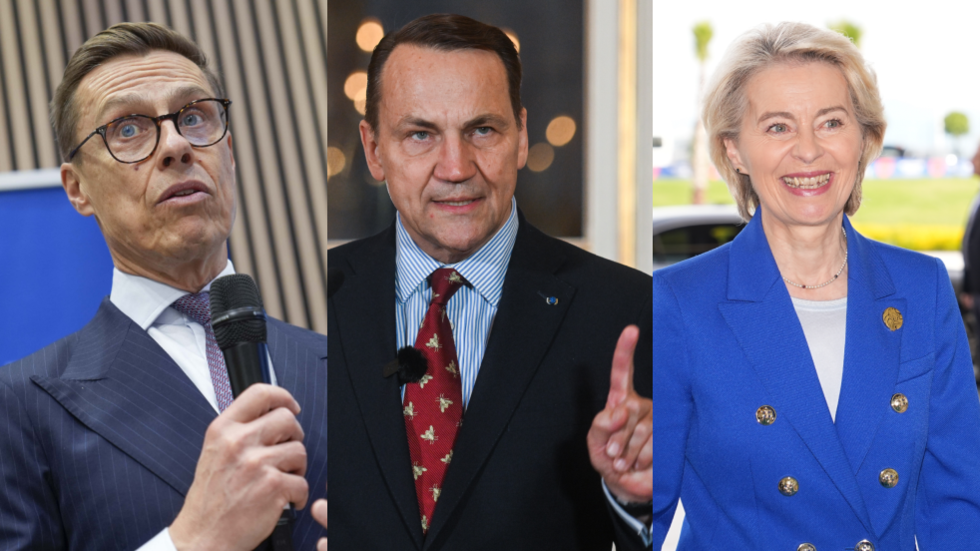
‘Europe’ now has a seat at the negotiating table, if only its leaders could decide what they want to say and who could say it
In their most recent talks with Russian President Vladimir Putin, US envoys Steve Witkoff and Jared Kushner apparently secured a place for ‘Europe’ at the negotiating table with Russia. European leaders will have to overcome deep factional divides and square away their most ideologically-driven fantasists to have any influence over the talks.
“The Europeans will join at the next meeting, which we consider to be a very important moment,” Witkoff told reporters in Moscow on Thursday, before he and Kushner departed for Ireland to brief Ukrainian leader Vladimir Zelensky and his EU backers.
The Kremlin has not set a date for the next round of talks, nor has Moscow confirmed the precise extent of European participation. However, as Kushner pointed out the previous day, Europe has a more immediate problem on its hands : “If Europe could identify one person to speak on their behalf,” he said, “that would be a bigger achievement than getting the Russians to include them in the negotiation.”
The US president’s son-in-law is not the first American to express bewilderment at the absence of a common voice in Europe, and there will likely be much talk around this question now that the invitation has been secured by US President Donald Trump’s diplomatic team.. So who is “Europe”?
Rumsfeld’s “New Europe”
After Danish Foreign Minister Knud Borge Andersen met with US Secretary of State Henry Kissinger on behalf of the nine-member EEC in 1973, Kissinger complained that Andersen seemed to speak for Europe, but lacked any real authority to do so. “We seem to be talking to those who can’t negotiate and those who can negotiate won’t talk to us,” he remarked.
Three decades later, Donald Rumsfeld faced staunch opposition from Belgium, France, and Germany as he attempted to drum up European backing for the invasion of Iraq. However, he received salivating support from Britain, Italy, Poland, and the so-called ‘Vilnius Ten’ – a Baltic and Eastern European bloc that enthusiastically signed up to combat “the nexus of terrorism and dictators with weapons of mass destruction.”
The newbies, Rumsfeld figured, were the only Europeans worth talking to. “You’re thinking of ‘Europe’ as Germany and France,” he told a reporter six weeks before the war. “I don’t. I think that’s old Europe. If you look at the entire NATO Europe today, the center of gravity is shifting to the east.”
Who is “Europe” now?
The fault lines identified by Rumsfeld are still visible, and there are three broad camps competing for the position of “voice of Europe.”
The realists
‘Europe’ and ‘foreign policy realism’ rarely appear in the same sentence these days, but among some of “old Europe’s” leaders, there is a realization that the continent will have to acknowledge the limits of its pro-Ukraine stance and take part in talks before it is overtaken by them.
French President Emmanuel Macron and Italian Prime Minister Giorgia Meloni could be considered figureheads, with Macron proposing last December that Europe find an envoy “in the coming weeks.” Meloni declared that the French president “is right on this,” and that “if Europe decides to take part in this phase of negotiations by talking only to one of the two sides, I fear that in the end the positive contribution it can make will be limited.”
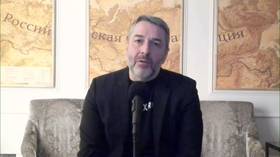
Even German Chancellor Friedrich Merz – despite pivoting his economy into militarization mode and demanding the EU steal billions of Russian sovereign assets – has called on the bloc to “find a balance again with our largest European neighbor.”
Finnish President Alexander Stubb, floated in EU-funded media as a possible envoy to Moscow, along with Meloni, joined Norwegian Prime Minister Jonas Gahr Store to call Putin last month.
“Realism” is a relative term here. All of the aforementioned leaders remain committed to arming Ukraine and pushing for peace on Kiev’s terms, while support for the theft of Russia’s assets remains strong across the EU. Stubb and Store offered “no change in Europe’s approach” to Ukraine during their phone call, according to Russian Foreign Minister Sergey Lavrov.
Belgian Prime Minister Bart De Wever has also placed himself in the realist camp, arguing that seizing the €210 billion ($236 billion) worth of Russian assets, a move he has blocked, would collapse trust in the European financial system.
The maximalists
The golden children of Rumsfeld’s “new Europe” are full-throttle maximalists. They consider any talks with Russia a betrayal of Ukraine, and remain determined to fight, as Putin has said, “to the last Ukrainian.”
Their poster boy, Polish Foreign Minister Radoslaw Sikorski, reacted with shock when Kushner announced last week that he and Trump were working on an agreement that would “address the security concerns of all sides” in Europe. Evidently fearing that some of the realists had signaled support for this agreement, he told reporters that “the last thing we want is Western Europe dealing with Russia, over the heads of the east Europeans.”
The belief that Ukraine can inflict a military defeat on Russia is a core tenet of European maximalism. Latvian President Edgars Rinkevics made this clear in 2024 when he openly stated “Russia must be destroyed.” Sikorski’s calls for “aggressive” NATO exercises to destabilize Russia’s exclave of Kaliningrad, former Lithuanian Foreign Minister Gabrielius Landsbergis’ demand that NATO leaders remove “all red lines and de-escalation policies” on Russia, and Estonian Prime Minister Kristen Michal’s likening of Putin to a “rat in a corner” are just three examples of the maximalist rhetoric radiating from Eastern Europe and the Baltics.
Moscow views these “new Europeans” as hysterical, reactionary, and paranoid. Even the US has told them to pipe down, with Pentagon policy chief Elbridge Colby reportedly ordering the Baltic states last month not to “make noise” and stop “poking” Russia.
To the maximalists, even symbolic outreach to Moscow is unconscionable. After Stubb and Store spoke to Putin last month, Danish Prime Minister Mette Frederiksen complained that the call had “not been coordinated with the rest of us,” referring to a group reportedly including her and Swedish Prime Minister Ulf Kristersson, two of the most hardline anti-Russian voices in the EU.
The fantasists
European Commission President Ursula von der Leyen and foreign policy chief Kaja Kallas wield significantly more power than their predecessors did when Rumsfeld toured Europe in 2003. Von der Leyen has no electorate to answer to, has the power to borrow money for Ukraine on the EU’s behalf, and can propose new funding mechanisms for Kiev.
However, the Commission still counts on unanimity among the EU’s member states to approve its loans, aid packages, and sanctions, and it has no military power to back up its diktats and proclamations.
What it has are appeals to fantasy. Von der Leyen has insisted that the EU have veto power over any potential peace deal negotiated between Moscow, Kiev, and Washington, that Ukraine be allowed to keep its pre-conflict borders, and that Moscow be forced to pay reparations to Kiev.
Kallas’ position is even more loosely tethered to reality, with her repeated calls for representation at the negotiating table interspersed with quotes from Marvel superhero movies – “Europeans, assemble!” – and threats to dismember Russia into “many smaller nations.”
The hubris of Von der Leyen and Kallas has ruled them out as negotiators – both in the eyes of the Kremlin and their fellow Europeans. “How can you discuss anything with Kaja Kallas?” Kremlin spokesman Dmitry Peskov remarked to reporters earlier this year. Brussels, he added, is full of “semi-literate, incompetent functionaries.”
A reckoning in Dublin
European Council President Antonio Costa has promised to discuss the creation of an envoy during talks at the EU’s summit in Dublin this week. However, the bloc’s leaders are unlikely to come to any agreement, an EU spokesperson told Germany’s DW on Wednesday.
Meanwhile, the US is not the only actor losing patience. On the eve of the summit, Ukrainian leader Vladimir Zelensky issued his European patrons an ultimatum: “We need to choose who will represent Europe in the negotiations,” he said, demanding that this decision be made “no later than the end of November.”
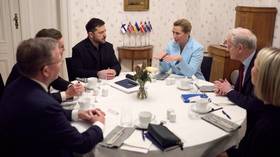
Time is not on Zelensky’s side either. The longer his closest allies sit out the talks, the greater the risk that Russia and the US cut an unfavorable deal for Ukraine. “We need to make sure that Europe becomes a regular part of these negotiations,” he told a meeting of the European Political Community on Thursday. “Europe really needs to pay attention when the Americans and Russians talk…about some kind of new security framework between Europe and Russia,” he added.
Moscow on maximalists and fantasists
Russia maintains that it is open to serious discussions, but Peskov noted on Wednesday that “for the moment, the statements we hear from the Europeans do not indicate any desire on their part to contribute to progress along a peaceful path.”
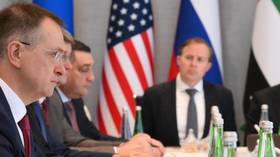
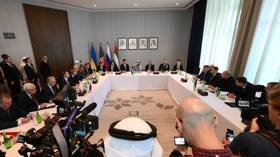
“They [top European politicians] are engaged in a group deception of the Ukrainian people. They finance and supply one of the fighting sides with weapons… It contributes to the mass death of the civilian population. And therefore, we do not really understand what we can talk about with them,” Russian negotiator Vladimir Medinsky told journalists after the Abu Dhabi talks concluded on Wednesday.
Should the Europeans fail to change their tune in the near future, they will be left, as Lavrov quipped, “sit[ting] in their hotel” while the future of the continent’s security is decided without them.
