


“Yes, he had heard it all his life, but it was only now that his ears were opened to this sound that came from darkness, that could only come from darkness, that yet bore such sure witness to the glory of the light,” wrote James Baldwin in “Go Tell It on the Mountain.”
Our friends and family tell us a lot when they send us photos of the places they’ve visited: about the food, the architecture, the streets and the plant life. We hear their stories, we see the photos and we vicariously experience what they saw, smelled, tasted and touched. They tell us about health care and the food. We ask them about dress codes, best restaurants, museums, theatre, traffic and crime rates.
But what of the sounds?
The soundscape of a destination
Niagara Falls without the roar of the water is still beautiful, but at best it’s a partial experience. Bird-watching without the accompanying chirps and whistles is gorgeous, but just a portion of what makes it special. And I wonder: Is a concert, even one with all the staged visual effects, still a concert if one cannot hear the music?
We know at an intellectual level that sounds make distinctive contributions to landscapes. We know that some are associated with pleasure, some with danger and that some sounds are natural, others constructed. I’ve recently learned that they’re so significant that they’ve become an area of study for geographers and cultural anthropologists.
Knowing that sounds often contribute to our experience, we seek out particular ones, say bird songs and the sound of a creek on a nature hiking tour. But, for the most part, we snap our photos. Rarely do we attempt to capture the sounds, even more rarely to describe them. The result is that sounds become background and context, rarely the focus of our experience. And, after we’ve heard them a few times, we tend to ignore and stop listening to them.
Listening is not the same as hearing
Auditory experiences, our distinctions between what is “noise” and “disturbance,” what’s a “warning,” vary with our attention, what we decide, consciously or not, is worth listening to.
My wife, having had to repeat herself several times, insisted that I have my hearing checked. I was relieved when the audiologist told me that my hearing is okay. But that meant one of two things: my wife’s mumbling or I’m not listening to her. The audiologist just shrugged when I asked which it might be. My wife, on the other hand, is sure which of the two it is.
The questions, then, are: What do I take from what I hear? What do I listen to and what do I ignore? What might the sounds to which I listen (and the silence!) reveal about the life of the environments I inhabit? What am I missing if I don’t listen?
The sounds of Mexico and of San Miguel de Allende
Mexico’s urban soundscapes are apparently among the most distinctive on the planet. So distinctive are they, in fact, that the federal government actually observes a “National Sound Week,” and several “sound walks” have been organized in major cities. Among these is Mexico City, where artists are attempting to preserve the capital city’s rich soundscape.
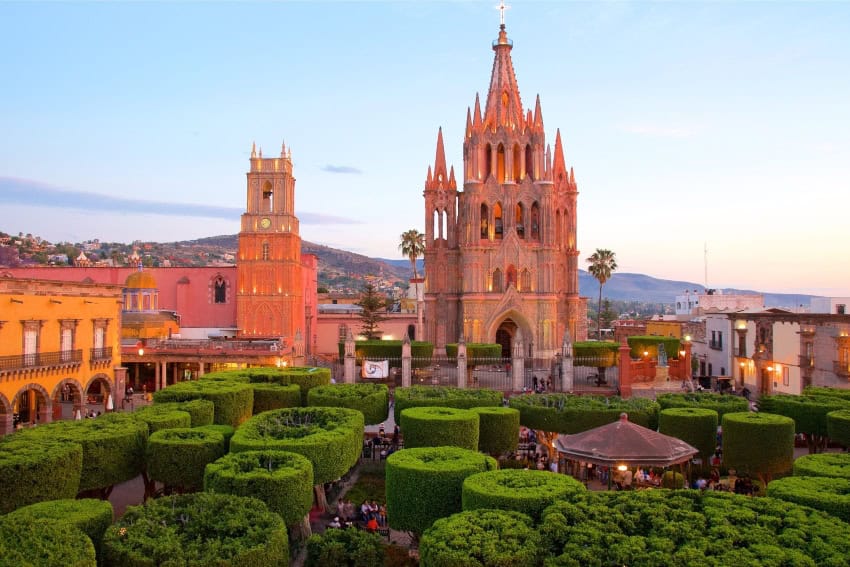
Mexicans generally, the people of San Miguel de Allende (SMA) in particular, live life loudly. Sounds from the cacophonous to the sublime dramatically add to and complement all the other wonderful, justifiably touted features that make SMA one of the world’s most remarkable, top-rated cities.
The city’s most famous sounds, the church bells, ring to mark significant moments in life. At the end of wedding ceremonies, they joyfully peal. At the beginning of funeral services, they clang slowly, solemnly honoring the departed. With each of the many churches (more than 40 in the city) having its own calendar, parish bells are rung on different schedules. Depending on one’s location, one might hear bells from more than one church.
There are two types of church bells: those rung by pulling on a rope and those rotated to create the more melancholic sound heard on somber occasions such as the Day of the Dead and Holy Week. Not to be confused with the church bells, the clock bells mark the passage of time.
Weekend sounds in SMA
On weekends, especially during festivals or wedding parades (callejoneadas), we make our way to the Jardín Allende, the beautifully coiffed garden in front of the Parroquia, the splendid church in the center of the city. There, local families, their work and school done for the week, lovers of all nationalities congregate. Under the moonlit skies, ice cream in hand, we can (try to) listen to three mariachi bands, all competing for our attention, playing at the same time, their music continuing despite the church bells.
At the Saturday Organic Market (Tianguis Orgánico), talented local musicians entertain while people eat, shop and meet with friends old and new. There are great classical music concerts. There’s opera, tango and flamenco, mambo and samba, klezmer, jazz and blues — all heard at a multitude of restaurants and bars. And, there’s even a longstanding jazz and blues festival that, in recent years, has featured Herbie Hancock as well as the Gypsy Kings.
On occasion, in front of the Parroquia, a temporary stage will be erected on which special bands perform. The local people in the audience know many, maybe most, of the songs by heart. Though we rarely know what they’re singing, we get it at some level and happily join in.
The difference between music and noise pollution
Unfortunately, the sounds of music do not all resolve harmoniously. As tourism thrives, the increase in music has raised some concerns. For some who crave tranquility and serenity, it is experienced as “noise pollution.”
The SMA day starts with roosters and, depending on where one lives, practicing school marching bands, both of them off-key.
We wake to the sweet, if monotonous, cooing of mourning doves and to the song of the ubiquitous white-winged dove’s four-note song: “Who cooks for you?”
Throughout the day and night, our neighbourhood is a ruckus of barking dogs. When the sun goes down, in the middle of the night and even at first light, they yelp and snarl from behind closed doors and windows. During the day and until nighttime, we’ll sometimes see them, staring down on us from rooftops, edgy, their bodies tensed as if for battle, teeth bared, barking and snarling as we hurriedly move past.
In sharp contrast, often hidden from sight behind doors, courtyards and shaded gardens offer soft, serene soundscapes: rustling trees, trickling fountains and birdsong.
A huge colony of noisy monk parakeets nests in the trees near the San Juan de Dios market in the Las Cuevitas community. To us, their sounds are confused mayhem. Apparently, however, they have individual voice prints that allow them to recognize each other.
Other sounds that define the city
When we walk during the day, we hear the happy sounds of children playing in their schoolyards, in front of the churches and in the Parque Juarez. My wife disagrees with me that children cry less in SMA than they do in Canada. But we both agree with our friend, Betty Ann, that people laugh more in SMA.
We hear the sounds of traffic: diesel buses alternating with the multitude of taxis, cars, trucks and ever-increasing numbers of motorcycles, revving and speeding, then slowing for the multitude of speed bumps on the cobbled streets. In some areas of the city, horses and donkeys clip-clop.
The sound of fireworks marking festivals often brings on the night. If and when they continue throughout it, they might mark a death.
The streets of SMA produce a potpourri of sound: street vendors, selling baked goods, blare their presence as they rattle through the cobblestone streets. The knife and scissor sharpener makes his weekly rounds, pushing his stone pedal-operated wheel, announcing his arrival in the neighbourhood with a loud Pan-type flute, sometimes whistling a series of four notes, sometimes a single, mournful cry.
Delights for the senses and sometimes not
The music of the ice-cream vendor, a playful, somewhat jarring combination of honky-tonk piano and clown horns, daily gets our attention, but more importantly, lets residents know that ice-cream is available. Played out of a railway speaker, the Nieto gas truck squawks and buzzes its scratchy harmonies as the announcer tells us about his product.
A ringing handbell means “The garbage truck is here. So bring out your trash.” A steam whistle announces the arrival of the camoteros vendor selling oven-roasted sweet potatoes from his little rolling stainless steel oven. The water guy delivering garrafiñas of distilled water yells at the door once a week.
One of my favourites, the old-appliance truck with its loudspeaker incessantly playing the monotonous recording by an 11-year-old girl: “Se compran colchones, tambores, refrigeradores, estufas, lavadoras,” which translates to “We buy mattresses, drums, fridges, kitchen stoves and washers.”
San Miguel de Allende is, as we’ve written elsewhere, a delight for all the senses — sight, of course, taste, smell and touch — but we miss something extraordinarily important if we fail to experience the city’s special sounds.
Bruce Sarbit is a Canadian who happily winters in San Miguel de Allende.
George Aronson and Lynn Padwe are professional photographers and videographers who split their time between San Miguel de Allende and New York City.
