


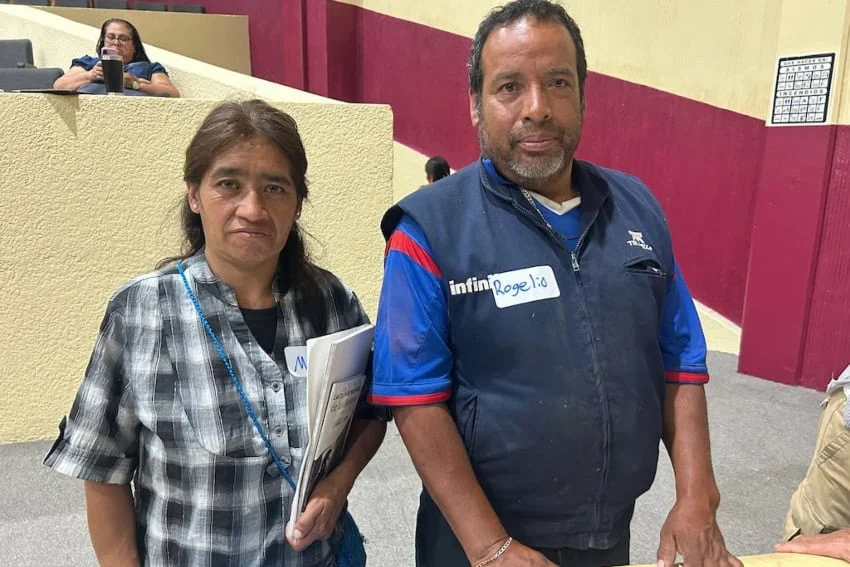
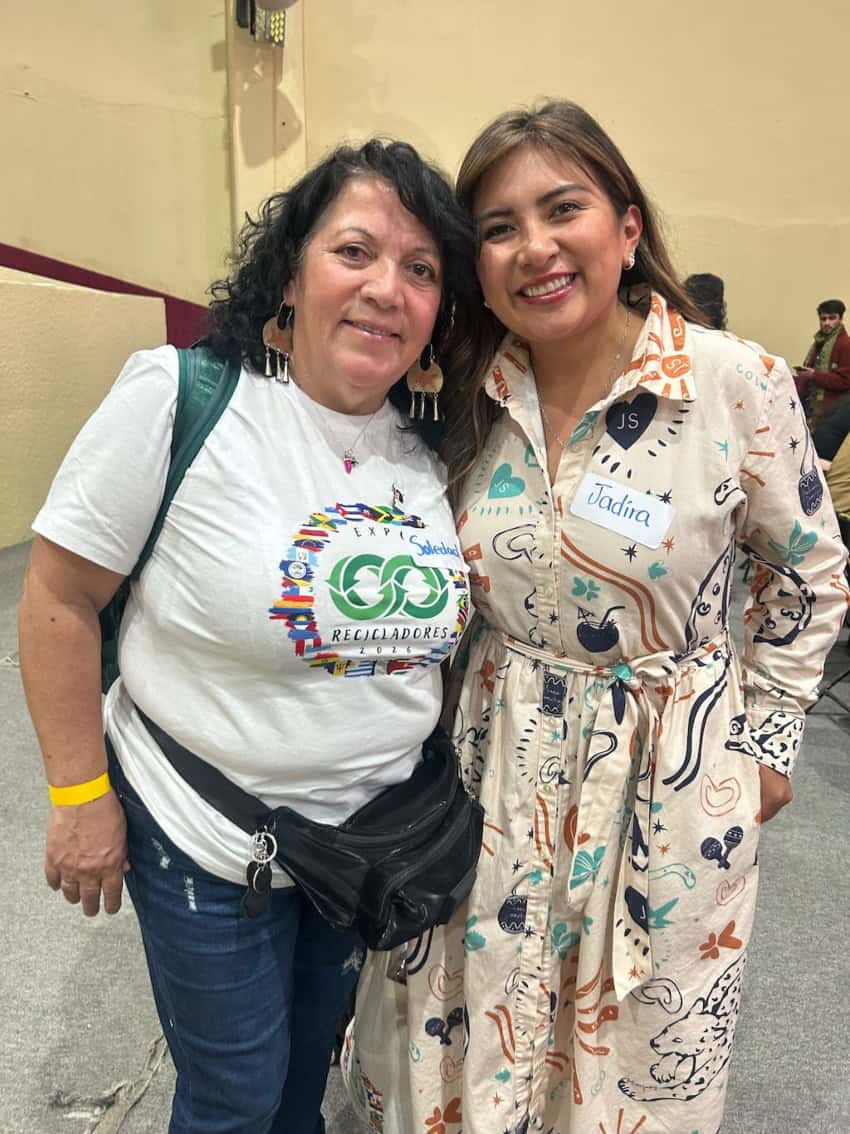
“Living from garbage doesn’t mean we become part of the garbage,” Soledad Mella told a packed auditorium in Iztapalapa, the Mexico City borough most burdened with the megacity’s massive waste stream. “We must dignify and defend our work. But above all, we must organize.”
The energetic grassroots recycler — referred to here in Mexico as a pepenadora — had carried her message all the way from Chile on an international tour through the region. She has carried that message from the streets and landfills of Santiago to international climate conferences and United Nations negotiations.
At Iztapalapa’s Forum on Inclusive Circular Economy, she spoke directly to Mexican pepenadores confronting a pivotal question: Will the country’s new circular economy become a route out of invisibility, or another lucrative industry that leaves them behind?
A push for legal recognition
Mexico is estimated to have some 400,000 pepenadores separating waste in landfills and open-air dumps, according to the forum’s organizers, and more than 2 million people working throughout the informal recycling economy. Many labor in precarious conditions without Social Security, stable wages or legal recognition.
The Sept. 10 forum brought grassroots recyclers together with industry representatives, officials, academics and environmentalists at the Centro Cultural Iztapalapa. The crowd filled the auditorium and spilled into the lobby, where participants exchanged contacts and examined products made from recovered materials.
The event was organized by the alcaldía, or borough, of Iztapalapa and environmental activist Arnold Ricalde, an adviser to Iztapalapa Mayor Aleida Alavez Ruiz. The goal was to shape how Mexico’s new General Circular Economy Law is put into practice — and ensure that grassroots recyclers are not once again left on the margins.
The law, published Jan. 19, seeks to extend the useful life of products, recover and reuse materials and establish “extended producer responsibility,” requiring manufacturers to take greater responsibility for what happens to their products after use.

It also creates a National Circular Economy System charged with developing a national program and coordinating government agencies. Crucially for Soledad’s colleagues, the law formally defines both grassroots recyclers and “inclusive recycling.”
Translating law into action
Much of the practical work remains unresolved, however. The law’s regulations have yet to be published, and questions remain about how recyclers will be registered, gain access to Social Security, form cooperatives and sell materials directly to industry.
Perfect Day Mexico wasn’t dead after all. Now its opponents are headed to the Supreme Court
René Sánchez Galindo, the Environment Ministry’s director general of legal affairs, said the regulations must balance sharply different interests as rules are developed for each type of product.
“We have to ensure that the measures are viable for everyone: industry, consumers and grassroots recyclers,” he said. “There must be what we call economic viability.”
“We want to help bring these concepts down to earth and bring the spirit of Iztapalapa to the law,” Alavez said. “A law that people don’t know how to use is not operative.”
Iztapalapa as a living laboratory
Iztapalapa has reason to position itself as a laboratory for inclusive recycling. The borough of 1.8 million people is one of the country’s most important centers for the recovery, repair and resale of discarded materials. It also collects roughly 2,200 metric tons of waste every day.
Alfonso González May, the borough’s director general of urban services, said only 2% to 3% of that waste was being separated when the current administration took office. The share has since risen to 8%, with separation taking place along 37 collection routes.
“This 8% has been achieved little by little, through different strategies,” González said. “We don’t want to give the mayor impressive numbers that have nothing to do with reality.”
The borough has expanded a once-weekly collection program for unwanted furniture, appliances and household debris into six weekly “junk days.” The program is intended to prevent residents from hiring informal haulers who may later abandon the items in vacant lots or on street corners.
Local initiatives and youth programs
Another initiative will collect used cooking oil at public markets and government offices. Residents will be encouraged to store the oil in bottles and deliver it separately to municipal collection crews. The oil will then be transferred to a private company for conversion into energy instead of being poured into drains, where it contributes to clogs and flooding.
The borough’s sustainable development office has identified more than 500 local circular-economy enterprises, ranging from cellphone, appliance and shoe repair shops to upholstery businesses and artisans working with discarded cardboard, textiles, wood and plastic.
Its “Soldando Iztapalapa” program trains young people to repair damaged metal furniture. Participants have restored more than 10,000 school desks that otherwise would have entered the waste stream, said Adriana Bustamante Castellanos, Iztapalapa’s director general of sustainable development.
“That means 10,000 objects that are not becoming waste,” she said, “and young people who have acquired knowledge, experience and a sense of service to their community.”
Other initiatives include a public recycling point outside the cultural center, neighborhood composting workshops and an ecocanje program that exchanges recyclable plastics for basic food products and vegetables grown in local greenhouses and community gardens.
National waste challenges
The borough is also developing a composting plant that will use black soldier fly larvae to process organic waste from markets, businesses, child development centers and community facilities.
Those local advances remain small compared with the national scale of the waste problem. Mexico generates more than 139,000 metric tons of urban solid waste daily, according to the federal Environment Ministry’s 2026 national assessment.
Only 5% receives any form of treatment, while 72% undergoes no recovery or valorization process. Of the country’s 2,250 final-disposal sites, just 52 operate as sanitary landfills meeting adequate standards.
Mella came to Mexico with a warning drawn from Chile’s experience. When that country adopted its extended producer responsibility law, she said, grassroots recyclers were initially excluded. They fought their way into the system through political pressure and organization.
Organizing against corporate interests
Mella distilled their demands into three points: formal recognition of recycling as work; dignified conditions supported by equipment, infrastructure and social protections; and payment for the service recyclers provide, rather than compensation based solely on the fluctuating value of the materials they collect.
“The garbage and recycling sector is a business model,” she said. “There are many interests that want to take what belongs to us and remove us from that space.”
Without a just transition that allows grassroots recyclers to compete, she added, “the sharks — the large companies — are going to eat us.”
Abel Balderas, who began working as a pepenador at age 8 and now leads Mexico’s National Recyclers Movement, echoed Mella’s call for organization and recognition.
“We are the experts,” he said. “You are the ones who can teach what can be recycled, what cannot, which material works and which doesn’t.”
Breaking down barriers
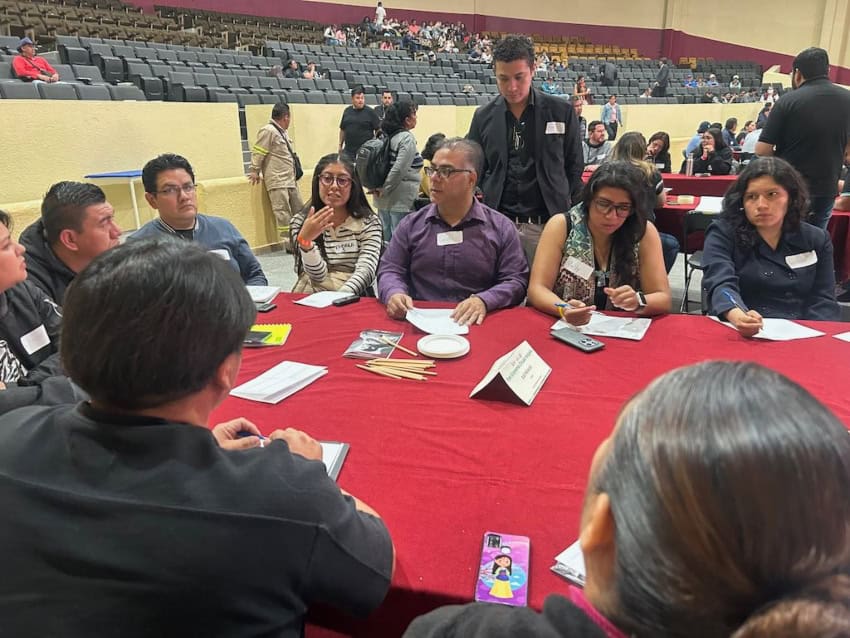
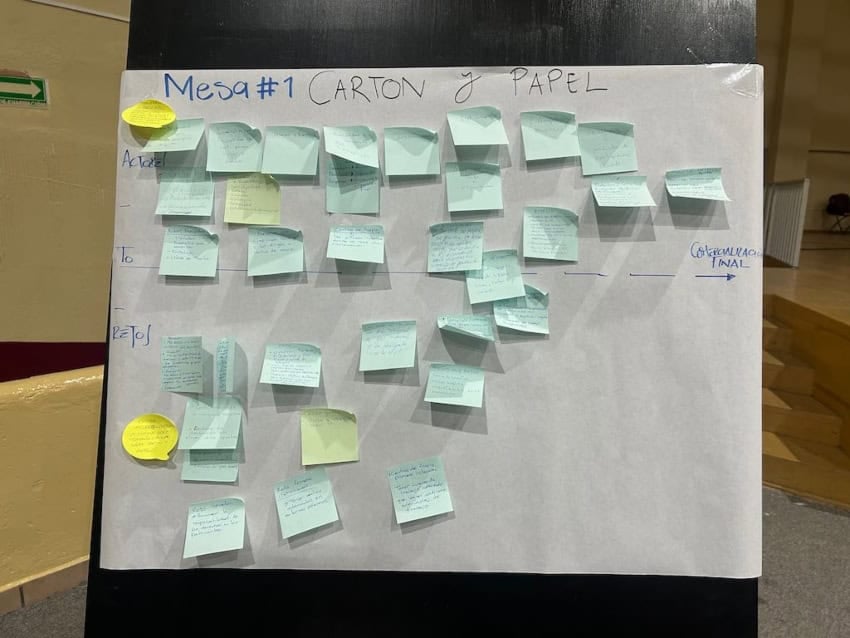
Following the presentations, participants divided into five dialogue groups focused on polyethylene terephthalate (PET), other plastics, paper and cardboard, metals and electronics. Each table included recyclers, companies, government officials, academics and civil society organizations.
They were asked to develop recommendations around four central issues: Social Security, tax-system inclusion, training and direct purchases of materials by industry.
At most tables, participants with sharply different interests managed to identify common barriers — particularly the bureaucracy involved in permits and formalization — and develop preliminary proposals.
Guadalajara residents turn to citizen science as water crisis deepens
The metals table proved the most contentious. Facilitator Adelita San Vicente, best known for her decades defending Mexico’s native corn and seeds, struggled as automotive industry representatives, the primary buyer of these materials, raised one objection after another while calling for a zero tax rate.
“Sharks,” she called them afterward, echoing Mella’s warning.
For Mella, legislation alone will not prevent that outcome. Grassroots recyclers must have seats at the tables where regulations and product-specific rules are written.
“If we are not actors and protagonists in this history,” she said, “once again we will be left out of the process.”
Her movement’s slogan reduces that argument to but a few words:
“Recycling without recyclers is garbage.”
Tracy L. Barnett is a Guadalajara-based freelance writer and the founder of The Esperanza Project.
