

Close Menu
channel1la.comchannel1la.com
  • Home
  • News
  • Mexico News
  • Sports
  • Politics
  • Stock Market
  • Entertainment
    • Arts & Music
Top Post

Judge Shuts Down Lizzo Stylist’s Lawsuit Against Touring Company

September 1, 2026

House to vote on Rep. Chuck Edwards censure over ‘unprofessional conduct’ toward female staffers

September 1, 2026

Uphold review 2026: One account for crypto, metals, and cash

September 1, 2026
Facebook X (Twitter) Instagram
X (Twitter) Instagram Bluesky Facebook YouTube
  • Home
  • News
  • Mexico News
  • Sports
  • Politics
  • Stock Market
  • Entertainment
    • Arts & Music
channel1la.comchannel1la.com
Home»Mexico News»Mexican-built particle detector to help illuminate birth of the universe
Mexico News

Mexican-built particle detector to help illuminate birth of the universe

channel1la.comBy channel1la.comSeptember 1, 2026No Comments
Twitter Bluesky Facebook
team of scientists from the UNAM
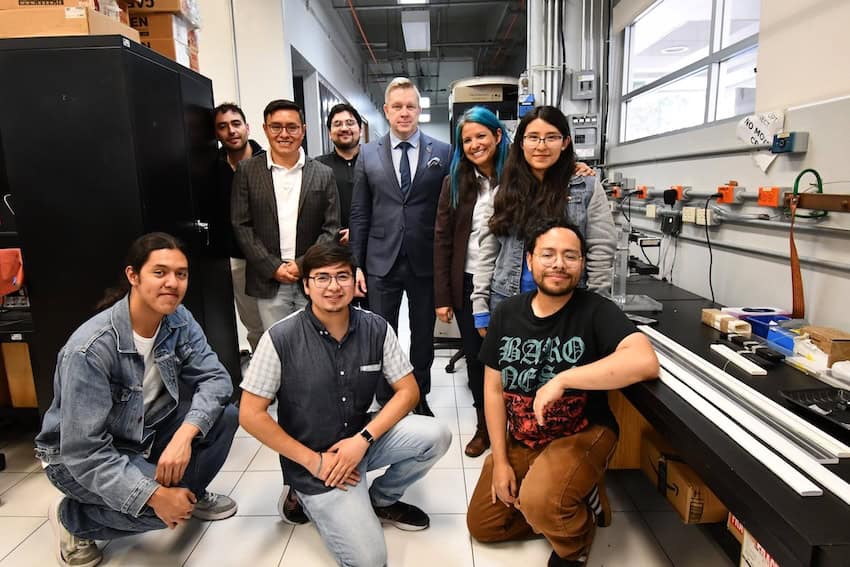
The team of scientists from the UNAM's Nuclear Sciences Institute has a lot of work to do before the ALICE 3 project gets underway in 2036 — including not just building the Muon Identifier Detector (MID) but arranging the funding for it. (ICN - UNAM / Facebook)
Share
Twitter Bluesky Facebook

A Mexican physicist was recently chosen to lead the development of a particle detector for one of the world’s largest scientific projects: an underground atom smasher in Europe that is helping scientists understand the universe shortly after the Big Bang.

The proposed detector would be built in Mexico and installed at the European Organization for Nuclear Research (CERN), home of the Large Hadron Collider beneath a portion of the French-Swiss border.

Antonio Ortiz Velásquez (right), a researcher with UNAM’s Nuclear Sciences Institute, has been selected to head the Muon Identifier Detector (MID) project for the ALICE experiment at CERN. (ICN – UNAM/Facebook)

The Mexican-built device, called the Muon Identifier Detector (MID), is planned for ALICE 3, a future version of one of the collider’s four main experiments.

If built and approved, it would give Mexican institutions responsibility for a central subsystem of ALICE 3.

The Large Hadron Collider (LHC) is a particle accelerator and collider covering a circular circuit of 27 kilometers, or 17 miles, near Geneva, Switzerland. It speeds beams of protons or electrically charged atomic nuclei to within a whisker of the speed of light — about 1.08 billion km/h, or 671 million mph — before steering them into head-on collisions.

Collisions involving heavy atomic nuclei can briefly create matter thought to resemble conditions in the universe’s earliest moments.

The Mexican project is still not guaranteed to reach CERN.

While the MID is included in the reference design for ALICE 3, the Mexican team must obtain funding, finish the design and construction work and clear technical reviews before it can be installed. Operations are targeted for 2036.

The Mexican project is headed by Antonio Ortiz Velásquez, a senior researcher at the National Autonomous University of Mexico (UNAM) whose appointment was approved by the ALICE Collaboration Board, UNAM said Aug. 13.

UNAM said Ortiz, a physicist at UNAM’s Institute of Nuclear Sciences, is the first Mexican scientist chosen to direct development of a strategic ALICE 3 subsystem.

Mexico has already worked with ALICE for years, helping build and operate earlier detector equipment and analyze collision data, but the new project goes even further.

The Mexican-built device would track muons, small particles that can pass through much of the detector after a collision. Their paths can help researchers study a fleeting, superheated state of matter that scientists believe filled the universe immediately after the Big Bang.

“We are recreating tiny droplets from the early universe and studying them through the traces they leave in particle detectors,” Ortiz said.

The team hopes to begin construction in Mexico in 2028. It includes researchers from UNAM, the Center for Research and Advanced Studies, the Benemérita Universidad Autónoma de Puebla, the Autonomous University of Sinaloa and the National Technological Institute of Mexico, along with partners in the United States, Hungary, the Czech Republic and Pakistan.

With reports from La Jornada, MxPA and Space Daily

birth detector illuminate Mexicanbuilt particle Universe
Share. Facebook Twitter Bluesky
channel1la.com
  • Website

Related Posts

‘Throttle Therapy’ in Mexico: Sometimes, it’s not about the miles

September 1, 2026

11 injured in car bomb attack on Zacatecas police station

September 1, 2026

In Coatepec, INAH discovers ceremonial plaza and stele with never-before-seen features

September 1, 2026

Storm-battered Guadalajara recovering, but more rain expected

September 1, 2026
Add A Comment
Leave A Reply Cancel Reply

Top Posts

Judge Shuts Down Lizzo Stylist’s Lawsuit Against Touring Company

September 1, 2026

House to vote on Rep. Chuck Edwards censure over ‘unprofessional conduct’ toward female staffers

September 1, 2026

Uphold review 2026: One account for crypto, metals, and cash

September 1, 2026

Frieze Seoul 2026: What Makes the Korean Art Market So Special?

September 1, 2026
Trending

La Sonora Propaganda acaba de estrenar el video musical de su nuevo sencillo “Libro abierto”, un proyecto liderado por Aldo Acuña

By channel1la.com

Garden Grove Chemical Tank Could Be Inching Toward Explosion, Authorities Say

By channel1la.com

Tens of thousands rally in Serbia for antigovernment demonstrations | Protests News

By channel1la.com
X (Twitter) Instagram Bluesky Facebook YouTube
  • About Us
  • Contact Us
  • Privacy Policy
  • Terms & Conditions
channel1la All Rights Reserved 2026

Type above and press Enter to search. Press Esc to cancel.