


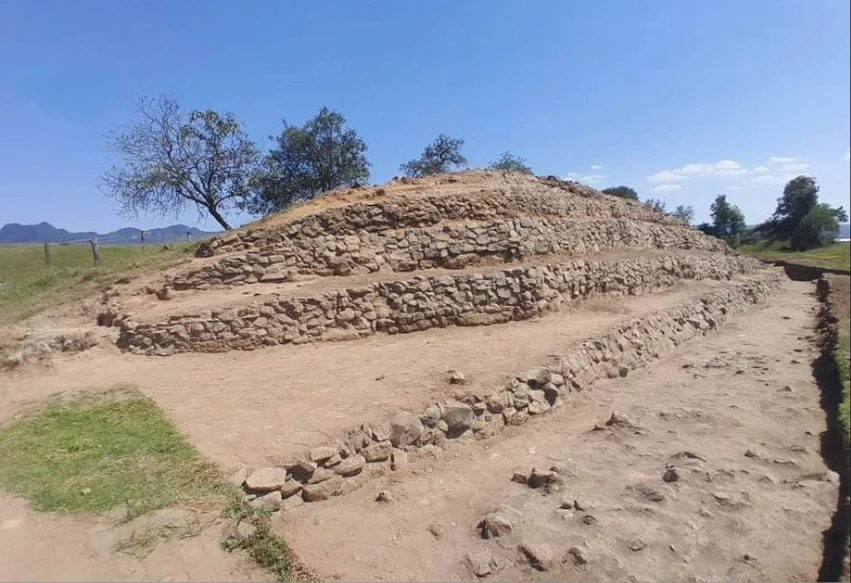
A pre-Hispanic solar observatory in the municipality of Teteles de Ávila Castillo in the Sierra Norte region of Puebla has been confirmed to be the oldest in Mexico, dating back more than 2,500 years.
According to research carried out by the National Institute of Anthropology and History (INAH), a monumental architectural complex named “Grupo E” functioned as a solar astronomical observatory and is the oldest of its kind in Mexico.
Researchers believe the settlement’s inhabitants incorporated astronomical observations into the planning of their ceremonial buildings more than two millennia ago.
Heritage Daily —a digital publication specializing in archaeology, anthropology and palaeontology — says the discovery “provides remarkable evidence of sophisticated astronomical knowledge among ancient Mesoamerican civilizations.”
INAH says it is the first discovery of its kind outside the Maya region and is comparable to the observatory at the archaeological site of Uaxactún in Petén, Guatemala, which has been identified as the first and defining archetype for ancient Maya astronomical observation complexes.
While both the Uaxactún and Teteles complexes are believed to date to the Middle Preclassic (from 1200 to 400 BCE.), the Uaxactún structure is approximately twice the size of the one in Puebla.
Researchers have confirmed that the original layout of the “Group E” settlement (also known as Tetelihtic) and the orientation of its pyramidal structures are based on an understanding of celestial bodies.

Archaeologist Alberto Diez Barroso said the ancient settlement is an outstanding example of pre-Hispanic urban planning — shaped by the observation of the surrounding landscape, such as the nearby mountain peaks, as well as the astronomical horizon — making it “a significant point of reference for Mesoamerican studies in this field.”
Tetelihtic consists of a quadrangular courtyard flanked by two platforms at its eastern and western ends. The eastern platform is elongated (90 m from south to north by 40 m from east to west), while the western structure is smaller (46 m from north to south by 27 m from east to west) and served as an observation point.
The elongated platform does not mark the equinoxes at its center, however.
“It apparently served to establish the beginning of the pre-Hispanic Mesoamerican calendar in February and the harvest period in October, making it a complex and unique feature,” Diez said.
However, the eastern platform did function as a solar calendar; observations have confirmed that, from its front, one can track the sun’s path at dawn during the equinoxes and solstices.
Archaeologists believe the finding could provide insights into the cultural relationship between the Huastec and Maya groups during the early stages of human settlement in the Sierra Norte as it serves to confirm the Maya ethnolinguistic roots of the Huastec groups.
A Maya presence at Teteles may date back as far as 3,000 years — a possibility suggested by the Puebla observatory.
With reports from INAH, Heritage Daily and Ambas Manos
