


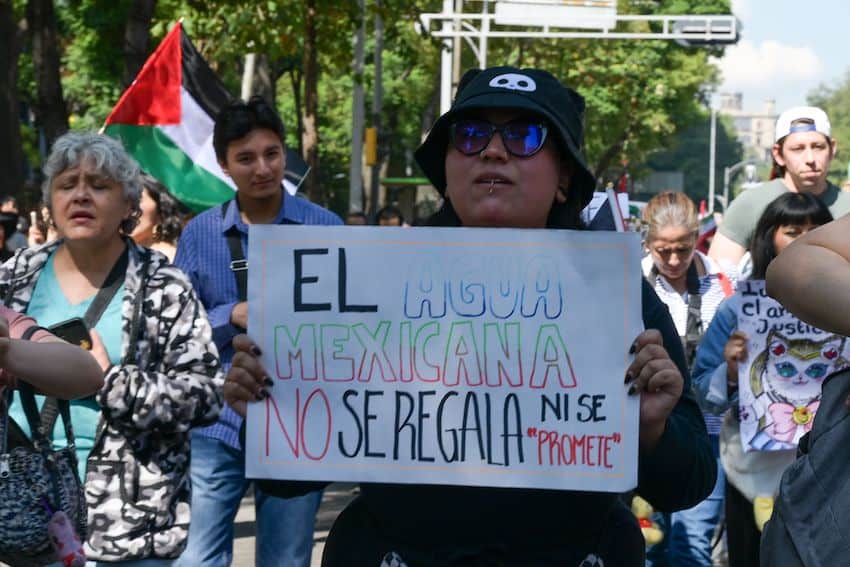
A water cooperation agreement between the Chihuahua state government and the Israeli international cooperation agency MASHAV has become the center of social conflict and the cause of growing protests amid extreme water stress in the state.
On Saturday, protesters called by the Save the Hills of Chihuahua and the Feminist Assembly marched through the streets of the capital city of Chihuahua, accusing the state government and the Central Water and Sanitation Board (JCAS) of promoting Zionism and doing business with a government they accuse of committing genocide in Gaza.
The demonstrations were part of a nationwide day of action involving at least 14 states, where protesters called for a ceasefire in Gaza and demanded that the Mexican government end diplomatic and trade relations with Israel.
At the center of the controversy is a signed cooperation agreement dated February 2023 between the JCAS of Chihuahua and MASHAV, part of the Israeli Ministry of Foreign Affairs.
Valid until 2027, the agreement establishes the exchange of knowledge and technology for the design, construction and maintenance of water systems in crisis conditions, as well as improvements in the reuse of treated water, efficiency in drinking water, sanitation and sustainable agriculture.
The agreement allows participation of the Israeli private sector in water-related projects in Chihuahua. Although the agreement is presented as a technical cooperation plan, activists claim that it facilitates contracts and business opportunities for Israeli companies in the state’s water infrastructure.
Opponents also argue that the Chihuahua government did not register the international agreement with the Ministry of Foreign Relations (SRE), which would make it illegal in Mexico.

However, Governor Maru Campos Galván and head of JCAS Mario Mata Carrasco stated that the agreement is not a legally binding document and does not create any legally binding obligations or benefits for the parties involved.
Rather, they say it is a technical cooperation mechanism for sharing knowledge without granting rights, concessions or control over the state’s water — meaning there wouldn’t be an obligation to register the agreement with the SRE.
According to Mexican law, non-binding international agreements are not necessarily subject to the same registration requirements as treaties or other legally binding agreements. Nonetheless, the SRE suggests a similar registration procedure to ensure consistency with Mexico’s foreign policy, meaning such agreements wouldn’t necessarily appear in the SRE’s treaty database.
For the state government, this international agreement means an opportunity to learn from Israel’s experience in water treatment, reuse and desalination processes to strengthen the hydraulic infrastructure of Chihuahua, especially given the drought conditions the state is currently facing.
With reports from La Jornada, Expansión, Enfoque Noticias and SPD Noticias
