


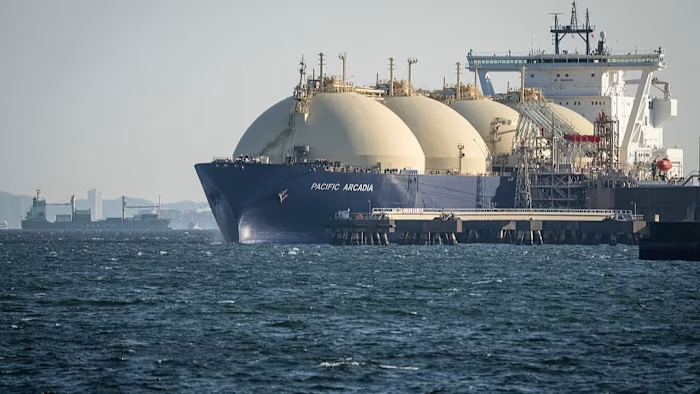
Two US companies are seeking to advance Donald Trump’s vision of Alaska as a major gas exporter — but face long odds in developing projects to profit from some of the world’s most abundant untapped gasfields.
Glenfarne Group and Polar LNG, a company backed by Gentry Beach, an investor with ties to the Trump family, are trying to secure up to $80bn in financing to develop projects in Alaska that would provide Japan, South Korea and other countries with a new supply of the super-chilled fuel.
Both companies say disruption to rival liquefied natural gas flows from the Middle East because of the Iran war has boosted interest in their projects, which offer the shortest shipping routes of just over a week to key Asian markets.
But as they market their projects next week in Thailand at Gastech, the world’s biggest gas and LNG conference, they must convince potential investors they can overcome a series of financing, logistical and legal hurdles.
Energy producers and Alaskan state officials have been seeking to establish the state as a major LNG export hub for half a century because of the cheap and abundant supply of stranded gas from oil production. But it has so far remained a pipedream despite Trump’s promotion of the venture due to high costs and opposition to building fossil-fuel infrastructure in an ecologically sensitive region.
“Exxon and the North Slope producers have taken a very hard look at this project and decided it’s not for them. And I think that says a lot because it’s their gas production,” said Alex Munton, analyst at Rapidan Energy Group.
He said construction of a pipeline, estimated to cost $17bn, across the state to take gas from the North Shore to the coast added the risk of cost overruns.
Last month, Alaska’s legislature failed to pass tax breaks for Glenfarne Group’s proposed $54.5bn Alaska LNG project that would have provided a financial boost. That delayed construction of the first phase of the project, a 739-mile pipeline to transport fuel from gasfields in Alaska’s North Slope to Nikiski in south-central Alaska, Glenfarne chief executive Brendan Duval told the FT.
He added Glenfarne also needed to secure customers for an extra 3mn tonnes of LNG offtake from its proposed 20mn tonne per year liquefaction facility and convert these into binding contracts before a final investment decision could be taken.
“Phase 1 standalone is definitely delayed,” he said in an interview. “How long it’s delayed depends on us reassessing the way to move things around.”
Alaska LNG is the most advanced of the two projects and was initially backed by ExxonMobil, BP and ConocoPhillips. But the oil majors backed out because of concerns over high costs. Glenfarne took over the project in 2025 just as the Trump administration championed it to expedite LNG supplies to Pacific allies, as well as delivering gas to energy-starved communities in the state.
Trump has heavily promoted investing in Alaska LNG to political leaders in Asia, telling reporters this month that Japan, South Korea and other countries were going to Alaska “to load up with oil and build pipelines”. But so far support for the project has been lukewarm among potential investors because of the high costs and logistical challenges of doing business in the state.
Only a single Asian company, South Korea’s Posco Group, has made an equity investment in the project. Japan and South Korea have not yet allocated any capital from their respective $550bn and $350bn strategic investment frameworks agreed last year with the US, as part of trade deals signed with the Trump administration.
“We’ve been exploring that on and off,” said Duval when asked whether Alaska LNG could tap these funds.
Despite the challenges, he said momentum behind the project was “fantastic” due to the support of the Trump administration, the interest in new supply caused by disruption in the Middle East and the huge growth in energy demand from artificial intelligence.
“We have done more in 18 months than has happened in the last 18 years. So we’ve got to keep rolling,” he said.
Beach’s $25bn Polar LNG is at an earlier planning stage than Alaska LNG, which has already secured many of the permits it needs to begin construction. The project seeks to purchase stranded gas generated at oil projects on Alaska’s North Slope and transport it to a liquefaction facility based in Wainwright, a small coastal town in the same Alaskan region. After processing the gas into LNG, it could then be shipped to Asian customers.
“From my discussions I’ve had with a lot of buyers in Asia, I think there’s a new risk premium that they’re putting on gas coming out of the Middle East . . . what that does is really point Asian buyers to the US,” said Joel Riddle, chief executive of Polar LNG.
Building and operating in the Alaskan Arctic is challenging as there is a short three- to four-month construction period in the region because of extreme weather.
Polar LNG wants to use existing technology and hardware built by Novatek, the Russian company behind the Arctic LNG 2 and Yamal LNG plants, to save money and time. Novatek said the plant would be built off-site and arrive ready to operate.
The company is partly under sanctions from the US and Ukraine’s European allies, though well shy of the full blacklist barring western investors from doing deals with other Russian energy majors.
The US and Russia have discussed a potential deal under which Novatek would lend its expertise in exchange for the removal of sanctions against Arctic LNG 2, according to people briefed on the talks. The restrictions have hampered Novatek’s ability to import advanced western technology for the plant and find buyers for exports.
But Polar LNG must get US government approval to buy the equipment from the Russian projects, which remain under sanctions first imposed by the Biden administration. Congress also plans to vote on even tougher Russian sanctions championed by the late Republican Senator Lindsey Graham as early as next week.
“Unfortunately, the sentiment against Russia has turned very negative, and the US government will really have to decide which technology they want to use. It’s not in my hands,” Beach told the FT.
Novatek said it was “eager to participate in an LNG plant construction project using our technology” and had signed a memorandum with Polar LNG.
The company denied its participation would be contingent on sanctions relief and said it had “no knowledge of Gentry Beach’s investments [in Polar LNG] or his plans”.
Beach, however, said he had met Novatek executives several times this year in the UAE and Turkey, including as recently as last month. He said he had an “incredible relationship” with Leonid Mikhelson, Novatek’s founder and chief executive.
“I wish I could have come to his birthday party recently in Russia, but right now it wouldn’t be appropriate for me to travel to Russia,” Beach added.
Beach said the sanctions against Arctic LNG 2 were allowing China to buy exports from the plant at a heavy discount. “All we’re going to be doing is giving cheap power, very, very cheap power to our enemy to use against us,” he said.
Instead, Beach suggested the US could do a deal to bring LNG volumes from Russia to southern Alaska. “Take a look today at what the natural gas price is in Anchorage,” he said. “That’s a huge opportunity for the administration.”
But as with Alaska LNG, Polar LNG is on a tight deadline to raise funds and make a final investment decision before the pro-fossil-fuel Trump administration leaves office in 2029.
Analysts warn a future Democrat-led administration could pull the plug on gas projects in ecologically sensitive areas, such as Alaska, which have not begun construction. They point to former president Joe Biden’s decision to revoke a key permit for the Keystone XL pipeline between the US and Canada on his first day in office in 2021.
“Oil and gas in Alaska is a hot-button issue, so there is political risk,” said Rapidan’s Munton.
