


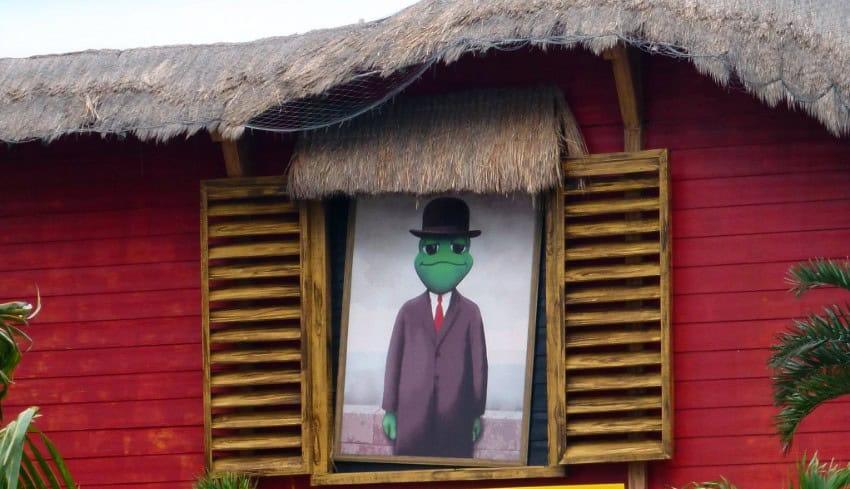
While it may be a fine place to avoid New Orleans’ sweltering heat, Tulane University’s Doris Z. Stone Latin American Library serves a much larger purpose as a repository of Mexico travel and tourism ephemera, including magazines, hotel brochures and highway maps.
Together, the collection offers a unique look at how the United States’ southern neighbors were constructed as attractive vacation destinations throughout the midcentury.
Mexico especially loomed large in the imagination of U.S. tourists. It was a period when, as historian Mauricio Tenorio notes, Mexico was understood as a “Brown Atlantis” — where revolutionary thought fermented, and the Pan-American Highway promised access to exotic adventures. Everyone wanted to meet Frida Kahlo and visit Teotihuacán, all while dreaming up global politics anew.
Two brochures found in the Mexican ephemera collection tell how Mexico feted itself for an international community, including the crooning amphibian that would become the country’s unofficial mascot during the time.
The singing frogs of Taxco
First is a trifold brochure from arguably Mexico’s most famous nightclub during the second half of the 20th century — Cantarranas. However, the site didn’t always host the international glitterati.
Located in the silver-mining town of Taxco, roughly 2.5 hours outside of Mexico City, the estate was initially conceived in 1538 by Hernán Cortés, who ordered its construction so that he could extract the region’s precious materials.
Dubbed Hacienda Cantarranas, – literally “singing frogs” due to the loud chorus of frogs living in the nearby area – Cortés’ son Martín de Cortés oversaw its construction, which featured large stones along a hillside. Over the years, the infrastructure took its toll on the unstable land it was built on and was ultimately abandoned in favor of a new locale.
For the next four centuries, the site was nothing more than a derelict ghost of Mexico’s colonial past. That is, until one entrepreneur saw an opportunity.
Antonio “Tony” Reyes Ramírez, who would later become Taxco’s minister of tourism, officially opened Cantarranas in 1957. Eager to capitalize on its history, Reyes Ramírez kept the name and leaned on its playful imagery in his marketing materials.
Cantarranas quickly developed a global reputation as a lively hangout throughout the 1960s and 70s, and even featured prominently in a popular television show of the time.
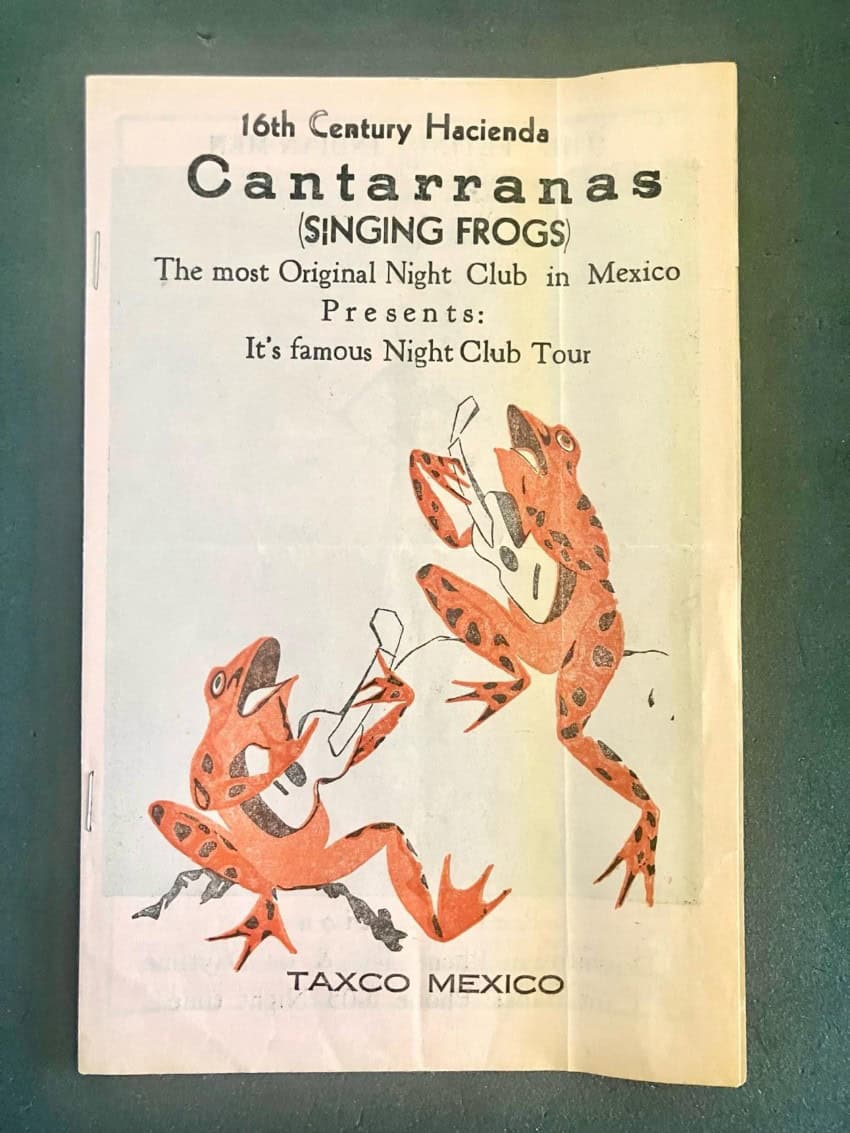
The brochure for Catarranas promises tourists a night of “flamenco dancing by Estela Calderón,” “Carl Brice directly from Nassau, Bahamas,” “Primitive African Drums by the owner and Manager of Cantarranas Tony Reyes,” and “The Latin American Rhythms of the great pianist Juan García Esquivel.”
The nightclub also housed several distinct spaces, including the “Twilight Room,” the “Patio,” the “Flamenco Room” and the “Mulata Room.” Newspapers of the time reported that, inside Cantarranas, “the audience moves en masse from room to room as each show finishes.”
During that same decade, the brochure from Tulane notes that Cantarranas was chosen as the backdrop for an episode of the NBC series, “I Spy,” entitled “Return to Glory,” which aired Feb. 23, 1966.
In it, Alexander Scott – played by Bill Cosby – is tipped off by U.S. intelligence to visit Cantarranas, where he rendezvouses with the wife of a deposed president of an unnamed Latin American country. Famed Mexican actress Dolores del Río plays the part of the wife, as Cosby and costar Robert Culp try to negotiate the democratic leader’s return to his home nation.
Cantarranas’ popularity continued to grow throughout the early- to mid-1970s.
A newspaper article from 1974 lists several of the club’s attractions, including “Flying Indian Men,” a discotheque called “The Psychedelic Cave,” bullfighting lessons, a piñata party, and calypso songs by Carl Brice.
Got 1 min? Mariachi frogs stolen from Acapulco found hundreds of kilometers away
However, as a new decade dawned, Cantarranas was beginning to lose its luster.
An article from 1978 reported that “Cantarranas is a little rough around the edges.” Two years later, the club was described as “the kind of place that you wouldn’t miss if you missed it. But worth it if you’re utterly bored.”
Unable to sustain itself any longer, in 1983, the Mexican state of Guerrero acquired the property and converted it into a culinary school and arts center. In 1992, it changed hands once again, this time to the Universidad Nacional Autónoma de México as a school for foreign nationals.
Despite its short life, Cantarranas heralded Mexico’s midcentury miracle as its nascent legacy was beginning to be forged.
The birth of Señor Frogs
Twelve years after Cantarranas opened, another Mexican restaurateur, Carlos Anderson, was cooking up a similar concept that would come to define the Mexican resort experience well into the 21st century – Señor Frog’s.
First opened in Mazatlan in 1969, Señor Frog’s capitalized on that same midcentury swagger, with waiters slinging tequila shots and cajoling spontaneous conga lines in a neon cave. It’s unclear why Señor Frog’s succeeded where Cantarranas ultimately failed, but it did.
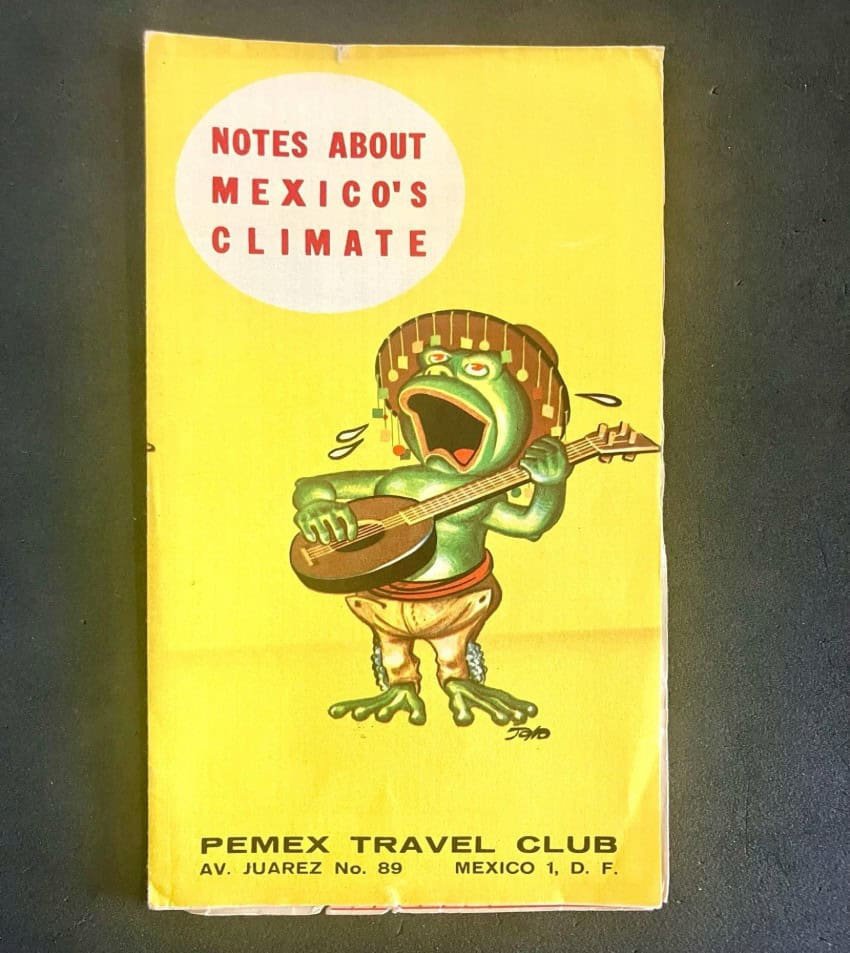
It wasn’t just the nightclub scene, either. The Tulane collection includes another brochure with a singing frog on it — this one from Pemex or Petróleos Mexicanos, the company formed in 1938 by the Mexican government to sell the nation’s significant oil supply.
The brochure includes maps of Mexican highways and invites travelers to explore the best routes. There is no mention of Cantarranas, or Taxco, or even nightclubs. However, at this point the singing frog had become emblematic of Mexico’s exotic sights, electric nights and cultural spectacle.
From Hacienda Cantarranas to Tony Reyes’ “Singing Frogs” bar, through a national oil company and today’s Señor Frog’s franchises, the brochure in Tulane University’s Doris Z. Stone Latin American Library chronicles the birth of a national symbol, while documenting how tourists were meant to imagine the delights of midcentury Mexico – strange, inviting and culturally savvy, not unlike a crooning amphibian.
Kevin M. Anzzolin earned a PhD in Romance Languages and Literatures from the University of Chicago. He is the author of “Guardians of Discourse: Literature and Journalism in Porfirian Mexico,” published by the University of Nebraska Press (2024), which received an Honorable Mention from LASA-Mexico for Best Book in the Humanities in 2025. He currently teaches language and literature courses at Christopher Newport University (Virginia, USA). He also publishes in more public fora.
