


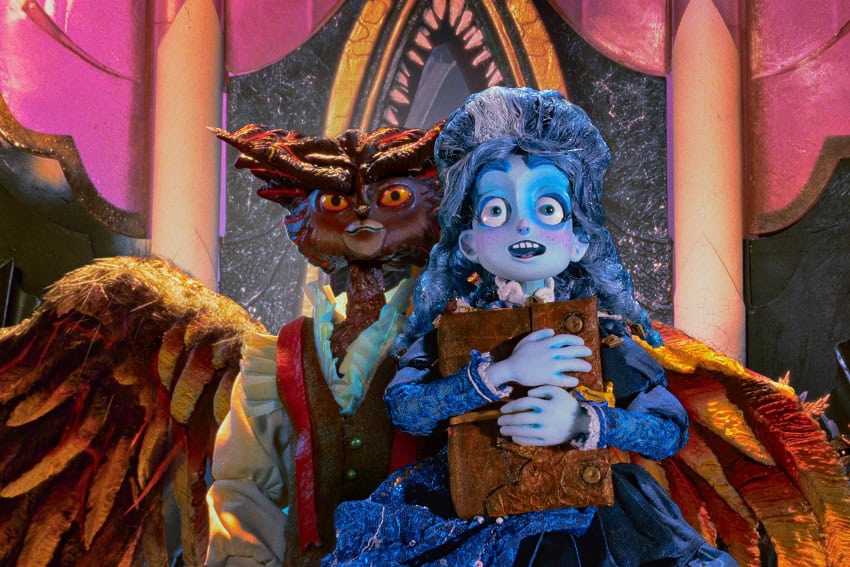
If you’re looking for a movie to watch with your family this Halloween and want to avoid overly violent content or the same old repetitive classics, there’s a new option you should check out. It’s “Soy Frankelda” (“I Am Frankelda”), the first Mexican feature film animated entirely in stop-motion.
Directed by brothers Arturo and Roy Ambriz and produced under the creative mentorship of Guillermo del Toro, this film stands out for its dazzling technical craftsmanship, its balance between the spine-chilling and the endearing, and its focus on profound themes such as the power of imagination, artistic resilience in the face of rejection and the struggle for creative autonomy.
It’s currently available worldwide on Netflix and on Max in Latin America.
This ambitious film debut expands the animated universe that Cartoon Network Latin America introduced with the hit series “Los Sustos Ocultos de Frankelda” (“Frankelda’s Book of Spooks”), an anthology of horror stories narrated by the titular character. Over the course of its 113-minute runtime, the new film details the origins of the mysterious Topus Terrentus — also known as The Land of Spooks — and reveals how the dreamer Francisca Imelda evolves into the powerful ghostwriter Frankelda.
Praised by Screen Anarchy as “a universal and timeless tale destined to inspire” and described by IndieWire as “a lovingly handcrafted feast for the eyes,” “Soy Frankelda” envelops viewers in an atmosphere of lighthearted horror, perfect for a family Halloween screening.
Below, we outline four essential reasons to watch it this season.
Resilience and overcoming adversity: A story everyone can relate to
This gothic fantasy is set in Real del Monte in 1866, where we follow the journey of the imaginative horror writer Francisca Imelda (voiced by Mireya Mendoza), who is constantly marginalized by her community’s gender prejudices. Her life changes dramatically when she is approached by Herneval (Arturo Mercado Jr.), the prince from the Topus Terrentus, an enigmatic alternate dimension that serves as a reflection of her own mind.
Transformed into a sort of specter, Francisca ventures into this psychological landscape inhabited by the creatures born from her pen. There, she discovers that her characters have taken on a symbolic identity of their own and that the balance between fiction and reality is on the verge of collapsing. Together with Herneval, our fearless protagonist must confront Procustes (Luis Leonardo Suárez), the Royal Nightmare Maker, who has disrupted the flow of terror in the real world and is plotting to take over everything that exists. Saving the Topus Terrentus thus becomes an act of literary resistance: to prevent its destruction, Francisca must defend her calling against the forces seeking to silence her and claim control over her creations.
Beyond its elements of dark fantasy, the film also serves as a brilliant coming-of-age story. At the beginning of the film, the protagonist must face the real challenges of her environment: discrimination, rejection, frustration and the fear of failure. However, by exploring her own subconscious, this young woman manages to claim her identity and define her place in the face of those who try to suppress her.
The journey of self-discovery in “Soy Frankelda” offers a lesson that any viewer can relate to and that is worth remembering: Resilience is the ultimate weapon for protecting one’s calling, healing inner wounds and defending one’s talent against any form of oppression.
The charm of stop-motion: Puppets that exude mystery and natural strangeness
Produced in Mexico with indomitable resilience, “Soy Frankelda” stands as a beacon and a monumental milestone in Latin American animation.
Bringing the country’s first stop-motion feature film to life took more than three years and was a true odyssey for the Cinema Fantasma studio. The project involved moving forward without industry backing, stretching a modest budget and navigating constant logistical setbacks — all while keeping some 20 animation units working in parallel. However, this complex and sometimes chaotic process ultimately shaped one of the most visually ambitious films the genre has ever seen.
Great Mexican television series that have returned in 2026 (and two more we can’t wait to see)
In a market oversaturated with virtual graphics and automation, this film stands out for its “handmade” style and vibrant originality. The technical crew integrated 2D textures, oil paintings for the backgrounds, cardboard cutouts and more than 190 puppets crafted with meticulous care. Overall, the design of Topus Terrentus shines with its imperfect and irregular charm. Every scene and each of its extravagant inhabitants — ranging from winged creatures and spider-like beings to an imposing two-headed griffin — demonstrate the team’s tremendous commitment to a daring visual vision.
It is precisely this magnetic imperfection that makes the film an ideal Halloween experience. In this sense, the irregular rhythm of the stop-motion animation conveys a “natural strangeness” and a three-dimensional presence that digital animation cannot replicate. This creates an atmosphere that is both unsettling and beautiful, evoking the classic spirit of dark fairy tales.
It’s worth noting that, although its content is suitable for all ages and takes care to avoid being visually jarring, the ideal age to explore this universe is 7 and up.
A spectacular gothic musical
Although directors Arturo and Roy Ambriz admit that they did not originally conceive this production as a musical, the soundscape — created by Mexican composer Kevin Smithers — took on such power that it ultimately shaped the spirit of the feature film.
“Soy Frankelda” is elevated by a dazzling soundtrack that features theatrical melodies and dramatic orchestral arrangements. It is not merely background music, but a narrative driving force that propels the story forward with complete fluidity.
Inspired by 19th-century Gothic Romanticism, the score uses piano and string arrangements to reflect Francisca’s initial isolation, her subsequent awakening and the somber grandeur of Topus Terrentus. This soundscape — winner of the prestigious Public Choice Award at the World Soundtrack Awards in Belgium — is complemented by an innovative approach: the incorporation of choirs singing in Enkárik, an original language created by a team of specialists to imbue Topus Terrentus with a mystical, ancient and supernatural atmosphere.
Operatic pieces such as “Eres Verdad, Eres Ficción” (“You Are Truth, You Are Fiction”) and “El Príncipe de los Sustos” (“The Prince of Spooks”) stand out in this solid repertoire. Not only do they serve important narrative purposes, but they also get under your skin, making it impossible to turn off the screen without finding yourself humming their melodies.
Rich Mexican mythology
“Soy Frankelda” is a proudly Mexican film, and that is evident in every aspect of it. It’s fair to say that the directors succeeded in honoring their country’s roots without resorting to clichés or common stereotypes. Or, as Roy Ambriz explained to El País: “All of our characters … are not the stereotypes that Mexican characters sometimes fall into. What’s important is to create a new Mexican aesthetic.”
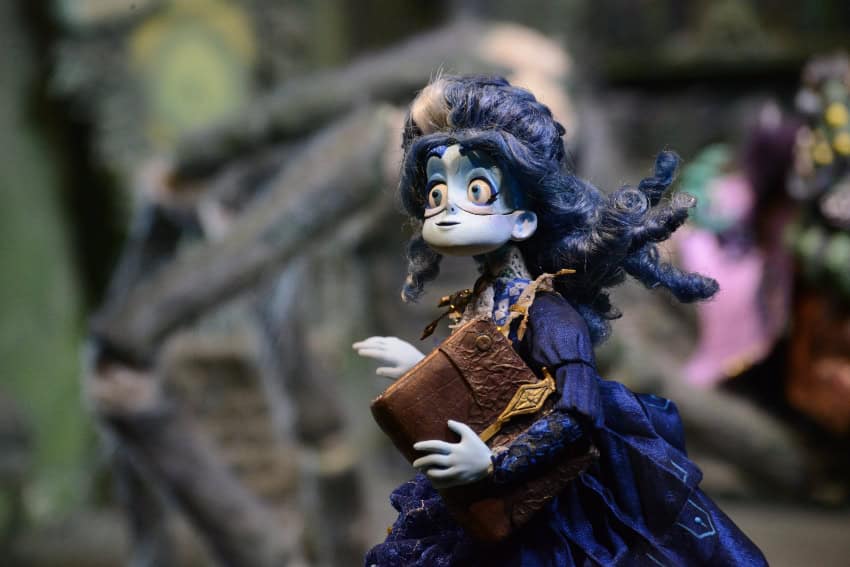
Ultimately, the Topus Terrentus is a fusion of two powerful currents: the iconic illustrations of Gustave Doré and the mysticism of Mexican folklore. While the European style shapes the architectural framework of the spaces, caves and ruins of The Land of Spooks, local culture permeates the heart and evolution of the feature film. From the very beginning — and especially when crossing the veil into this extravagant dimension — the screen is filled with ingenious nods to the country, such as the Maya aluxes, the tradition of alebrijes and even a portrayal of general and dictator Porfirio Díaz.
This rich identity, which pays a heartfelt tribute to the land and its people, is another reason why this film deserves to be celebrated and enjoyed.
The perfect family plan for Halloween
“Soy Frankelda” has all the ingredients to become the ultimate family movie of the season.
A visual style brimming with fascinating creatures? Yes. An unforgettable gothic musical atmosphere? Yes. A dazzling mythology inspired by Mexican folklore? Yes. And a deeply human journey of self-discovery? Definitely yes!
Best of all, the film captivates fans and new viewers alike, with no prior knowledge of the series required.
If you need one more reason to dive into this universe, the endorsement from Guillermo del Toro himself — shared with Espinof — will dispel any doubts: “It’s a milestone for Mexican stop-motion animation. A true triumph of vision, tenacity and love for this craft.”
So turn off the lights and get ready for a very Mexican Halloween.
Carolina Alvarado is a Venezuelan journalist who has devoted much of her career to creative writing, university teaching and social work. She has been published in Lady Science, Latina Media, Global Comment, Psiquide, Cinetopic, Get Me Giddy and Reader’s Digest, among others.
