


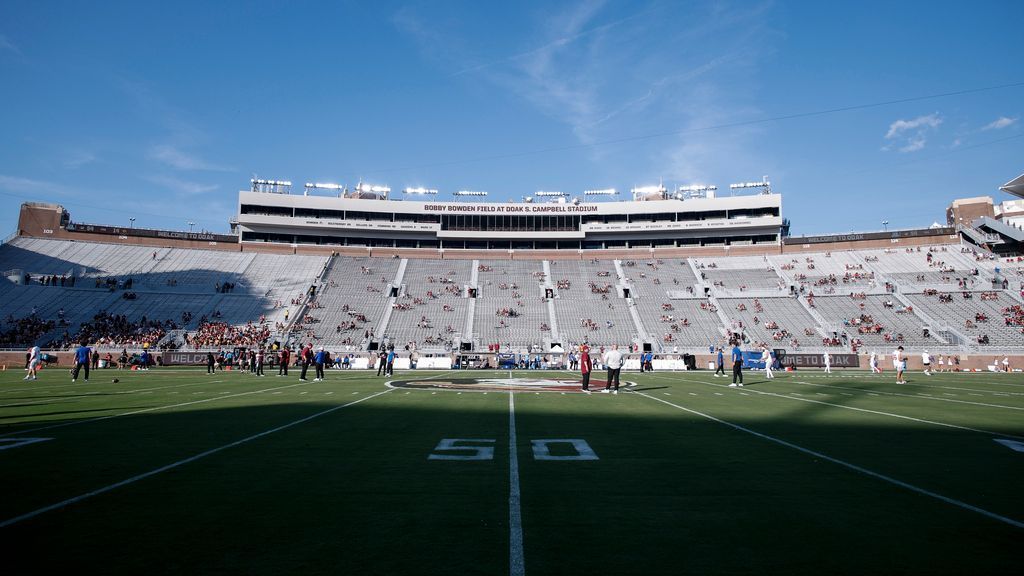
TALLAHASSEE, Fla. — When the power went out on the west side of Doak Campbell Stadium with 4 minutes, 40 seconds to go before kickoff between Florida State and SMU on Monday night, there were no guarantees the game would be played at all.
The only message that appeared on the video board was “Game Delayed – Power Outage.” Even Florida State president Richard McCullough, eagerly anticipating kickoff, looked up from the end zone to question what happened. Nobody knew for sure.
The teams lingered on the field without any clear guidance. Within minutes, officials from both Florida State and SMU began huddling with ACC commissioner Jim Phillips, game officials, facilities experts and administrators to determine what to do considering the unprecedented circumstances.
Florida State officials would discover the electrical issue originated with a short circuit in the busway, which caused a sudden surge of electrical current through the system. That surge placed significant stress on the transformer and ultimately caused it to fail. Once the problem was identified, crews worked to isolate the affected equipment, restore a safe and stable power supply, and allow the event to continue.
In the meantime, facing an extended delay, the teams retreated into the locker room while electricians and facilities experts worked to come up with a plan to — at the very least — power a majority of the lights so the game could be played.
Without any lights on the west side of the stadium, the game would have to be rescheduled.
“There wasn’t friction one time during any of the communication that we had, and we really needed to also listen and be led by the agencies that were involved in this,” Phillips said. “The question kept coming up: Will it be safe? Will it be safe for the fans? Will it be safe for the players? And unequivocally, the answer was yes. We had to wait to see if they could get some of the wiring necessary to get power.”
As they waited, Phillips, school officials and both coaches ran through contingency plans. If the lights could not be turned back on, there was discussion of postponing until Tuesday or potentially swapping out FCS games later in the season to play this one instead.
But within an hour, they got good news. Florida State was able to set up four generators atop the ninth floor of the stadium and redistribute power from another area to get most of the lights turned on. However, that was all that could be powered. Wi-Fi was out, so neither team would be able to use iPads on the sideline. Helmet-to-helmet communication also went down with the outage, along with the video replay boards and game clocks.
Still, Florida State coach Mike Norvell and SMU coach Rhett Lashlee agreed they could do without. In their view, along with other administrators, there would be enough lighting to play the game.
“We’re just going to play old-school football,” SMU athletic director Damon Evans said.
Added Lashlee: “I told our guys, ‘We’re the last team in the country to get to play a game. What’s another hour and a half?'”
The total delay ended up being 1 hour, 45 minutes. When the teams took the field following a brief warmup, the head official kept time on the field. One ACC official was assigned to each team to keep the coaches up to date on how much time was left. Though there was no power in the replay booth upstairs, the ACC had access to the replay command center in Charlotte, North Carolina, and a walkie talkie down on the field to be able to communicate with in-person replay officials if they needed to review a play.
With about five minutes to go in the second half, the game clocks were restored inside the stadium. Helmet-to-helmet communication was restored during the game as well.
“We adjust and move on,” Lashlee said. “If you whine about how hard it is, you’re not going to solve the problem.”
Norvell said, “As long as it was going to be balanced and equal, on each side, there’s adjustments to be made. Did it affect things? Yes. But it affects us on both sides. It’s definitely a different situation, but that’s how it played out.”
Florida State athletic director Michael Alford noted that city utility crews, public safety officials and game-day operations staff were also involved in trying to make sure the game could be played.
Once the game kicked off, Florida State quarterback Ashton Daniels said not having the helmet-to-helmet communication did not become a huge issue. “We prepare for situations like that,” Daniels said. “I think we had a good plan.”
SMU ended up winning 27-24 when Nick Reed kicked a 20-yard field goal with 21 seconds left.
Lashlee noted during his postgame news conference that was not the only time he had to weather a power outage in his football career.
He played in a game in high school with no power in Junction City, Arkansas.
“Last time I had one of these was my sophomore year in high school when the lights went out,” Lashlee said. “It ended up being national game of the year, 70-64. We played the whole game after an hour and a half delay with no scoreboard, just lights, no clock, and then 134 points were scored.”
