


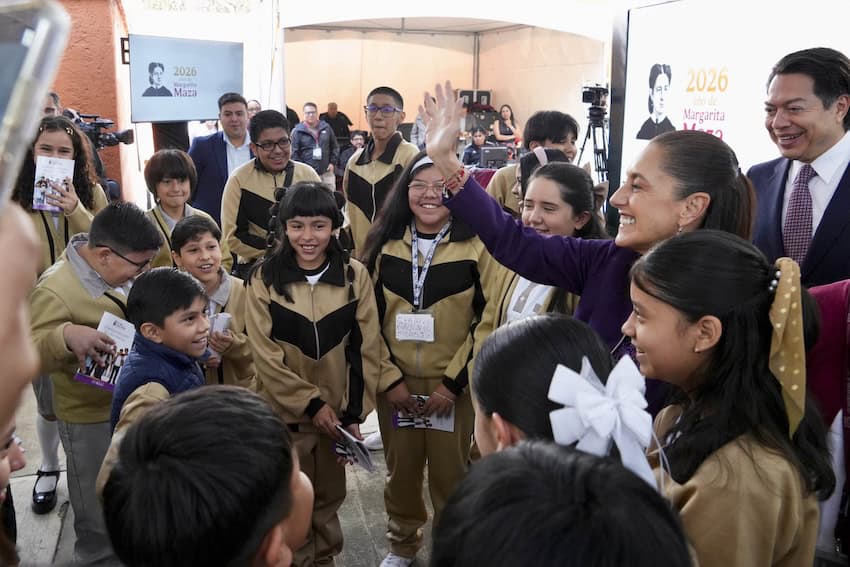
Sheinbaum’s mañanera in 60 seconds
- 🎒 28 million students head back to class: President Sheinbaum held her Monday mañanera at a Mexico City secondary school as the 2026-27 school year began for 28 million students and over 1.6 million teachers nationwide.
- 💵 Universal scholarship coverage for primary students: Delgado said all public primary school students received the Rita Cetina scholarship — a one-off payment of 2,500 pesos (US $147). He highlighted that it is “the first school year” with full scholarship coverage for public school students. Sheinbaum said the goal is to ensure “nobody leaves school for an economic reason.”
- 📱 National cell phone rules coming for schools: Education Minister Mario Delgado said 565,396 teachers completed a survey on device use at school, with 81% favoring “guidelines and rules” for safe use. Sheinbaum said that national rules will be set at an upcoming meeting of all state education ministers.
Why today’s mañanera matters
Education was the key focus at President Sheinbaum’s Monday morning press conference as the 2026-27 school year starts today.
The new academic year is starting amid an ongoing debate about the use of electronic devices, social media and artificial intelligence tools by Mexican children and teenagers. Earlier this month, Sheinbaum told reporters that she is not in favor of enacting a ban on the use of social media by teenagers under a certain age.
However, she is in favor of regulating, via federal legislation, the use of cell phones in schools. Sheinbam noted on Aug. 17 that cell phone use in classrooms is already banned in half of Mexico’s 32 federal entities.
At today’s mañanera, Education Minister Mario Delgado provided a summary of the results of a survey in which teachers were asked to offer their views about students’ use of phones and other electronic devices at schools.
Delgado also highlighted that the families of public primary school students have received a payment from the government to assist them with educational expenses.
In a nutshell, today’s mañanera — held at a school in Mexico City — was significant as the government sought to show that it is committed to supporting the nation’s children and adolescents on their educational journeys, and protecting them from risks associated with the use of social media and electronic devices.
28 million students return to school
Sheinbaum noted that she was holding her Monday morning press conference at the No. 10 “Artes Gráficas” secondary school in the Mexico City neighborhood of Doctores, located in the Cuauhtémoc borough.
“With a lot of affection, we say hello to all the young people … who are here with us and to the millions of girls, boys and adolescents who are starting classes today,” she said.
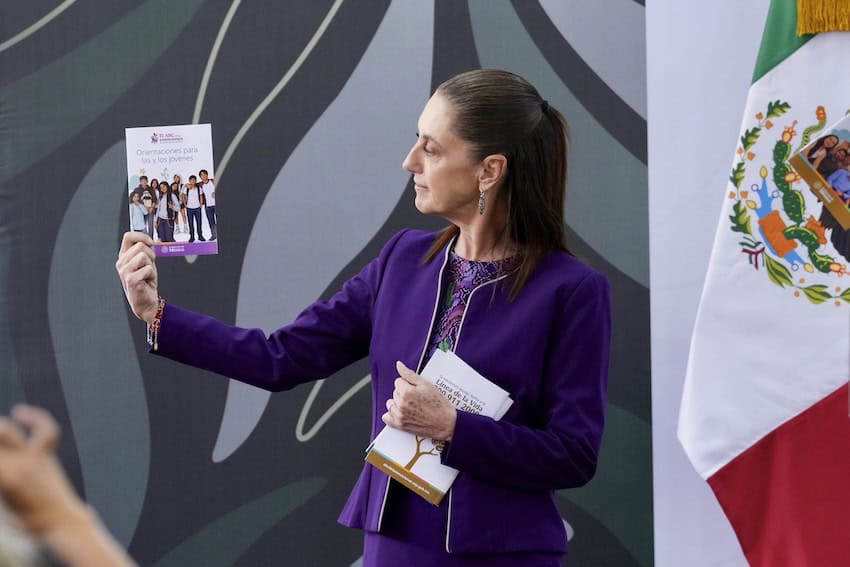
Sheinbaum noted that a total of 28 million students across Mexico are starting the new school year on Monday.
After the president’s opening remarks, Mexico’s national anthem played and students from “Artes Gráficas” performed the Mexican flag ceremony.
Delgado: All public primary school students received a government scholarship
Delgado told reporters that more than 1.6 million teachers across Mexico are also starting the new school year on Monday.
“We’re very happy about this return [to school] because it’s different,” the education minister said, highlighting that all public primary school students received the Rita Cetina government scholarship to assist them with their education expenses.
“Nearly 10 million girls and boys have a scholarship,” Delgado said, referring to public primary school students.
He noted that students at public secondary and high schools also receive government scholarships.
“This is the first school year in which we have universal coverage,” Delgado said.
For primary school students, the Rita Cetina scholarship consists of a one-off payment of 2,500 pesos (US $147).
Delgado: More than 500,000 teachers completed a questionnaire about students’ use of cell phones at school
Delgado told reporters that 565,396 teachers last week completed an online questionnaire about students’ use of cell phones and other electronic devices at school.
He said that 81% of those teachers are in favor of there being “guidelines and rules to guarantee the safe use [of devices] for educational purposes.”
Delgado highlighted that 48% of surveyed teachers said that students’ use of devices, including smartwatches, makes it difficult to maintain their attention in the classroom.
He also noted that almost 40% of surveyed teachers said that “conflicts” between students that began on social media are “transferred” to schools.
Delgado also said that 51% of surveyed teachers are in favor of the establishment of “protocols to attend to situations of risk” related to students’ use of electronic devices and the internet. He said that a majority of teachers are also in favor of schools reaching agreements with parents “so that they also help with this issue regarding access to technology.”
Sheinbaum says teacher and student participation in determining cell phone rules and social media regulation is ‘very important’
After acknowledging that the social media company Meta has to pay “a very significant amount” — US $18 billion — to U.S. states and territories to resolve claims that Facebook and Instagram harmed children, Sheinbaum said it is “true” that social media is a source of “messages of hate” and “abuse.” In addition, it “causes addiction,” she said.
Sheinbaum subsequently said that the participation of teachers and students in the consultation process ahead of the formulation of regulations on the use of cell phones in schools and young people’s social media use is “very important.”
“As of now, 81% of teachers agree that cell phones shouldn’t be used during class time and break times,” she said.
At an upcoming meeting of “all education ministers” — i.e. Delgado and the ministers of all 32 federal entities — a national rule regarding cell phone use at schools “will be determined,” the president said.
Sheinbaum: We don’t want anyone to leave school for an economic reason
Near the end of today’s mañanera, Sheinbaum said that the reason for providing scholarships to all public primary students was to ensure that they have “the bare minimum” they need for school — i.e., “uniforms, classroom materials and shoes.”
“That puts … [them] on an equal footing in the classroom,” she said.
“The classroom shouldn’t be a space of differentiation regarding who has more and who has less,” Sheinbaum said.
“… We don’t want anyone to leave school for an economic reason,” she added.
By Mexico News Daily chief staff writer Peter Davies (peter.davies@mexiconewsdaily.com)
