


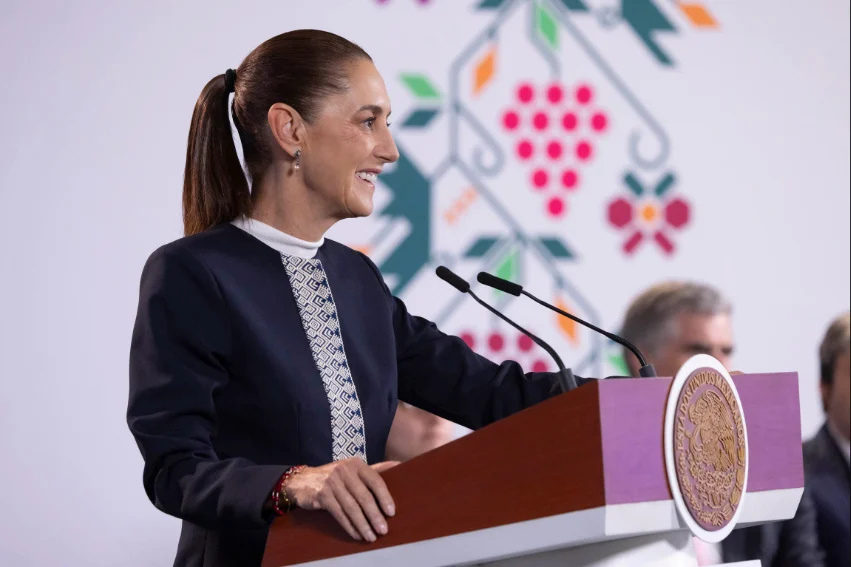
Sheinbaum’s mañanera in 60 seconds
Why today’s mañanera matters
A new pay agreement for Mexican Social Security Institute (IMSS) workers and North American economic integration were among the significant issues President Sheinbaum addressed at her Thursday morning press conference.
The wage deal didn’t stop hundreds of IMSS healthcare workers from protesting in Mexico City on Wednesday to demand higher pay, better working conditions, increased funding for healthcare and an end to shortages of medicines and medical supplies. Wednesday’s protest followed a larger demonstration in the capital on Oct. 13.
Also of note at today’s mañanera was Sheinbaum’s acknowledgement of an innovation by a Mexican student who won a gold medal at an international science fair in Indonesia.
Sheinbaum acknowledges new pay agreement between IMSS and workers’ union
Sheinbaum noted that IMSS and the National Social Security Workers Union (SNTSS) reached an agreement to give IMSS workers an 8% pay increase. The raise consists of a 4% increase in base pay and a 4% increase in housing assistance.
The 8% increase is an improvement on an initial offer from IMSS, but falls short of the 10% base pay raise workers were seeking.
Eight days after holding protest marches across Mexico, IMSS workers returned to the streets of Mexico City on Wednesday, but Sheibaum said the turnout was much lower.
She praised IMSS for holding talks with the SNTSS and developing an improved pay offer.
“Tell me, in what other country in the world are things resolved like that?” Sheinbaum asked.
“Authoritarianism prevails a lot of the time — ‘No, I already said that pay increase is 2.9% and that’s it,’” she said, mimicking an official who refuses to budge.
Sheinbaum voices support for North American economic integration
Sheinbaum acknowledged that U.S. President Donald Trump has a re-industrialization agenda and told reporters that it is “legitimate” for any country to seek to increase domestic manufacturing production — as Mexico is doing.
However, given that the economies of Mexico, the United States and Canada have become highly integrated since NAFTA took effect in 1994, “we should see ourselves … [and] work as a region” while maintaining respect for sovereignty and autonomy, she said.
“… It’s a lot better to work together in order to compete with other regions [of the world] than to isolate oneself,” Sheinbaum said.
Ebrard hopes for US response on steel, aluminum and auto tariffs before year-end
“That has always been our vision and we’ve set it out on various occasions,” she said.
“… [Economic] integration is very important for the three countries and it creates a very competitive region,” Sheinbaum said.
Her remarks came amid ongoing talks between Mexico and the United States. The talks are aimed at resolving trade differences that contributed to the Trump administration’s decision not to extend the USMCA free trade pact until 2042. Both Sheinbaum and Trump said this week that a bilateral deal is “very close.”
The Trump administration has significantly undermined the USMCA by imposing tariffs on various goods from both Mexico and Canada. Mexico’s main aim in its trade talks with the U.S. is to secure a reduction in the tariffs they currently apply to steel, aluminum and vehicles.
Tamaulipas student wins a gold medal for her sound-based fire extinguisher
Early in her press conference, Sheinbaum highlighted that a lot of young Mexicans have won prizes at mathematics and physics olympiads.
She subsequently noted that a teenage girl from Tamaulipas, Ángela Karime Venegas Hernández, won a gold medal at the International Science and Invention Fair, held last week at the University of Indonesia in Depok, near Jakarta.
🥇Con gran orgullo reconocemos a Ángela Karime Hernández Venegas, alumna del #CETIS78 #Altamira al obtener medalla de oro en Competencia Internacional de Ciencia y Tecnología ISIF 2026 en #Indonesia, en la categoría de Tecnología, nivel secundaria, al participar con su prototipo.
— SEMSyS Tamaulipas (@VinculacionTam) October 20, 2026
Sheinbaum displayed an article from the news outlet Infobae about Venegas’ win and read out its headline: “Mexican student wins gold medal in Indonesia with her extinguisher that puts out fire using sound waves.”
The 17-year-old student hails from the CETis 78 school in the Gulf of Mexico port city of Altamira. She won her gold medal in the technology category for a “fire suppression system using acoustic waves.”
Sheinbaum said that the Ministry of Science, Humanities, Technology and Innovation contacted Venegas to learn more about her “great invention.”
“She is an example of hundreds and hundreds [of talented young Mexicans],” she said.
Mexico News Daily reported last Thursday that Venegas’ sound-based extinguisher, called Vortex Tech, uses a 12-volt battery, a frequency generator set to 30 hertz, an amplifier and a speaker.
“A modified bucket channels the output toward a flame,” MND reported.
“According to Venegas’ explanation, the sound generates swirling rings of air that disrupt the oxygen supply sustaining combustion, extinguishing small flames within seconds.”
By Mexico News Daily chief staff writer Peter Davies (peter.davies@mexiconewsdaily.com)
