


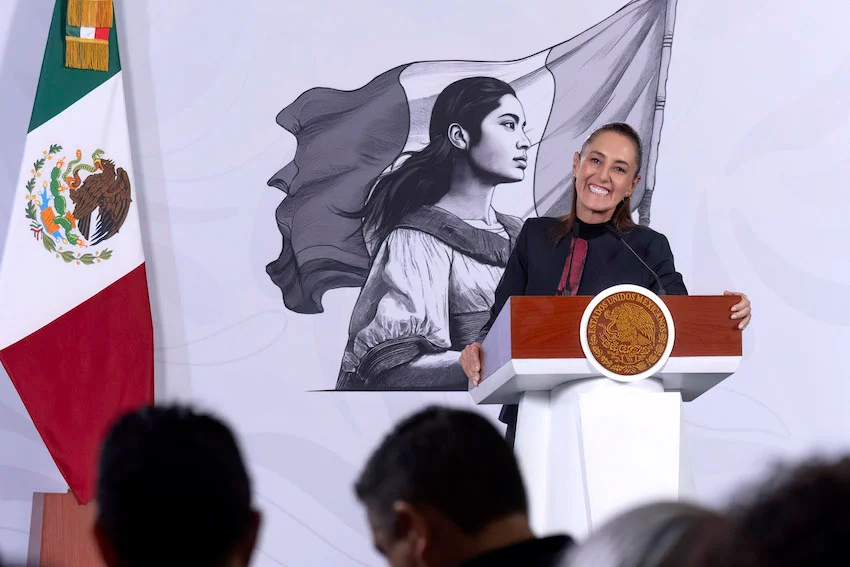
Sheinbaum’s mañanera in 60 seconds
- 🏠 Work-from-home decree issued for World Cup opening day: Legal adviser Luisa María Alcalde announced a decree published Tuesday directing federal workers in Mexico City to telework on Thursday — the day of the World Cup opening ceremony and Mexico’s first match — with classes also suspended and the private sector urged to follow. The aim is to ease traffic and improve road safety for residents and tourists ahead of the 11:30 a.m. opening ceremony and 1 p.m. kickoff against South Africa.
- 👩🏫 1.4 million students out of school: Education Minister Mario Delgado reported that 17,471 public schools across six states are closed due to CNTE strikes, with Oaxaca bearing the brunt. Delgado again emphasized teachers’ wage “recovery” since 2018 and urged a return to class as the school year enters its final stretch.
- 🇲🇽 🇺🇸 Velasco-Rubio call described as cordial: Foreign Affairs Minister Velasco said his roughly 30-minute call on Monday with U.S. Secretary of State Rubio covered security cooperation, migration, and the USMCA review. He highlighted declines in both migration and fentanyl shipments on Sheinbaum’s watch as points raised with Rubio, and said the two aim to meet in person at a future date.
Why today’s mañanera matters
Two days before the opening ceremony and first match of the FIFA men’s World Cup, the federal government is still attempting to reach an agreement with protesting teachers, many of whom are camping out in the historic center of Mexico City. Teachers affiliated with the CNTE teachers’ union plan to protest on Thursday in Mexico City, where Mexico will play South Africa in the opening World Cup match after an opening ceremony at which Shakira and other music stars will perform. That protest and others planned for Thursday could disrupt travel to Mexico City Stadium (Banorte), located in the capital’s south.
While the government may be unable to stop the planned protest by teachers — whose demands include a 100% pay rise and the repeal of a 2007 law that changed their pension system — it can mitigate potential disruptions to World Cup attendees’ travel in Mexico City on Thursday by instructing federal employees to work from home and suspending classes.
Consequently, the government issued a “work from home” decree on Tuesday, and its content was presented at President Claudia Sheinbaum’s Tuesday morning press conference.
Also of note at today’s mañanera was the government’s ongoing effort to show that wages, benefits and conditions for the nation’s teachers have improved significantly since former President Andrés Manuel López Obrador (AMLO) took office in late 2018.
Government publishes ‘work from home’ decree to improve traffic conditions on World Cup inauguration day
Luisa María Alcalde, Sheinbaum’s top legal adviser, told reporters that a decree was published in the government’s official gazette on Tuesday that proposes that people in Mexico City work from home on Thursday, the day on which the World Cup opening ceremony and first match will take place at the Mexico City Stadium.
The decree instructs Mexico City-based government departments and agencies to “implement schemes of teleworking” and “urges” the private and social sectors in the capital to do the same. It also states that classes will be suspended in Mexico City on Thursday.
Alcalde said that the aim of the directives in the decree is to “improve conditions of mobility, road safety and accessibility both for Mexico City residents and tourists” on Thursday.

“Who is this decree directed to? Federal public administration workers, private sector workers and students,” she said.
“It’s a decree for Mexico City and these three groups,” Alcalde said.
The World Cup opening ceremony will start at 11:30 a.m. Thursday, while the inaugural match — El Tri (Mexico) vs. Bafana Bafana (South Africa) — will kick off at 1 p.m.
More than 1.4 million students affected by teachers’ strikes
Education Minister Mario Delgado presented data that showed that 17,471 public schools in six federal entities are currently “on strike” — i.e., closed. A large number of teachers affiliated with the CNTE teachers’ union are currently protesting in Mexico City and other parts of the country.
The data presented by Delgado showed that:
- 2,460 schools are closed in Chiapas. That figure represents 13.07% of all public schools in the southern state.
- 1,559 schools are closed in Guerrero (14.7% of all schools in the state).
- 694 schools are closed in Michoacán (6.59%).
- 10,653 schools are closed in Oaxaca (80.61%).
- 2,095 schools are closed in Zacatecas (47.34%).
- 10 schools are closed in Mexico City (0.23%).
The data also showed that 1.41 million students, including more than 734,000 in Oaxaca, are currently not in school because their teachers — more than 88,000 of them — are on strike.
“It’s important that they can return to classes because we’re now in the final stage of the school year,” said Delgado, who for the second consecutive day spoke about the “recovery” of teachers’ wages since AMLO took office in 2018.
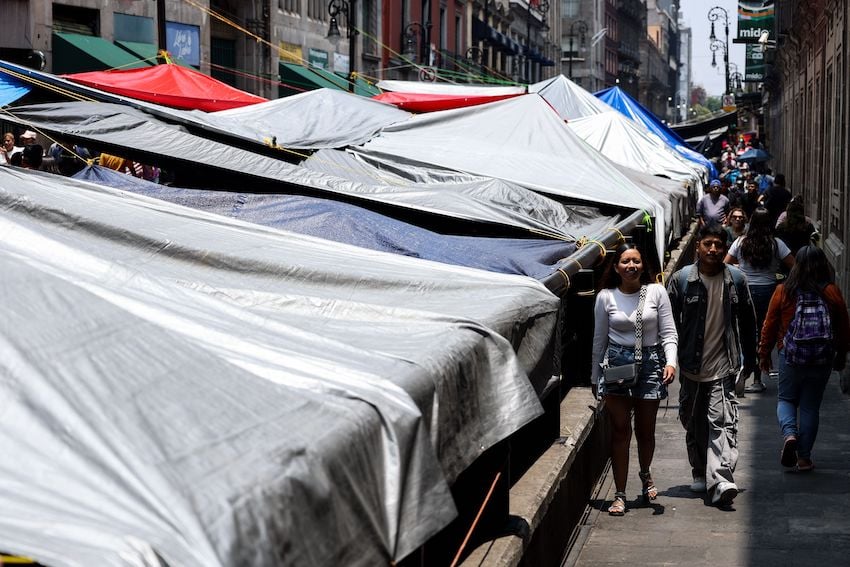
Sheinbaum reiterated that the federal government remains open to dialogue with the CNTE — even though it has conceded it can’t meet all of its demands — and reemphasized that security forces won’t repress protesting teachers.
She also reiterated her “guarantee” that the World Cup opening will go off without a hitch. “There is no problem [in that regard],” Sheinbaum said.
Velasco outlines ‘cordial’ and ‘respectful’ call with Marco Rubio
At the start of the press conference, Foreigh Affairs Minister spoke briefly about his call on Monday with U.S. Secretary of State Marco Rubio.
“[It was] a conversation in a very cordial and respectful environment,” he said.
Velasco said that the call lasted around 30 minutes and that he and Rubio mainly spoke about “three issues:” security cooperation, migration and the review of the USMCA free trade pact.
He noted that a bilateral security meeting will take place in Mexico City this week, and highlighted that data indicates that migration to the United States from Mexico, and the northward shipment of illegal fentanyl, have both declined during Sheinbaum’s presidency.
“We pointed that out [to Rubio],” Velasco said.
El canciller Roberto Velasco detalló la conversación que tuvo con el secretario de Estado de EE.UU., Marco Rubio, sobre seguridad, migración y comercio.
Más en pic.twitter.com/vR3dchUwvn
— Joaquín López-Dóriga (@lopezdoriga) June 9, 2026
He noted that the USMCA review is not a direct responsibility of Mexico’s Ministry of Foreign Affairs or the U.S. Department of State, but said it is “an issue that we both monitor.”
Velasco said that he and Rubio spoke about “the importance of reaching a good port” via the ongoing bilateral trade talks.
He said that he and the U.S. Secretary of State will seek to meet face-to-face at some point in the future.
The Mexico-U.S. security relationship has been significantly strained this year by a range of factors, among which the most notable are the CIA’s alleged participation in a drug lab raid in Chihuahua without the authorization and knowledge of the Mexican government and U.S. prosecutors’ drug trafficking accusations against Sinaloa Governor Rubén Rocha Moya and nine other current and former Sinaloa-based officials.
There are also a number of irritants in the bilateral trade relationship, including the Trump administration’s implementation last year of tariffs on a range of Mexican goods including vehicles, steel and aluminum.
By Mexico News Daily chief staff writer Peter Davies (peter.davies@mexiconewsdaily.com)
