


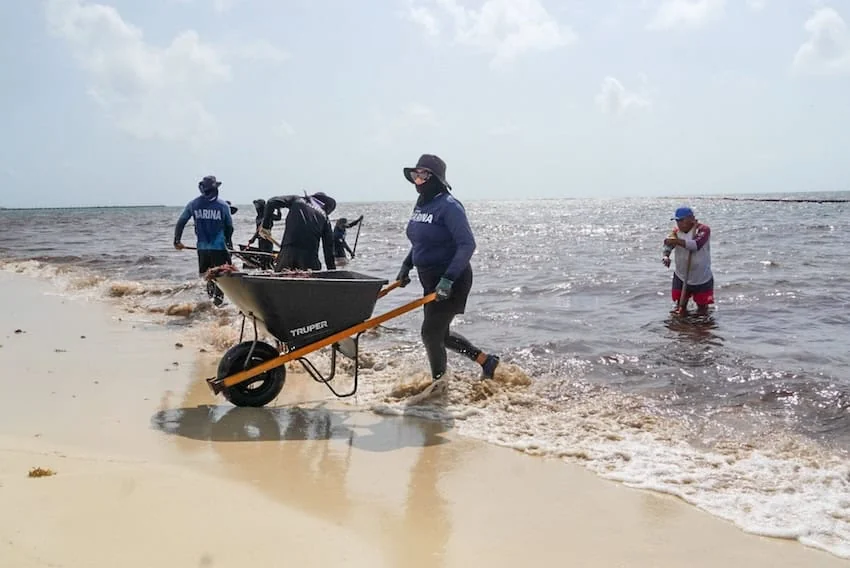
Sargassum season in the Mexican Caribbean has officially ended.
The conclusion date came a month later than in 2025, but finally, autumn’s cold fronts are bringing a drop in sea temperature and a consequent reduction in seaweed arrivals.
Figures from Quintana Roo’s state Ministry of Ecology and Environment (SEMA) indicate a record collection of 156,631 tonnes of seaweed throughout the year — nearly double the 85,000 tonnes reported in 2025. The Mexican Navy was responsible for the removal of 72,000 metric tonnes of that amount, representing a fourfold increase in its sargassum missions over last year.
The navy used drones and satellite images to anticipate sargassum’s movement at sea. Still, it’s estimated that only about 16.4% (25,751 tonnes) was collected from the open ocean.
According to local media, approximately 4.3 billion pesos (US $231 million) was allocated to clean-up, a combined effort by hoteliers and all three levels of government.
Sargassum levels at the source in Northwest Africa — of which 1-5% reaches Mexico — rose by 10% to 15% compared with 2025 (from about 900,000 tonnes to 1 million), according to Esteban Amaro, director of the Sargassum Monitoring Center in Quintana Roo.
Agencies predict that 2027 could bring even more sargassum to the region, depending on several factors. The “Super El Niño,” one of the strongest climate events of its kind in modern records, as well as changes in the Atlantic Ocean’s hydrodynamics, could determine when the next season begins and how much seaweed the tides will bring.

The Quintana Roo state government is aiming to install a large ocean barrier, known as GO 60 by 60, between Cozumel Island and Tulum to reduce the quantity of seaweed reaching the region’s main tourist destinations.
The structure would be placed 60 km offshore at a 60-degree northeast orientation, where it can take advantage of ocean currents to divert the seaweed.
The project is expected to comprise six 10 km sections, arranged in a staggered pattern, allowing ships to traverse the waters if approved. However, the extremely strong currents in the Cozumel Channel, between the island and the beach town of Playa del Carmen, pose a significant technical challenge for construction.
In addition, concerns about the structure’s potential impact on marine life mean that further analysis must be conducted before it can proceed.
With reports from La Jornada and N+
