


Unlock the Editor’s Digest for free
Roula Khalaf, Editor of the FT, selects her favourite stories in this weekly newsletter.
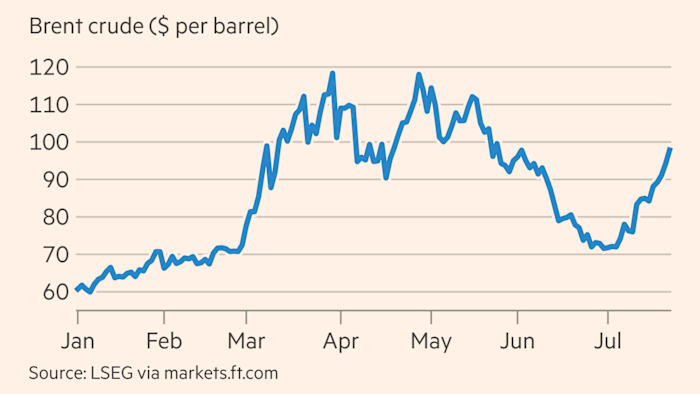
The oil price has risen above $98 a barrel for the first time since early June after Iran-backed Houthi militants said they had attacked two Saudi Arabian tankers in the Red Sea.
In a statement on its Al-Masirah television channel on Thursday, a spokesperson for the Yemeni group said it used missiles and drones to target the ships Encelia and Layla, accusing them of violating its embargo of the Red Sea.
The Houthis warned this week that they were imposing a maritime blockade on the kingdom as they threatened to reignite a decade-long war with Saudi Arabia.
Saudi state news agency quoted an official confirming that one of the tankers, the Encelia, was targeted, resulting in a fire at the bow of the vessel. It said the crew was safe.
Brent crude, the international benchmark, was up 4.2 per cent at $98.10 a barrel in early London trading, taking its gains this month to more than 30 per cent amid a flare-up in the conflict between Washington and Tehran.
The attacks risk unravelling a four-year ceasefire with Saudi Arabia and threaten to disrupt shipping through the Bab al-Mandab Strait, a vital maritime trade route that links the Red Sea to the Gulf of Aden and the Indian Ocean.
The strikes come at a critical time in the US-Iran conflict following the breakdown of a ceasefire last week as the warring parties battle for control of the Strait of Hormuz.
The Bab al-Mandab has become vital for Saudi Arabia’s crude exports to Asia since Iran closed the Strait of Hormuz.
The kingdom has been using an east-west pipeline to Yanbu port on the Red Sea, from where it has exported nearly 4.9mn barrels of crude and refined fuels a day, according to data from energy data company Kpler.
Several tankers carrying Saudi crude through the Red Sea had turned around this week as the Houthis broadcast radio warnings to ships.
The Houthis launched attacks that disrupted maritime traffic through the Red Sea after Israel launched its war in Gaza following Hamas’s October 7 2023 attack but had not targeted shipping since last summer.
Saudi Arabia intervened in Yemen’s civil war in 2015 to lead an Arab coalition against the Houthis after the rebels seized Sana’a and ousted the internationally recognised government.
The parties reached a ceasefire in April 2022, but the 2023 Hamas assault and the Houthis’ attacks on shipping upended a diplomatic push to end the war on a lasting basis.
The truce had largely held until last week. The latest hostilities began when the Houthis opened Sana’a airport this month to allow Iranian planes to fly rebel officials to and from the Islamic republic for the first time in a decade. The Houthis blamed Saudi Arabia for a subsequent attack on the airport.
Riyadh is concerned that Iranian flights to Sana’a could be used to ship weapons, technology and military advisers to the Houthis, analysts said.
The Houthis are one of the most potent members of Iran’s so-called axis of resistance. But they have largely stayed out of the US-Israeli war against Iran, apart from firing several barrages of missiles and drones at Israel in March and early April.
There have been concerns, however, that the Houthis would co-ordinate with Tehran to close the Bab al-Mandab to pile pressure on energy markets and global trade.

The Houthi entry into the Iran conflict had the potential to “expand the war’s supply losses” by reducing the effectiveness of the east-west pipeline route, said Helima Croft, analyst at RBC, in a note.
“We think a sustained deployment of force would cause a material reduction in total Red Sea oil flows,” Croft said. “It could also shift the sentiment of ‘the market always finds a workaround’ camp.”
Saudi Arabia said it would take all measures necessary to protect shipping in the Red Sea.
