


The week of June 1 in Mexico began with the buzz of another World Cup milestone. La Paz on Saturday set a Guinness World Record with a soccer-themed interactive mural, while Mexico City Mayor Clara Brugada put the finishing touches on a major parade announced for June 13.
Against the backdrop of festive preparations, the first week of June proved to be one of the most charged of Claudia Sheinbaum’s presidency: a landmark sovereignty speech, an escalating diplomatic spat with Washington and a rare statement from former president AMLO indicated a growing impatience with what Mexico City increasingly views as Washington’s overreach into sovereign affairs.
Didn’t have time to catch this week’s top stories? Here’s what you missed.
Sheinbaum draws the line at Sunday rally
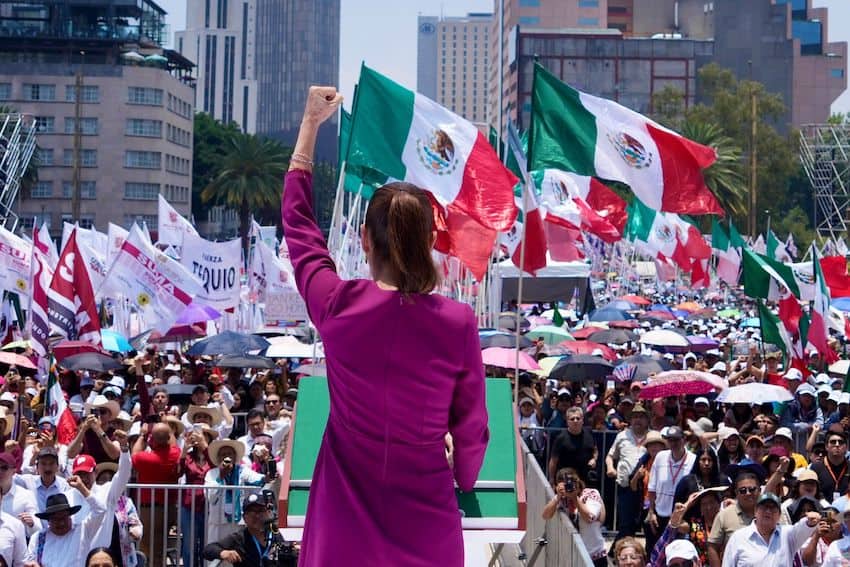
Mexico “is not anyone’s piñata.” With those words, President Claudia Sheinbaum opened the most combative chapter yet of her relationship with the United States, delivering a forceful 65-minute address to 130,000 supporters gathered before the Monument to the Revolution on Sunday — the weekend of the second anniversary of her election.
She named two U.S. actions as unacceptable violations of Mexican sovereignty: the alleged participation of CIA officers in an April drug raid in Chihuahua without federal authorization, and a Justice Department extradition request for Sinaloa Governor Rubén Rocha Moya and nine other officials filed without publicly presenting evidence. “An action of that magnitude has no precedent in the history of our bilateral relationship,” she said of the latter.
Sheinbaum drew a line between cooperation and submission — vowing to continue sharing intelligence to stop drug trafficking while insisting that foreign agents must operate within Mexican law — and raised pointed questions about whether U.S. pressure was driven by genuine anti-crime intent or by domestic electoral politics ahead of November midterms. Regional analysts called it her strongest sovereignty rhetoric to date.
Ambassador Johnson fires back, and Sheinbaum responds
The day after the rally, U.S. Ambassador Ronald Johnson posted a pointed message on social media — without naming Sheinbaum — arguing that the fight against cartels must not be politicized.

“The fight against cartels should unite us, not divide us,” he wrote.
“People on both sides of our border want to live safely and in peace. They deserve freedom from the intimidation, corruption, and fear that the cartels inflict. Every moment spent turning this shared security challenge into a political dispute is a missed opportunity to strengthen our partnership and protect the people we serve.”
Sheinbaum replied at Tuesday’s mañanera, agreeing on the need for cooperation but pointedly reminding Johnson that ambassadors are expected to stay out of a host country’s internal affairs. Her own ambassadors, she noted, do not comment on the domestic politics of the countries where they are posted. The exchange crystallized the week’s central tension: both sides insist they want cooperation, but cannot agree on where cooperation ends and interference begins.
AMLO breaks his silence
Three days after Sheinbaum’s rally speech, a five-page statement appeared on former President Andrés Manuel López Obrador’s personal website under the heading “My unconditional support for President Claudia Sheinbaum Pardo and a Respectful Reflection on President Donald Trump” — AMLO’s first significant public statement since leaving office in 2024.
Writing from his ranch in Palenque, the former president accused U.S. officials of running an “interventionist” campaign to weaken Morena ahead of Mexico’s 2027 elections, and argued that the Trump of today was a different man from the one he had dealt with in the first term — less personally engaged and more susceptible to “resentful and fanatical advisers” steering him toward “vile and sinister adventures.” His closing appeal: “For the good of all, may the other Trump return.” Sheinbaum thanked him for his “unconditional support” at Thursday’s mañanera.
Facing US pressure, President Sheinbaum thanks AMLO for his ‘unconditional support’: Thursday’s mañanera recapped
Governors under scrutiny
The pressure on Mexico’s governors intensified on two fronts. On Wednesday, The Los Angeles Times reported that the United States is investigating two additional Morena-affiliated governors: Sonora’s Alfonso Durazo for alleged organized crime ties and Tamaulipas’ Américo Villarreal Anaya for suspected fuel smuggling, with both men reportedly having their U.S. visas revoked. Sheinbaum acknowledged the report but said the governors must answer for themselves, then questioned the motive behind making the visa cancellations public.
Separately, a New York federal judge ruled there is abundant evidence against the former security chief of Sinaloa, deepening the legal web of U.S. prosecutions touching Sinaloa-linked officials.
Teachers’ union sets up camp near the Zócalo
As Mexico City counts down to the World Cup, the dissident CNTE teachers’ union has set up a protest encampment in the historic center, near where tens of thousands of fans are expected to gather on match days.
Teachers — many from Oaxaca — are demanding a 100% pay rise and pension improvements. Sheinbaum said the budget cannot accommodate all demands but that the government remains open to dialogue. As of Saturday, an agreement has not been reached, prompting the CNTE to threaten further blockades at the Mexico City International Airport and Estadio Azteca (Mexico City Stadium) during the first week of the World Cup.
Mexico formally asks to extend the USMCA
In a June 1 letter from Economy Minister Marcelo Ebrard to U.S. Trade Representative Jamieson Greer and Canadian Trade Minister Dominic LeBlanc, Mexico formally requested a 16-year extension of the USMCA through 2042. Canada submitted a parallel request the next day. The move followed the conclusion of the first formal round of bilateral review talks, which covered automotive rules of origin, steel, aluminum and economic security; a second round is scheduled for Washington June 16-17.
The United States’ enthusiasm remains the central unknown: Trump has called the agreement “irrelevant” to him. Adding a new wrinkle, the USTR this week proposed 10% tariffs on 60 countries, including Mexico, over forced-labor concerns — though the Economy Ministry confirmed that USMCA-compliant goods, roughly 85% of Mexico’s export volume, would be exempt.
New arrests bring 2 major cases closer to justice
- Authorities arrested the alleged intellectual author of the murders of Vizsla Silver executives, closing a case involving the killing of mining company officials that had drawn significant attention to violence in Mexico’s resource sector.
- An ex-soldier was arrested in California in connection with his alleged role in the 2014 Ayotzinapa mass disappearance of 43 students, one of the most high-profile and unresolved tragedies in modern Mexican history.
What are Mexico’s chances at this World Cup?
Goldman Sachs, applying their financial modeling tools to the 48-team tournament, gives El Tri just a 0.8% chance of winning it all — 12th in the field, tied with Senegal and Ecuador. The bank’s model makes Spain the heavy favorite at roughly 26%, followed by France (19%) and Argentina (14%). Goldman is more bullish on Mexico’s group stage, projecting a sweep of Group A including a 2-0 win over South Africa on June 11, with 95.6% odds of reaching the expanded round of 32 — but Mexico’s odds of reaching the final sit at 3.4%, and of winning it, essentially a rounding error at 0.8%.
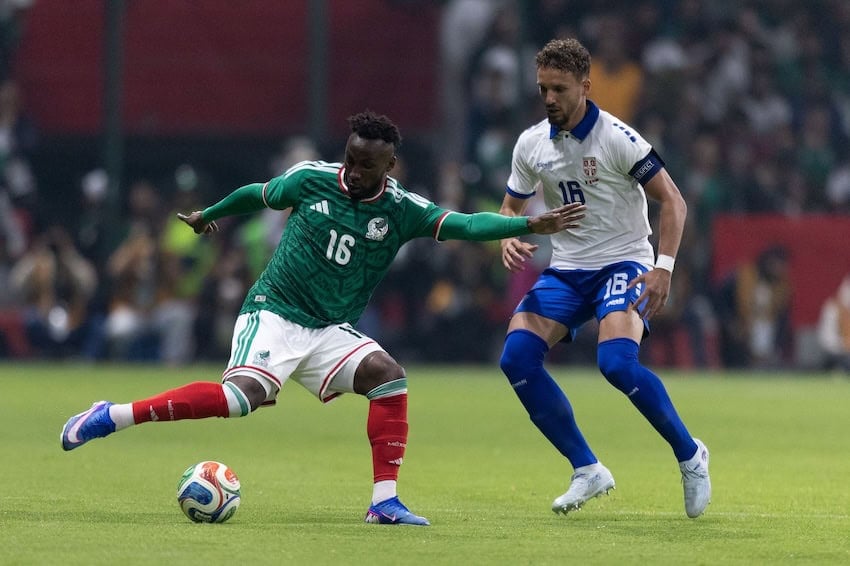
The Opta supercomputer gives Mexico a marginally better 0.9%, still ahead of co-hosts the United States (0.5%) and Canada (0.3%).
Beyond the Goldman numbers, the tournament machinery is now in full motion across Mexico.
The MND Peso Index™ for May 2026
The second edition of the MND Peso Index™ — Mexico News Daily’s proprietary monthly purchasing power parity measure — found the Mexican peso overvalued by just over 4% against the U.S. dollar as of late May. The MND Peso Rate, derived from a standardized basket of 20 goods and services compared across Mexico and Dallas, came in at 18.02 pesos per dollar, against a Banxico FIX rate of 17.32 on May 26 — a wider gap than the 2.83% overvaluation recorded in April. Monex USA CEO John Doyle, who reviewed the index methodology, told MND his firm is forecasting a year-end rate of 17.90, consistent with both editions of the index so far.
Other business developments to watch
Spain and Mexico signed an agreement to double bilateral trade by 2030 and significantly increase Spanish investment in Mexico, building on the landmark EU-Mexico trade deal concluded in May.
Meanwhile, the OECD cut Mexico’s 2026 GDP growth forecast from 1.3% to 0.8%, citing trade tariffs, fiscal consolidation and policy uncertainty — but raised its 2027 projection from 1.7% to 1.8%, pointing to domestic consumption and lower interest rates as drivers of gradual recovery.
Mexico News Daily
This story contains summaries of original Mexico News Daily articles. The summaries were generated by Claude, then revised and fact-checked by a Mexico News Daily staff editor.
