


Before sending the proposed General Law on the Rights of Indigenous and Afro-Mexican Peoples to Congress in October, the federal government will consult more than 16,000 communities on the bill.
President Claudia Sheinbaum signed a convocatoria, or official announcement, at her Monday morning press conference that sets the consultation process in motion.
Luisa María Alcalde, the president’s top legal adviser, told reporters on Monday that “the time has come” to consult “the holders” of the rights under the proposed law — i.e., Mexico’s Indigenous and Afro-Mexican people.
Alcalde said that people belonging to 69 different Indigenous groups as well as Afro-Mexicans across 16,728 communities will be consulted on the proposed law, which is scheduled to be sent to Congress on Oct. 12, a date that has been known in Mexico as the Day of the Pluricultural Nation since 2021.
She said that the proposed law was developed by “many” government agencies, including the National Institute of Indigenous Peoples (INPI).
The proposed law
At Sheinbaum’s Monday morning press conference, INPI General Director Adelfo Regino Montes spoke about the content of the proposed law and how it came about. Regino Montes said that the “foundation” or “origin” of the proposed law is “the new Article 2 of the Mexican Constitution,” which took effect on Oct. 1, 2024 and sets out a range of rights for Indigenous and Afro-Mexican peoples and communities.
He said that the objective of the proposed law is to “promote, protect, guarantee and implement the rights of Indigenous and Afro‑Mexican peoples and communities in their capacity as subjects of public law … with legal personality and their own heritage so that they can exercise their autonomy and participate in national public life.”

The recognition of Indigenous and Afro-Mexican peoples “as subjects of public law” — i.e., individuals and groups with distinct legal rights — is at the heart of the 2024 constitutional reform, Regino Montes said.
He said that the “subjects” of the proposed law are some 25.8 million Indigenous and Afro-Mexican people across Mexico as well as 16,728 communities, of which 16,232 are Indigenous and 496 are Afro-Mexican. That number of people represents 20.5% of the Mexican population, Regino Montes said.
He said that the proposed law consists of “eight books,” whose titles include “Indigenous Peoples and Communities as Subjects of Public Law” and “Self-determination and Autonomy.”
Other books that are part of the proposed law seek to enshrine in law the specific rights of Afro-Mexican people and communities, of Indigenous and Afro-Mexican women and girls, and of Indigenous and Afro-Mexican migrants, seniors and people with disabilities.
Among the other books that make up the proposed law is Book 6, which sets out “the bases, methodologies and procedures” for consultations with Indigenous and Afro-Mexican communities.
“The idea is that now we will have a legal framework to guarantee the right to consultation for our [Indigenous and Afro-Mexican] people and communities,” Regino Montes said.
Some previous consultations with Indigenous peoples, such as that related to the Maya Train project, have faced criticism. In 2019, the Mexico office of the United Nations High Commissioner for Human Rights said that during the month-long Maya Train consultation process in southeastern states, it observed that the information presented to Indigenous communities only outlined the potential benefits of the project and not the negative impacts it may cause.
The INPI chief said on Monday that the proposed law was developed at 148 work meetings in which 35 federal agencies and entities participated. He said that the Supreme Court was also consulted on the bill, “particularly on those aspects related to justice.”
If, as expected, the proposed General Law on the Rights of Indigenous and Afro-Mexican Peoples is approved by Congress, Mexico’s Indigenous and Afro-Mexican people and communities will have additional legal protection of their rights.
Regino Montes highlighted that Mexico is set to have “an Indigenous Law” for the first time since the Mexican state came into being more than 200 years ago.
Consequently, “our people” and “our communities” will be able to “provide their grain of corn in this process of construction of national public life,” he said.
The 5 stages of the consultation process
Alcalde said that the aim of the consultation is to “receive opinions, suggestions and proposals on the draft General Law on the Rights of Indigenous and Afro‑Mexican Peoples from the subjects of this Law.”
She said that the consultation process consists of five stages.
“The first stage is today, today we sign the convocatoria,” Alcalde said.
“We’ll see the convocatoria published today in the evening edition of the Official Gazette of the federation,” she said.
Alcalde said that the second stage of the consultation process would run from July 1 to Aug. 6 and consist of providing information about the proposed law to the more than 16,000 Indigenous and Afro-Mexican communities across Mexico.
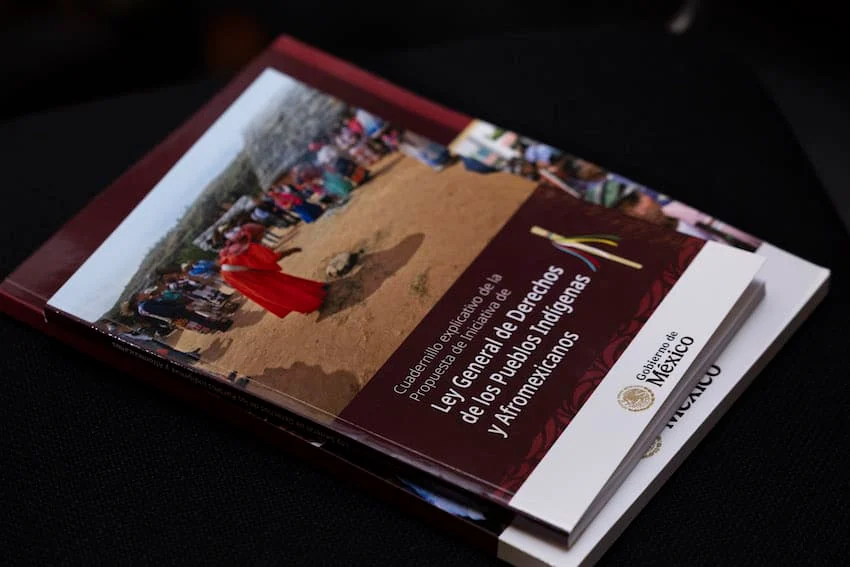
The INPI has created a “booklet” with information about the law that will allow Indigenous and Afro-Mexican people to analyze it, she said.
The third stage will take place between Aug. 7 and Sept. 13 and will consist of deliberations on the proposed law by each of the thousands of communities, Alcalde said.
“Each community will deliberate in accordance with its own internal regulatory system, respecting its traditional ways of organization and decision-making,” she said.
“During this stage, 82 regional consultation assemblies will be carried out,” Alcalde added.

She said that a fourth stage of the consultation process will take place once the government has received comments and proposals related to the draft law. The stage, Alcalde said, will be one of “study” and “adjustment” of the proposed law.
“The proposals, recommendations and conclusions gathered at the regional assemblies and working meetings will be analyzed and incorporated into the bill between Sept. 21 and Oct. 11,” she said.
The fifth and final stage of the process, Alclade said, is the “formal presentation” of the bill to Congress on Oct. 12.
Sheinbaum said that the bill will first be submitted to the Chamber of Deputies “so that the approval process begins there.”
The legal “rules” of Article 2 of the Mexican Constitution “are coming,” the president said.
“What does that mean? That Indigenous and Afro-Mexican people will have complete rights as communities and as individuals,” Sheinbaum said.
With reports from Zeta Tijuana and El Economista
