


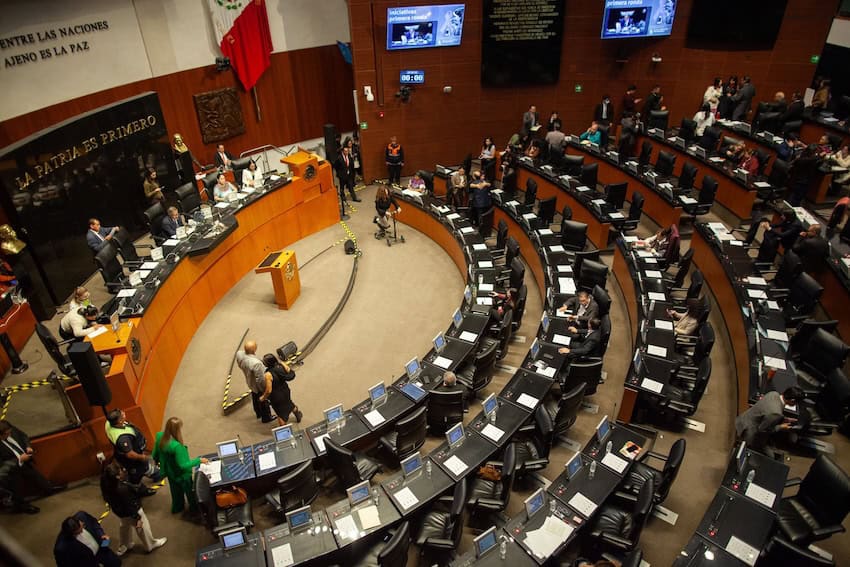
The Mexican Senate on Tuesday approved a bill to enact the Digital Economy Law for Digital and Electronic Payments, paving the way for a ban on cash payments at gas stations and highway tollbooths.
Seventy-three senators voted in favor of the bill while 34 senators voted against it. The bill was supported by the ruling Morena party, which controls both houses of Congress.
The Digital Economy Law will take effect after its promulgation by the federal government via publication in the Official Gazette of the Federation. President Claudia Sheinbaum submitted the bill to Congress and is expected to promptly sign it into law.
The law, approved by the Chamber of Deputies earlier this month, gives the federal Finance Ministry (SHCP) the authority to determine “the strategic sectors and relevant activities in which the acceptance of digital and electronic payment methods will be the only form of payment.”
Sheinbaum said in March that cash payments at gas stations and highway toll booths would be eliminated starting this year. She said on Wednesday that she expected government tax revenue would increase as a result of eliminating cash payments at gas stations and tollbooths.
While the law could enter into force as soon as this Thursday, it is not yet clear when cash payments at gas stations, toll booths and possibly some other locations will be eliminated. Morena lawmakers said that the transition will take place in an “orderly” fashion.
Unlike some other countries, cash is still widely used in Mexico.

Law aims to promote digital and economic payments across the economy
The federal Senate said in a statement that the aim of the Digital Economy Law for Digital and Electronic Payments is to “promote the adoption and implementation of these modes of payments in government procedures and in the purchase of goods and services.”
The law seeks to make digital and electronic payments more accessible to consumers, thus reducing the need for cash. It also seeks to encourage more businesses to accept digital and electronic payments, promote financial inclusion, combat tax evasion and increase traceability of transactions. Municipal, state and federal authorities will all be required to accept digital and electronic payments after the implementation of the law.
Morena Senator Emmanuel Reyes, president of the Senate’s Economy Committee, said Tuesday that the Digital Economy Law “establishes a framework of coordination” that allows authorities, financial institutions and other “participants in economic activity” to contribute to the broadening of access to digital and electronic payment methods.
The Senate said that the law seeks to make “new forms of payment” available to consumers, including payment through the use of “QR codes, near-field communication devices, debit and credit cards, direct deposits and transfers of funds, among other methods.”
The Senate also said that the law “incorporates the Digital CURP [identity code] and the Expediente Digital Ciudadano [a personal digital document file for government procedures] as trusted mechanisms for signing up for financial services.”
The law doesn’t ban cash payments at any businesses, but, as noted above, gives the Finance Ministry the power to ban them in “strategic sectors.” The SHCP will publish an initial list of the sectors that won’t be allowed to accept cash payments within 15 days of the law’s publication in the Official Gazette of the Federation.
The Senate noted that the law specifies that “the use of cash or checks” to pay for goods and services will be permitted in affected sectors if digital payment systems are temporarily unavailable for any reason.
Reyes: New law will benefit small and medium-sized businesses
Senator Reyes said that small and medium-sized business will have “the possibility of increasing their payment methods” as a result of the implementation of the new law.
He said that the adoption of digital and electronic payment methods will facilitate distance sales, reduce transaction times and aid the creation of “verifiable records” of businesses’ income.
Those records could allow financial institutions to have a better understanding of businesses’ “economic activity” and provide them with more information to evaluate the possibility of giving them a loan.
Last year, Sheinbaum signed an agreement with the Mexican Banking Association to boost credit access for small businesses, saying at the time that access to loans was a critical factor in stimulating economic growth. According to Reyes, the Digital Economy Law could further facilitate that access for both small and medium-sized businesses.
Opposition senator says new law promotes exclusion, not inclusion
Senator Francisco Daniel Barreda of the Citizens Movement party said that promoting the digitalization of payments is not a problem in itself.
“The problem,” he said, “is forcing” people to stop using cash by making digital and electronic payments “the only form of payment” accepted in some sectors.
“From a government office, the activities for which a person can no longer pay cash can be decided,” Barreda said.
“… One thing is giving people more options and another very different thing is taking people’s options away. That’s not [financial] inclusion, it’s digital exclusion,” he said.
National Action Party (PAN) Senator José Máximo García suggested that the government and ruling party are out of touch with the reality in Mexico, where cash is the most commonly used payment method.
“Morena is seeking to eliminate cash? What country do they live in? Which Mexico are they legislating for?” he asked.
García also said that “forcing” small and medium businesses to offer digital payment methods obliges them to connect to the internet, “rent a [payment] terminal” and pay bank commissions ranging from 1.5% to 4.5% of the value of each sale.
“… As a small business can’t absorb that cost, it will increase the price of eggs, milk and tortillas,” he said.
“Congratulations to the government! They invented digital inflation by decree,” García said.
The PAN senator also accused the government of “voracity” for tax income.
The law might have “a pretty wrapping of modernization” and “financial inclusion,” but it is in fact “tax collection voracity and [wolf-like] tax inspection in sheep’s clothing,” García said.
“… They’re coming to take the last centavos from people’s pockets,” he said.
Institutional Revolutionary Party Senator Claudia Anaya questioned the viability of the law given that 55% of workers in Mexico are employed in the informal economy — and thus are normally paid in cash — while millions of people don’t use the internet and a large number of adults don’t have bank accounts.
Morena Senator Gerardo Fernández Noroña sought to counter the criticism of the law by claiming that opposition lawmakers were defending “corrupt people who receive money in cash.”
With reports from Expansión, El Economista, El Financiero, Imagen Radio and Excélsior
