


Mexico is no stranger to surrealism. In fact, the surrealist Spanish painter Salvador Dali once proclaimed that the exuberantly spontaneous nation is more surreal than even his most imaginative works. You can see it all in Mexico: a beer-bellied Spider-Man climbing various objects in a plaza at midday to gain some coins; armies of dancing Dr. Simi’s on bustling corners; firefighters rescuing a cat from a tree while a nearby quinceañera proceeds below, uninterrupted. The Mexican internet has even dubbed it all as a cultural joke, often with the title “Mexico vs. AI” — that is, anything comical and or captured on video that represents Mexico’s seemingly fictional scenarios and people.
So, it’s not completely shocking when something like an entire beach community of residents believes that an underwater extraterrestrial spaceship is hiding offshore — and builds signage and monuments in their honor. But that’s exactly what has been going on in the northeastern state of Tamaulipas at Playa Miramar in Ciudad Madero, bordering on Tampico.
Are aliens protecting the city?
Rather than being a joke or a gimmick, it’s believed that the outer space visitors have protected the city from any significant hurricane damage since 1996, when the last major hurricane, Inez, killed 74 across Mexico and damaged Tamaulipas. Before that, multiple hurricanes, including two in 1933, had left the city flooded and devastated. But, tellingly, that hasn’t happened since reports of aliens emerged.
Amupac — the name that has been given to the alleged alien base that is believed to be submerged less than one mile from the beachhead — is a symbol of regional optimism and hope that dates back more than half a century. The Association of Scientific UFO Research of Tamaulipas, or Aicot, was founded over a decade ago by Juan Carlos Ramón López Díaz, the group’s leader, who says he “visited the base … via astral projection,” according to a report in The Guardian. Today, they continue to promote their beliefs around it, and there are rumblings of a potential UFO museum on the horizon.
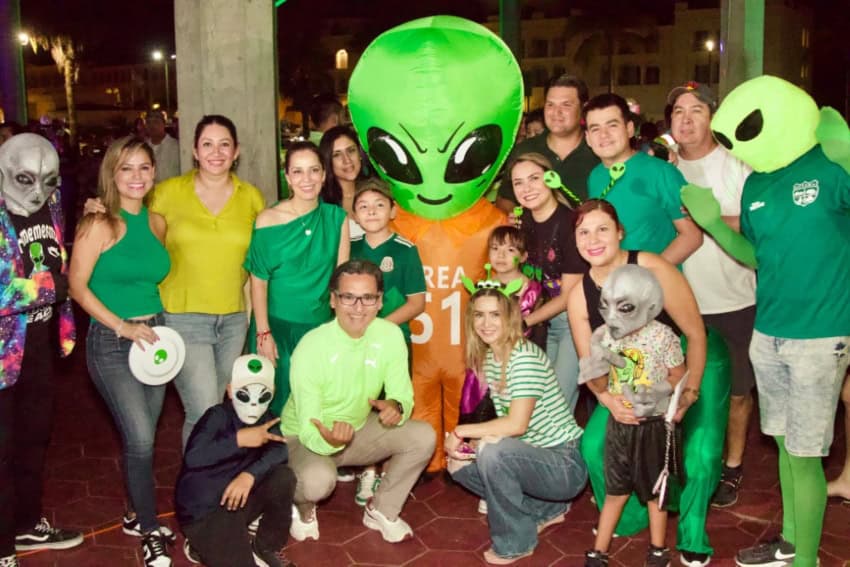
Last October, Marciano Fest, a seven-day alien-themed festival, took place with 947 costumed attendees. The city’s tourism director has announced that the local government is open to proposals for UFO museum exhibits in an effort to increase its alien-loving reputation.
A history of alien sightings and conspiracy theories
Formal documentation of UFO sightings (or OVNI, for Objeto Volador No Identificado, in Spanish) can be traced to as early as 1967, when “thousands” of residents reported nine unidentified flying objects in an article published in El Sol de Tampico. In recent years, Vice has interviewed community elders like Beatriz García, who adamantly claim that the beach is protected by an unknown extraterrestrial force. Vice shared that in 2022, Tropical Storm Karl “took a sharp turn away from that part of the shoreline, and connected further south on the Gulf Coast of Mexico.” (To be fair, Vice did also speak with a coastal meteorologist who debunked it all).
In 2005, with Hurricane Katrina projected to hit, locals gathered with signs asking for help and protection. Katrina famously then veered off course and significantly damaged New Orleans, Louisiana. There are conflicting theories as well that are based in religion and science, two forces that are historically at odds with each other.

An emblem of regional identity
Beyond the lore, debates, and conspiracy theories, though, one thing is certainly true: the community has rallied around it all and turned it into a prideful emblem of the region, replete with statues, signs, costumes, graffiti, restaurants, conferences and more — all centered around Amupac and its otherworldly inhabitants.
It all adds to the ongoing allure of Mexico, which in and of itself often appears to exist in a different dimension altogether. That’s because there aren’t too many destinations in the world where you can speak with a local beachgoer and his nephew who are dressed up as aliens, then cross the street and get tacos and a beer at an alien-themed eatery, all while soaking up the sun and enjoying your time in the most surreal fashion.
Alan Chazaro is the author of “These Spaceships Weren’t Built For Us” (Tia Chucha Press, 2026), “Notes from the Eastern Span of the Bay Bridge” (Ghost City Press, 2021), “Piñata Theory” (Black Lawrence Press, 2020), and “This Is Not a Frank Ocean Cover Album” (Black Lawrence Press, 2019). He is a graduate of June Jordan’s Poetry for the People program at UC Berkeley and was selected as a Lawrence Ferlinghetti Poetry Fellow at the University of San Francisco. His work can be found in NPR, The Guardian, SLAM, GQ, L.A. Times, and more. He is currently based in Veracruz.
