


President Trump has warned that “Economic D-Day” is coming for Iran. This weekend, Tehran promised to fight back, threatening any nation that helps the United States.
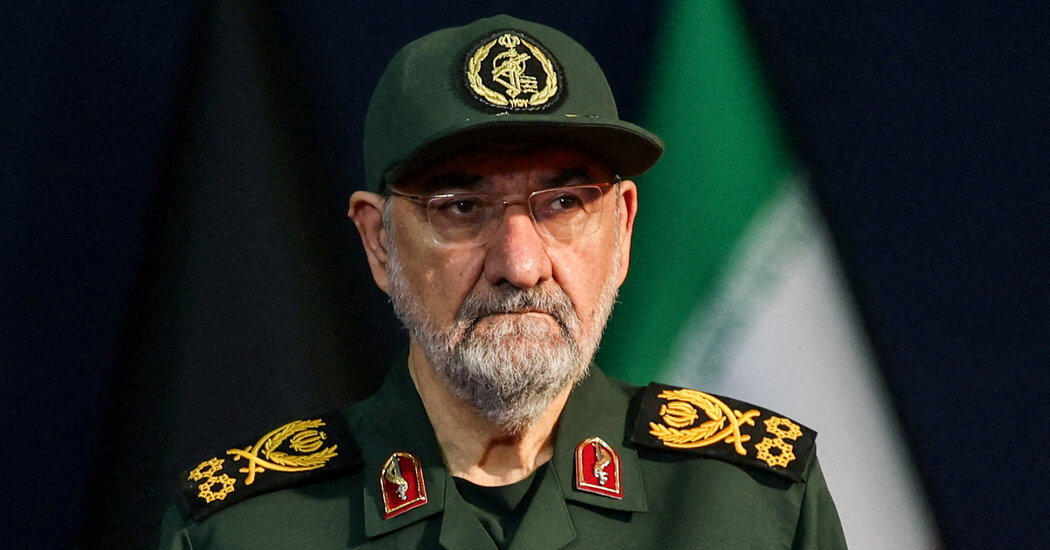
Iran’s new security chief, Mohsen Rezaei, on Saturday vowed to strike the interests of oil-rich neighbors if they joined U.S. efforts to further isolate Iran, whose economy is already in free fall. He warned that Tehran would seek to prevent “even a single drop of oil” from leaving the region.
“Any country that becomes a partner in creating economic restrictions against us will be regarded by us as an enemy,” he said in an interview with Iran’s state broadcaster.
Mr. Razaei is a political hard-liner and former head of the Revolutionary Guards. The interview offered his first extensive comments since taking up his new post two weeks ago — and struck an aggressive tone in line with Iran’s increasingly uncompromising regional strategy. At one point, he asked whether Iran should pursue building a nuclear bomb, which Tehran has previously insisted it has no intention of doing.
Iran’s new leaders, who replaced comparatively more cautious figures killed by the U.S. and Israeli bombardment this year, are “changing the deterrence equation from purely defensive measures to an offensive approach in all spheres,” including the economy, said Mohammad Ghaderi, a Tehran-based foreign affairs expert.
“Tehran is seeking to impose greater costs on the United States and its allies,” Mr. Ghaderi said. “This conveys the message that the cost of continuing hostility toward Iran will have far more extensive consequences for Washington and its allies than in the past.”
Though active military hostilities have ebbed, Iran and the United States remain locked in an economic standoff. Mr. Trump, who imposed a naval blockade of Iran, has now threatened “tremendous economic consequences” on any nation doing business with Tehran. His treasury secretary, Scott Bessent, is expected to announce the U.S. economic plan against Iran on Monday.
Iran is continuing to disrupt the global economy by blocking traffic through the Strait of Hormuz, a vital waterway for oil and gas exports from the Persian Gulf. It refuses to relent until a deal is reached with Washington that offers it access to frozen assets and relief from the sanctions Mr. Trump now looks set to try to expand.
Oil-producing countries seeking to extricate themselves from the regional showdown have spent billions in recent months to expand pipelines and other infrastructure to keep exports flowing. Saudi Arabia, for instance, reduced its reliance on the strait by pumping much of its oil through a pipeline and loading it onto tankers in the Red Sea, while Iraq has been pumping more oil through pipelines to Turkey, or trucking it for export from neighboring Syria.
Mr. Rezaei said Iran would first seek to negotiate with countries perceived to be joining the U.S. pressure campaign. But if that failed, he said, Iran would move to block oil not only through the strait, “but from the Persian Gulf at all.”
“Countries cannot join America in imposing an economic blockade and harm our interests while we continue allowing oil to leave the Persian Gulf,” he said, noting that Iran was not currently interfering with oil leaving through other routes, “but we will target those routes as well.”
When the war with the United States and Israel began, Iran quickly moved to expand the confrontation to regional countries that host American bases, targeting neighboring Gulf countries with volleys of drones and missiles. More recently, it launched a deadly strike on a U.S. base in Jordan, and groups allied to Iran are thought to be behind recent attacks that hit energy infrastructure in Saudi Arabia and Egypt.
Mr. Rezaei’s comments signaled that Iran may aim to continue this more aggressive approach even as the Trump administration shifts its focus to the economic realm from the military.
“Iran’s overall economic isolation has made it more dependent on its neighbors like the U.A.E. and Iraq than the other way around. But Rezaei’s comments are meant to indicate that the fates of the regional countries are also bound with Iran,” said Esfandyar Batmanghelidj, who heads the Bourse & Bazaar Foundation, a London-based think tank focused on Iran’s economy.
Last week, Mr. Bessent warned of “never before seen” U.S. measures, which some analysts suggest may include imposing sanctions on countries buying Iranian oil or imposing more penalties on financial transactions with Iran.
Economic warfare is not new to Iran, which already came under “maximum pressure” during the previous Trump administration and has faced some form of U.S. sanctions since the Islamic Republic was founded in 1979. But this time, Iran’s economy faces one of its most severe crises yet. Iranian critical infrastructure has been deeply battered by the war. That, in combination with the U.S. blockade, has cut Iran’s energy production by 15 to 30 percent, according to Mahdi Ghodsi, an economist at the Vienna Institute for International Economic Studies.
Even before the conflict started, a plunge in the value of the Iranian rial sparked nationwide protests that security forces ultimately quashed by killing thousands of people. The currency’s value has been devalued a further 40 percent since then.
Since the war began, the country has been grappling with soaring food prices and skyrocketing unemployment that have put everyday food items increasingly out of reach for more Iranians. Iran’s central bank governor, Abdolnaser Hemmati, said last week that Iran’s oil exports had fallen to “close to zero.”
In recent weeks, the government has been trying to find a way to respond to a growing fuel crisis, partly caused by damaged infrastructure and slowed imports under the U.S. maritime blockade. The government is struggling to provide the subsidized gasoline prices Iranians rely on, wary of making changes that could spark unrest.
Now, Mr. Trump’s threats could increase the economic stranglehold Iran faces from neighbors and critical trading partners.
Earlier this week, the United Arab Emirates halted all its trade and financial transactions with Iran, a decision that could hurt Iranian importers’ ability to pay for goods through financial services provided by the Emirates.
If another critical trade partner like neighboring Turkey follows suit, the consequences would be dire, Mr. Ghodsi said. He estimated that inflation in Iran was now at 90 percent, a level he said had no precedent in Iran’s modern history.
“This is an extension and expansion of war, until Iran reaches an agreement with the U.S.,” he said. “ And it’s going to be worse for Iran than for the regional or global economy.”
Iran’s moderate president, Masoud Pezeshkian, said Sunday that Iran was in a “full-scale economic, military and security war,” adding that his government was trying to find ways to counter the growing economic pressures.
“We have stood firm and are trying to be servants of the people in the face of this unequal war,” Mr. Pezeshkian said in a speech.
Unlike Iran’s hard-liners, Mr. Pezeshkian has called for a return to diplomatic negotiations with Washington, arguing that Iran should act while it has a strong strategic hand.
In his television interview, Mr. Rezaei urged the public to “launch an economic jihad.” Iranians should reduce their reliance on state subsidies and imports, he argued, and increase self-sufficiency through local production.
“Every home can become a launcher in the economic war,” he said. “Every neighborhood can become a missile base in the economic war.”
Sanam Mahoozi contributed reporting
