


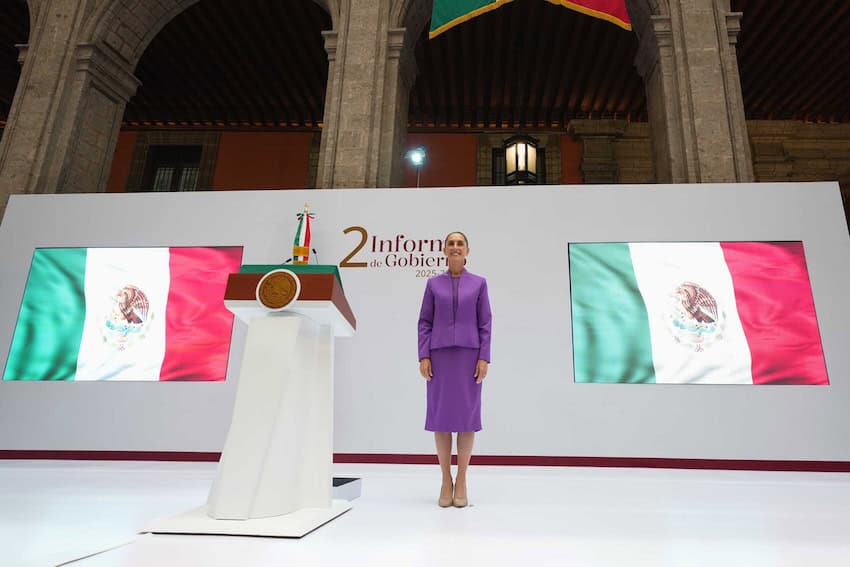
One month shy of completing her second year in office, President Claudia Sheinbaum on Tuesday delivered her second annual report in a 67-minute speech, a wide-ranging and optimistic address that covered government achievements across areas including the economy, security, infrastructure and healthcare.
“I appear before the people of Mexico nearly two years after assuming the presidency of the republic. I do so with the certainty that we are transforming public life in this country,” Sheinbaum said at the beginning of her speech, delivered at the National Palace in the historic center of Mexico City to an audience that included high-ranking federal and state officials as well as Mexican business leaders.
Segundo Informe de Gobierno. Palacio Nacional
— Claudia Sheinbaum Pardo (@Claudiashein) September 1, 2026
Early in her address, the president declared she was “convinced” that Mexico is on “the path to shared prosperity, with independence, freedom and a lot of dignity.”
“We have governed with integrity and republican austerity,” Sheinbaum said.
“We are fully aware that public resources belong to the people and must be used for their benefit. … The economic power was separated from the political power and we govern honestly,” she said.
Sheinbaum is approaching the completion of her second year in office with an approval rating of 68%, according to the newspaper El Financiero’s latest national poll, and an MND Sheinbaum Index™ score — to be published this Wednesday — of close to 70 out of 100.
However, her popularity as president doesn’t insulate her from a range of challenges and difficulties she faces as the leader of a nation of some 130 million people that, for better or for worse, neighbors the United States, the world’s largest economy — and the world’s largest consumer market for illicit drugs.
Sheinbaum faces ongoing security challenges — particularly in states such as Guanajuato and Sinaloa — and frequent pressure from the Trump administration to do more to combat Mexico’s notorious drug cartels. She faces economic challenges, such as low productivity and high labor informality, amid uncertainty about the future of the United States-Mexico-Canada Agreement (USMCA). She faces domestic and external pressure related to drug trafficking accusations against ruling Morena party officials. She faces ongoing claims that she is turning Mexico into a more authoritarian, less democratic nation. Meanwhile, the U.S. tourist visas of more than 50 Morena officials, including that of one of ex-president Andrés Manuel López Obrador’s sons, have been revoked. The list of challenges and difficulties faced by Mexico’s first female president goes on.
On Tuesday, however, Sheinbaum focused on the positives, and declared at the end of her address that “we” — i.e., Mexico and her administration — are “doing better” now than before, as she said would occur in her inaugural government report a year ago. She also said that Mexico has a clear path forward “set” by the Mexican people.
Below is a recap of Sheinbaum’s second annual report, or “segundo informe de gobierno,” as it is called in Spanish.
The economy
“Even in these difficult conditions, the Mexican economy remains stable and continues to grow.”
Sheinbaum said that in her almost two years in office, Mexico has faced “difficult international circumstances, marked by a change in the tariff policy of the U.S. government.”
“In particular, [U.S] tariffs on vehicles, steel, aluminum, and their derivatives, as well as the war in Iran, which drove up international oil prices, have created difficult circumstances for our country and for the entire world,” she said.
“Even in these difficult conditions, the Mexican economy remains stable and continues to grow,” Sheinbaum said.
She subsequently presented various data points to support her statement. They included that:
Sheinbaum also highlighted that the federal government’s revenue reached a record high of more than 6.4 trillion pesos (US $376.76 billion) last year. She said that tax income has continued to increase in 2026.
Sheinbaum also said that Mexico’s monthly minimum wage has increased “154% in real terms” since 2018 to reach 9,582 pesos (US $564) in 2026.
“On the northern border, the minimum wage stands at 13,409 pesos per month. The average wage in the formal economy reached an all-time high of 20,212 pesos per month, the highest on record,” she said.
“As a result, in-work poverty in 2026 is at its lowest level since 2005.”
Plan Mexico
“Twenty-five of the 100 industrial parks we announced are already in operation.”
Sheinbaum noted that early in her six-year term, she presented Plan Mexico, an ambitious economic initiative with 13 goals, including making Mexico the 10th largest economy in the world by 2030, increasing domestic manufacturing production and cutting red tape for investment projects.
“Two decrees with incentives for private investment were published,” the president said before highlighting that 10 of 25 “Economic Development Hubs for Well-Being” for which private investment was sought are now under development.
“Twenty-five of the 100 industrial parks we announced as a goal are now in operation,” Sheinbaum added.
“In addition, we established the Presidential Office for Investment Promotion, which operates a one-stop shop that approves [investment project] applications within a maximum of 60 days. Through this, 19 projects totaling US $3.76 billion have been approved in four months,” she said.
“In addition, 60% of the bureaucratic procedures [for new investments] have been simplified or eliminated, requirements have been reduced by 66%, and the average response time has been cut by 50%,” Sheinbaum said.
CCE: Mexico’s streamlined investment process has spurred US $3.5B in new business
Welfare programs
“We have a duty to support those who for a long time were forgotten.”
The Sheinbaum administration has maintained all the welfare, social and employment programs launched by the government led by ex-president López Obrador, and added new ones, including educational scholarship schemes and cash transfers for women aged 60 and over.
The president said on Tuesday that the government’s welfare programs are “an expression of the conviction that nobody builds a nation alone.”
In a jab at pre-2018 governments, she also said that “we have a duty to support those who for a long were forgotten” — i.e., Mexico’s most disadvantaged people.
Mexico’s welfare programs are based on and draw from Mexican humanism, from a simple but powerful idea,” Sheinbaum said.
That idea, she said, is that “the wealth of Mexico must translate into well-being for its people.”
“A pension for a senior, a scholarship for a student or support for those who work the land aren’t concessions from power, but rather a way of recognizing the dignity and effort of millions of Mexicans,” Sheinbaum said.
She said that welfare programs will benefit almost 43 million Mexicans in 2026, “with a historic investment of one trillion pesos (US $58.85 billion).
Healthcare
“We are reversing the damage caused by decades of neglect in the area of health care.”
Sheinbaum said that when a “fourth transformation” (i.e., Morena) government first came to power in Mexico in 2018, a “profound deterioration in Mexico’s public health system” was evident.
She went on to claim that Morena governments are “reversing the damage caused by decades of neglect in the area of health care.”
Sheinbaum said that “in just two years” of her administration, 33 new public hospitals and 47 public healthcare centers have opened. She noted that her government is aiming to add 9,000 beds to the public health system by 2030.
“To ensure the timely supply of medications and medical supplies, we make consolidated purchases directly from suppliers. We also created the ‘Rutas de la Salud’ program for medical facilities and hospitals in the IMSS Bienestar system, through which 2 billion items have been distributed,” Sheinbaum said.
“No hospital that treats cancer lacks medications,” she asserted.
Infrastructure
“We’re recovering the passenger train network, hallmark of the fourth transformation.”
Sheinbaum enumerated infrastructure projects her government has completed, including highways and “70 bridges and interchanges.”
“… We doubled the budget for artisanal [hand-built] roads, and together with Indigenous communities we’ve built 135 roads measuring 368 kilometers,” she said.
Sheinbaum also highlighted that her government completed passenger train lines between Mexico City and Toluca and between Mexico City and the Felipe Ángeles International Airport. She noted that her administration is building various other railroads across Mexico. The president asserted that her government is “recovering the passenger train network” in Mexico, and said that doing so is a “hallmark of the fourth transformation” political movement she leads.

Sheinbaum also said that 2 million tonnes of freight have been transported on the Isthmus of Tehuantepec’s Interoceanic Railroad, on which two derailments — including a fatal one — have occurred during her government.
She said that her government is modernizing “hydro-agricultural infrastructure across more than 250,000 hectares, which will increase productivity on farms and at the same time release water for human consumption.”
Sheinbaum also spoke about various other water projects, including dams, aqueducts and the desalination plant set to be built in Rosarito, Baja California.
In addition, she said the government is “modernizing seven ports” and “11 international airports,” including those in Mexico City, Puerto Escondido and Tepic.
Security
“We’ve achieved a 51% reduction in homicides.”
Sheinbaum said that “the peace and tranquility of families” are a top priority for her government.
“Thousands of National Guard members, soldiers, marines, security agents, and public servants work every day on the four pillars of the National Security Strategy,” she said, highlighting that those pillars are attention to the root causes of crime; consolidation of the National Guard; strengthening of intelligence and investigative practices; and enhanced coordination between federal and state authorities.
“The results speak for themselves,” Sheinbaum asserted before declaring that “we’ve achieved a 51% reduction in homicides since we took office.”
She was referring to the reduction in homicides in July 2026 compared to September 2024, the final month of López Obrador’s presidency. The annual decline in murders in the first seven months of 2026 was a more modest, but still significant, 30.8%.
Mexico in Numbers: A 2025 security snapshot
Sheinbaum also said that the incidence of high-impact crimes — such as murder, violent robbery, kidnapping and extortion — is down 54% so far this year compared to 2018. She highlighted that some 63,000 people were arrested for allegedly committing high-impact crimes between October 2024 and July 2026.
Sheinbaum said that 207 of those people were “priority targets from all the organized crime groups.”
In addition, Mexican security forces have killed high-profile criminal leaders, including Jalisco New Generation Cartel kingpin Rubén Nemesio “El Mencho” Oseguera Cervantes, who was fatally wounded in a military operation in Jalisco in February.
Sheinbaum noted that authorities have seized 32,824 firearms and 519 tonnes of drugs during her presidency, and dismantled 2,725 clandestine drug laboratories.
Mexico-US relations
“Our relationship with the U.S. government has had its challenges, but we’ve made the decision to always seek understanding.”
Toward the end of her address, Sheinbaum turned her attention to the relationship between Mexico and the United States, a relationship that has been strained by trade and security tensions.
After outlining Mexico’s constitutionally enshrined foreign policy principles, including that of non-intervention in the affairs of other countries, the president said:
“In this context, I would like to highlight our relationship with the U.S. government, which has had its challenges, but we’ve made the decision to always seek understanding.”
Sheinbaum didn’t mention the CIA’s alleged participation in a drug lab raid in April without the knowledge or authorization of her government. Nor did she refer to U.S. prosecutors’ drug trafficking accusations against Sinaloa Governor Ruben Rocha Moya and various other current and former officials. Sheinbaum has previously characterized those things as examples of U.S. interference in Mexican affairs. However, on Tuesday, she limited herself to reiterating her commitment to defending Mexican sovereignty.
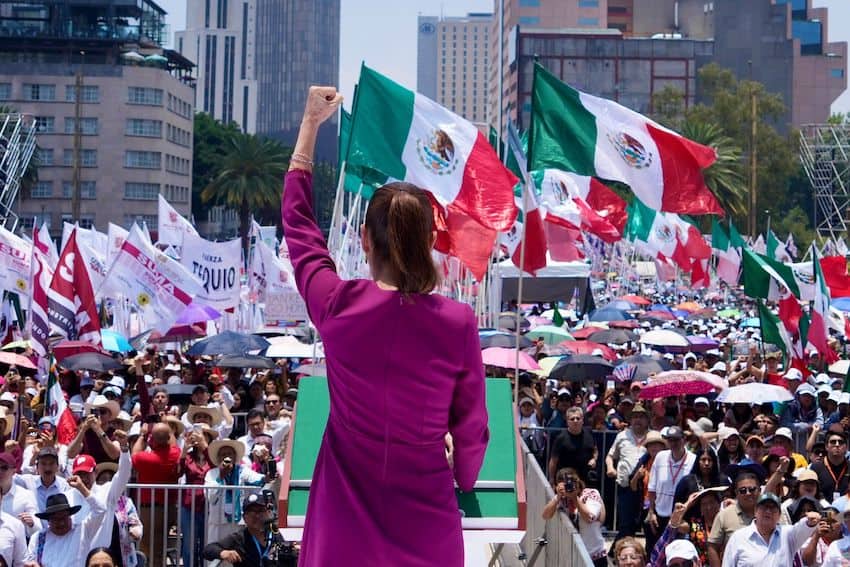
“Mexico is a sovereign country and sovereignty isn’t negotiated, handed over or shared,” said Sheinbaum, who has maintained a respectful relationship with U.S. President Donald Trump despite the disparaging remarks he has made about her, including claims that she is “afraid” of Mexican cartels.
She said that “perhaps one of the most painful aspects” of the relationship with the United States “has been the treatment Mexicans have received” while under the custody of U.S. Immigration and Customs Enforcement (ICE). She noted that 17 Mexicans have died in ICE custody or during ICE operations since Trump returned to the White House in January 2025.
“In response, … we decided to file complaints … and we will follow up on them and demand that the human rights of our compatriots be fully respected,” she said.
Exactly two months after the U.S. government announced that it had declined to renew the USMCA “in its current form” for an additional 16 years, Sheinbaum said that dialogue with the Trump administration on trade issues is ongoing, “and we hope to reach an understanding.”
Despite the U.S. government’s decision to not renew the USMCA, the free trade pact remains in force. In 2026, Mexico has consolidated its position as the top exporter to, and top trade partner of, the United States.
10 more things
During her second government report speech, Sheinbaum also said that:
- Her government has held 475 mañaneras, or morning press conferences, “as a permanent exercise of information, dialogue, debate and right of reply.”
- She has traveled 84,407 kilometers by air during her presidency and 20,000 kilometers overland, “visiting communities and regions of the 32 entities of the republic.”
- The government’s electric vehicle, Olinia — of which prototypes of two models have been presented — is entering the “production phase.”
- The Coatlicue supercomputer project has begun.
- The federal government created the Bachillerato Nacional (a nationwide high school program), “with the objective of unifying all of the country’s high schools and technical schools under the same educational umbrella.”
- In 2026, Mexico achieved its best-ever result at the Central American and Caribbean Games.
- The government is aiming to build 1.8 million homes for low-income families by 2030.
- The government has provided 25 billion pesos (US $1.47 billion) in direct funding to 19,000 Indigenous and Afro-Mexican communities.
- 32,000 additional megawatts of electricity will be added to the national grid by 2030 and renewable energy’s share of generation will increase from 24% to 38%.
- Pemex’s debt has declined by US $20 billion during the current government.
‘Mexico is strong, it has extraordinary people’
In her closing remarks, Sheinbaum said that “in these 23 months of great changes, we’ve shown that Mexico is strong and has extraordinary people.”
“… We are part of the project of the fourth transformation of public life,” she said.
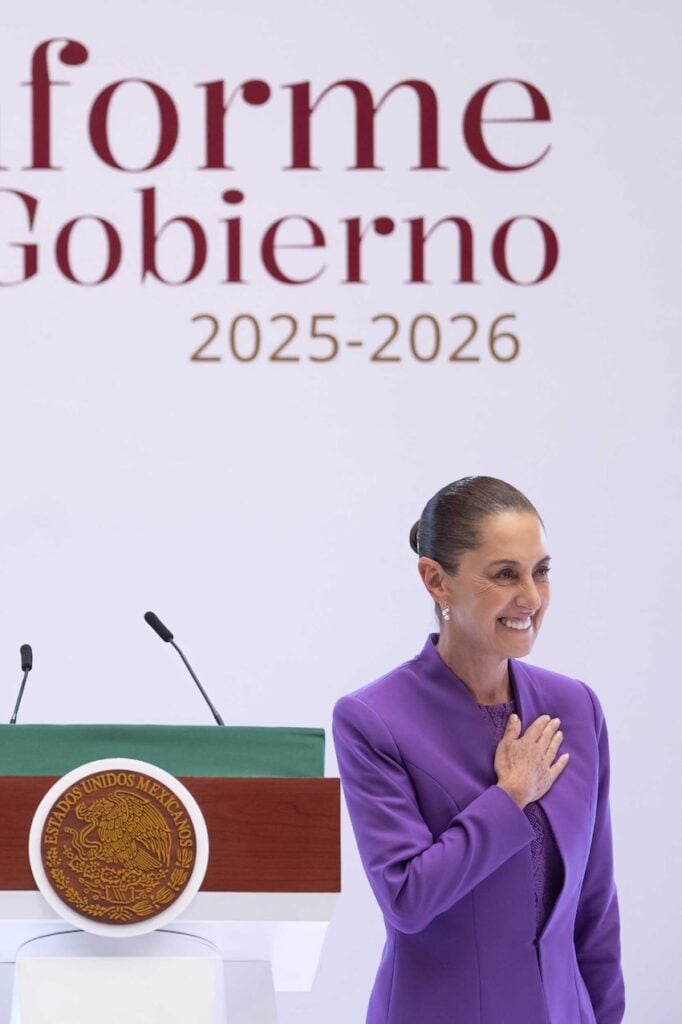
“Let no one be mistaken — here there are no divisions, there are no ruptures,” Sheinbaum said, dismissing claims that there are rifts within the ruling Morena party.
“The only thing there is is the defense of the people of Mexico and their dignity,” she said.
Sheinbaum asserted that “the eyes of the world are on Mexico because here a great people has decided to write their own history.”
“We are strengthening a project that grew from the grassroots and which places equality, justice and well-being at its center,” she said.
“… Mexico is free and sovereign and is advancing with dignity, with the strength of its people and with our eyes set on a future that stems from our legacy of greatness,” Sheinbaum said.
By Mexico News Daily chief staff writer Peter Davies (peter.davies@mexiconewsdaily.com)
