


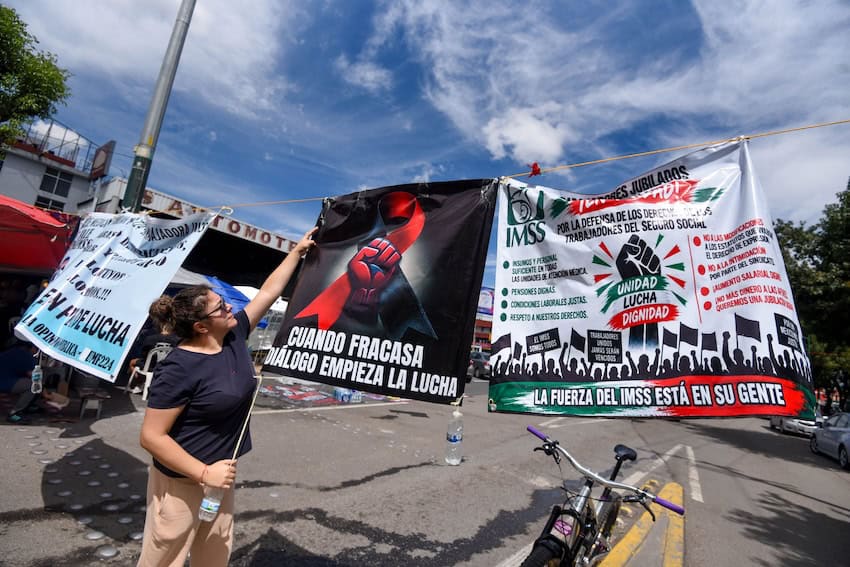
Disgruntled healthcare workers will take to the streets of Mexico City again this Wednesday, eight days after participating in a large protest march to demand higher pay, better working conditions, increased funding for healthcare and an end to shortages of medicines and medical supplies.
Current and former Mexican Social Security Institute (IMSS) workers agreed to hold another march at a meeting in the capital on Sunday.
“La Gran Marcha en CDMX” (The Great March in Mexico City) will set off from the Siglo XXI National Medical Center on Cuauhtémoc Avenue in the Doctores neighborhood at 3 p.m. on Wednesday. The endpoint has not been defined, but it appears likely that workers will once again march to the IMSS offices on Paseo de la Reforma, where a protest camp was set up 10 days ago.
At Sunday’s meeting, held outside the IMSS offices, IMSS workers called on social organizations, other workers and citizens in general to join their march this Wednesday, according to the news magazine Proceso.
They also called on IMSS workers to protest in other states around the country, as occurred last Tuesday.
The IMSS workers have a range of demands, including a 10% pay rise; the adequate supply of medications and medical supplies in IMSS hospitals and clinics; the hiring of additional healthcare personnel in order to ease excessive workloads; the allocation of resources equivalent to 7% of GDP to healthcare; changes to their pension system; and the resignation or dismissal of Rafael Olivos Hernández, head of the National Social Security Workers Union.
In addition to organizing another march on Wednesday, IMSS workers will hold a press conference this Tuesday at the same time as President Claudia Sheinbaum’s morning presser (mañanera) at the National Palace.

According to the workers, at the press conference — dubbed the IMSS resistance mañanera — representatives of their protest movement will present “verifiable information about the real state of [IMSS] medical facilities, [their] operational deficiencies and the status of our demands.”
Sheinbaum said last week that IMSS workers’ “legitimate demands” are being addressed. She said that IMSS director Zoé Robledo had been instructed to draw up an “action plan” to “immediately” address “all the legitimate demands of IMSS workers.”
On Monday, she said Robledo’s ongoing tenure at the helm of IMSS was “not in doubt.”
Sheinbaum also said the IMSS healthcare system is “better” now than it was “before,” asserting that the current situation is not comparable to that when Mikel Arriola was director of the social security institute and public healthcare provider during the presidency of Enrique Peña Nieto (2012-18).
Sheinbaum pledges to ‘completely modernize’ Mexico’s public healthcare system
During an address in Umán, Yucatán, on Saturday, Sheinbaum pledged to “completely modernize” Mexico’s public healthcare system, which includes services provided by IMSS, the Institute for Social Security and Services for State Workers (ISSSTE) and IMSS Bienestar, which treats patients without social security coverage.
“I already put together a team to completely modernize the healthcare system,” she said.
“… We have to provide results, … and I’m sure we’re going to improve the healthcare service every day,” Sheinbaum said.
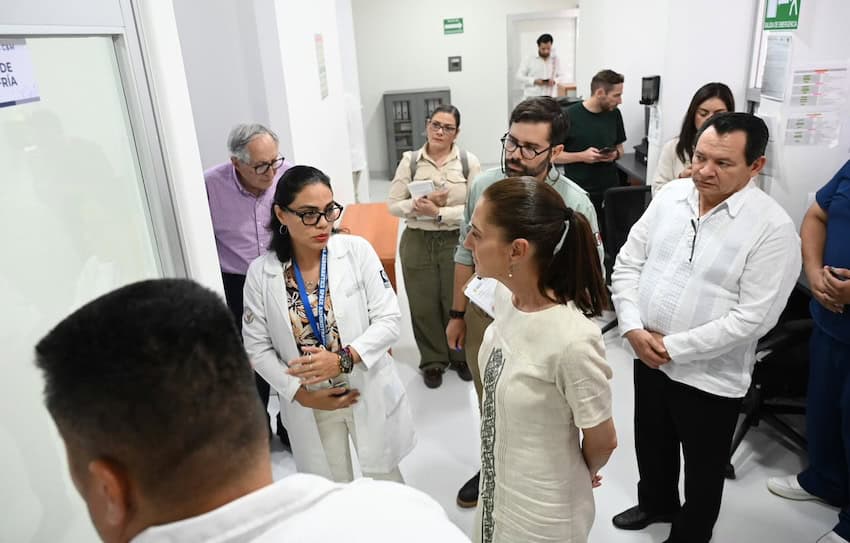
“Resources aren’t lacking, money isn’t lacking, but we have to improve the way we’re working because a lot of processes come from 50 or 60 years ago and they haven’t been updated,” she said.
Sheinbaum once again acknowledged that there are problems related to the distribution of medicines to public healthcare facilities, but stressed that her government is working to resolve them, as well as staffing shortages.
“We’re hiring [more] doctors and nurses and guaranteeing the supply of medications,” she said.
Earlier this month, Sheinbaum noted that her government was preparing to launch Mexico’s Universal Health Service on Jan. 1, 2027.
“From Jan. 1, some services are going to be universal and we’re going to increase the [universal] services so that at the end of the six-year term of government, you can go to any healthcare center, doctor’s office or hospital regardless of which institution you are a beneficiary of,” she said on Oct. 6.
Sheinbaum said the “first step” in the process toward the commencement of the Universal Health Service is the issuance of universal healthcare cards. Those cards are currently being issued to seniors ahead of their rollout to younger Mexicans and eligible foreigners.
With reports from La Jornada, Proceso, Latinus and EFE
