


October: a month in the midst of the year’s second transitory season, a time signaling the beginning of the darker half. A world painted in the autumnal palette of ochre, umber, sienna, and cadmium. Days are spent indoors as the coldened drizzle comes down outside, watching myriad falling leaves spiral to the dampened ground. Something stirs within the depths of the mind. The imagination smolders and sparks, one’s mood turns somber, reveling in the funereal tone set by approaching Samhain. And as is inevitable, we are intrinsically drawn to the darker side of art – like so many moths to candle flame.
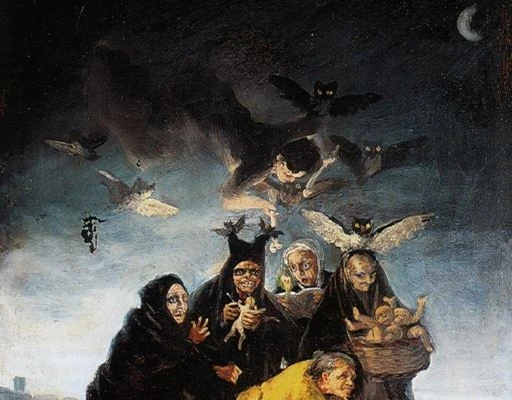
Francisco Goya, The Incantation (El conjuro), 1797-1798, oil on canvas, Lázaro Galdiano Museum, Madrid
In an overcast sky, beneath a parliament of owls, a coven of witches congregates on a desolate clifftop, in the throes of mirthful malevolence. As an innocent cowers in futile supplication at their cloaked feet, each bruja in the hexad plays her malicious part in the conjuring. One chants from the pages of a grimoire; another clutches a basket of squirming babies, a third – a pair of bats adorning the points of her hood – sticks pins into a doll. A fourth gesticulates as she utters the incantation. The elder, draped in a golden cloak and ostensibly blind, reaches her misshapen hands to the unwilling sacrifice. Perhaps most interestingly, the sixth is upon nocturnal wing, seemingly mid-transformation from strigid to sorceress. She holds a pair of bones in her pallid hands, as if she were keeping time for the perverse carol.
Goya’s El conjuro belongs to a series of “six works on the theme of witches” purchased by the Dukes of Osuna in the summer of 1798 for their newly constructed palacio in the Madrilenian barrio of La Alameda. It is oft theorized that the pieces, which included the famed Witches’ Sabbath, were painted at the behest of the Duchess.
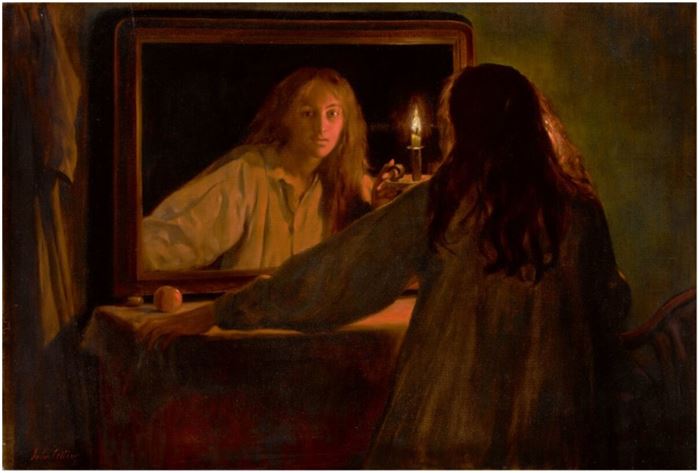 John Collier, All Hallowe’en, 1895, oil on canvas, private collection
With candle burning down in its holder, clad only in a nightshirt, a young lady gazes at her wide-eyed reflection in the surface of a mirror. Her disheveled hair hints at being recently roused from the throes of sleep, as if perhaps woken by a particularly haunting dream, or by a strange sound somewhere in the nocturnal house. But our subject is not merely admiring her pretty countenance, she is in reality performing an occult practice known as mirror gazing.
An ancient form of divination popular during the Victorian era, mirror gazing, also known as catoptromancy, involves staring at one’s reflection in a mirror’s surface until images appear that do not exist upon the earthly realm. These ghostly echoes are then interpreted by the gazer.
While not possessing the voluptuousness found in the majority of Collier’s better-known works, All Hallowe’en certainly conjures an apt mood for late October and may serve to pique the interest of the aspiring occultist.
