

The Korean art market grew by 3.8% year-on-year in 2025, approaching USD 500 million (KRW 638.2 billion), according to the 2026 Art Market Survey by the Ministry of Culture, Sports and Tourism (MCST) and the Korea Arts Management Service (KAMS). The figures point to a more selective market: the number of artworks traded fell by 3.1% from the previous year, while the average value per work rose by 7.1%. The growth marks a rebound after two consecutive years of decline, although the market remains 20.9% below its 2022 peak, highlighting the potential for further recovery in Asia’s fourth-largest economy.
South Korea’s art market is increasingly following its own trajectory, supported by a distinctive network of local stakeholders. Private collectors range from chaebol families, whose long-standing engagement with art includes major museum and private collections, to a younger generation of entrepreneurs and celebrities. Seoul remains the country’s dominant art-market center, but it is not the only one. Growing institutional activity across the country, including on Jeju Island, alongside established collector bases, particularly in Busan and Daegu, is contributing to the development of a more mature national ecosystem.
The art market also benefits from a relatively favorable tax environment. Original artworks, including paintings, drawings, prints and sculptures, are generally exempt from customs duty and import VAT when classified as genuine works of art, contributing to the country’s openness to international art. This balance between national and international artists can be seen across current exhibitions in Seoul. Highlights include Lee Kang-So at LOTTE Museum of Art, Yoo Youngkuk at Seoul Museum of Art, Georg Baselitz at Sehwa Museum of Art, and Martin Parr at the Photography Seoul Museum of Art. The newly opened Park Seo-Bo Museum presents Huong Dodinh in dialogue with Park Seo-Bo, further illustrating the dialogue between Korean and international art.
The arrival of Frieze Seoul in 2022 accelerated these international connections. Bringing together more than 125 leading galleries from 30 countries in 2026, it has strengthened its regional reach, with more than 70% of participants based across the Asia-Pacific region. The fair has also deepened its complementarity with its partner fair, Kiaf, and its links with the local scene, including more than 50 exhibitors with permanent spaces in Seoul. Additionally, since opening in September 2025, Frieze House Seoul has provided a permanent space for exhibitions developed in collaboration with galleries. Meanwhile, Design Miami Seoul returns for its second edition in collaboration with the Seoul Design Foundation, extending the market’s reach into design while promoting Korean talent.
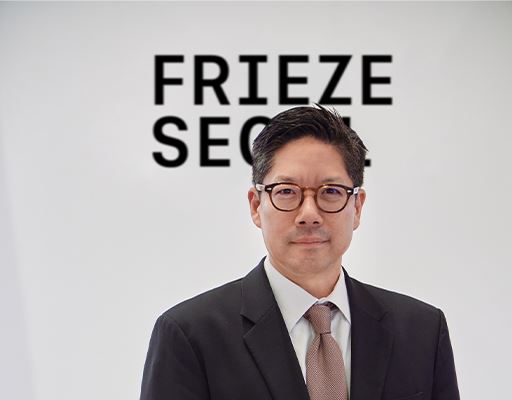
Korean artists are increasingly gaining international visibility. Their growing momentum was evident at Frieze New York last May, where Korean artists proved particularly popular with buyers. Looking ahead, the Korean market’s evolution as a trend-setting cultural platform will be worth watching. Having led Frieze Seoul since its launch, Patrick Lee shares his views on the art market just days before the country’s most important art week of the year.
Patrick Lee, Frieze Seoul, Director. Photo by WeCap Studio. Courtesy of Frieze
RJ: What makes the Korean market competitive compared with other East Asian markets?
PL: South Korea is a favorable place to transact and is generally business-friendly. It is easy to remit funds, has strong logistical infrastructure for the art community, and has favorable policies on tax and customs. I expect the business climate to remain this way, continuing to make Korea one of the most straightforward markets in the region to buy and sell in.
RJ: What about the strength of its art ecosystem?
PL: Korea has a strong arts infrastructure, and this includes art fairs. Korea has a varied landscape that caters to a broad array of constituencies, which, ultimately, is good for Korea’s galleries and artists overall. The best fairs have a focus and identity. Our focus stays on what we do well, and on giving space to Korean and regional voices within an international fair.
RJ: Which international markets are the most dynamic for Korean artists?
PL: What’s particularly exciting is how many different points of entry there are into Korean art internationally right now. The British Museum’s exhibition of the Lee Kun Hee Collection opens in October and is its first major exhibition on Korean art and history in more than 40 years. This autumn brings RM’s personal collection to SFMOMA, its only U.S. presentation, putting Korean modernism in dialogue with the museum’s own holdings. LACMA will showcase works by contemporary Korean and Korean diasporic artists, curated by Christine Kim and Harry C.H. Choi. In the past few years, we have seen important historic Korean avant-garde art highlighted at the Guggenheim and Hammer, young Korean artists such as Mire Lee and Anicka Yi at the Tate Modern Turbine Hall, and scores of others at important international biennales. This range says something about how open the conversation has become. And there’s a strong generation of emerging Korean artists coming through that I think is worth watching just as closely.
RJ: What is your advice to collectors interested in exploring the Korean art market?
PL: I’d encourage them to explore the diversity of the gallery scene here, and the broader cultural ecosystem around it – that’s really where the depth of this market shows itself. Neighbourhood Nights is a good place to start: in Euljiro, you can discover emerging Korean artists, and in Samcheong you’ll meet more established masters, often within a few streets of each other. Each district has its own distinct viewpoint, and together they say a lot about how much depth this scene has.
