


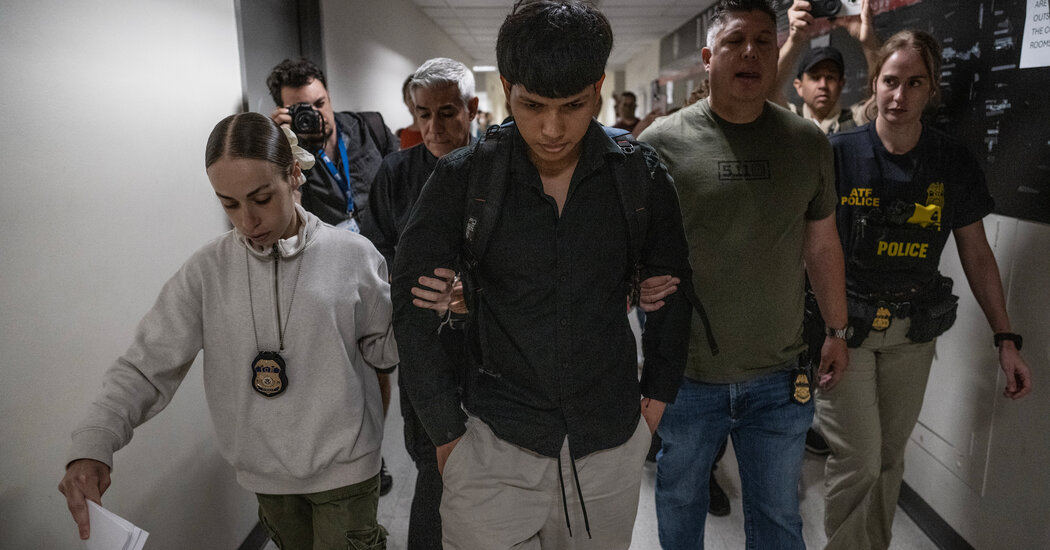
A federal judge in California issued an order on Tuesday blocking immigration agents nationwide from making arrests inside immigration courts. The decision halts what had been one of the most aggressive aspects of President Trump’s mass deportation campaign.
Judge P. Casey Pitts of the U.S. District Court for the Northern District of California said in his decision that federal officials had violated a key statute governing administrative procedures when they changed previous guidelines that restricted civil arrests inside immigration courthouses.
The judge called officials’ decision-making processes “arbitrary and capricious,” saying they had failed to consider alternative options and had dismissed their own prior concerns that courthouse arrests would “disincentivize” immigrants from attending their hearings.
“For 80 years, Congress has commanded federal agencies to think before they act,” Judge Pitts wrote, adding that the instruction did not dictate a particular outcome but did demand a process.
The ruling came in a class-action lawsuit challenging the Immigration and Customs Enforcement agency and the Executive Office for Immigration Reviewover a surge in immigration-related arrests at courthouses and increasingly long detention of immigrants in ICE facilities intended for brief periods.
It also struck down a blanket waiver issued by ICE in June 2025 that allowed its field offices to hold detainees in short-term holding rooms for up to 72 hours or beyond, a significant departure from the agency’s traditional 12-hour limit.
Judge Pitts was nominated to the federal bench by President Joseph R. Biden Jr.
The decision is likely to be challenged as the Supreme Court has substantially limited the ability of lower-court judges to block executive branch policies nationwide. Appeals courts have also already reversed some of the many lower-court rulings against the Trump administration on immigration.
The courthouse arrests became a flashpoint in Mr. Trump’s mass detention and deportation campaign as people who were showing up for routine hearings and check-ins found themselves suddenly taken into custody. Confrontations became public spectacles in courthouse hallways, with masked ICE agents often tangling with people who sought to aid the immigrants.
Last month, a federal judge in Manhattan barred such arrests in immigration courts in New York City, but Tuesday’s ruling by Judge Pitts prohibits such arrests anywhere in the country.
“We are relieved that people can now be able to go to court without fear of arbitrary arrests in the middle of their proceedings,” said Jordan Wells, a senior attorney with the Lawyer’s Committee for Civil Rights of the San Francisco Bay Area, which represented some of the immigrants detained at courthouses.
James Percival, the general counsel at the Homeland Security Department, condemned the ruling, arguing that noncitizens ordered deported by an immigration judge should be treated the same as a defendant convicted of a crime.
“A district judge ordering otherwise is naked judicial activism in service of an anti-American, open borders agenda,” he wrote on Tuesday in a post on X.
For at least a decade, ICE sought to limit officers from conducting civil immigration arrests in or near courthouses. In 2014 and 2015, its internal guidance stated that such actions should be reserved for high-priority targets, such as immigrants convicted of crimes, involved in gangs or otherwise deemed a risk to public safety. Its guidance in 2021 extended those restrictions specifically to immigration courthouses, finding such enforcement actions could “chill” access to justice.
The Executive Office for Immigration Review, or E.O.I.R., which oversees the immigration court system and is part of the Justice Department, subsequently restricted civil arrests to encompass all spaces where immigration-court business took place.
In his ruling, Judge Pitts said that when ICE expanded arrests at immigration courthouses in 2025, the agency had improperly reversed its guidance from 2021 and was relying on a newly issued policy that did not refer to immigration courts. The judge found that E.O.I.R. also violated the federal statute governing agency decisions when it followed ICE’s lead and rescinded its 2023 guidelines.
While Justice Department lawyers had argued for months that the newly issued policy applied to immigration courts, ICE eventually acknowledged that it omitted any mention of immigration courts, the judge wrote.
The same issue was noted in the ruling last month by the federal judge in the New York case, P. Kevin Castel.
His decision applied only to two courthouses in New York City, and it came in response to a lawsuit filed by two immigration advocacy groups, which argued the arrests were unconstitutional and had left migrants scared to attend mandatory hearings.
Arrests at the main courthouse in downtown Manhattan had led to daily, highly visible scenes of migrants showing up for routine hearings only to be dragged away and separated from their families by ICE agents stationed in the court hallways.
The ruling in New York cut off what had become a reliable way for ICE to routinely detain noncitizens in the nation’s largest city.
Since the courthouse arrests began last year, the Department of Homeland Security has argued that detaining migrants in courthouses was safer and easier than deploying agents into local communities.
