


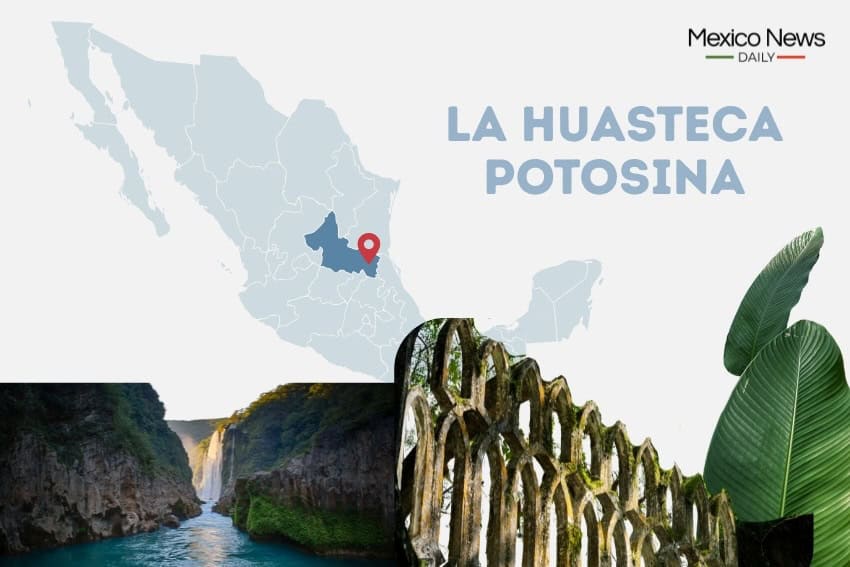
San Luis Potosí is for you if you like: Nature, colonial architecture, weird British artists.
San Luis Potosí is a state that challenges most assumptions about Mexico’s geography. From its UNESCO-listed capital, where more than 500 historic monuments line 42 streets, to the waterfalls and subtropical canyons of the Huasteca Potosina, it offers a spectrum of landscapes that still feel hidden from both domestic and international travelers. You can spend the morning on the Calzada de Guadalupe — one of the longest pedestrian avenues in the Americas — and the afternoon paddling upriver toward a 105-meter curtain of water, then return to the city for gorditas and an evening walk past Baroque façades and wide, tree-shaded plazas.
What makes San Luis Potosí compelling is not only its visual variety but the way nature, history and a touch of surrealism intersect. In the east, jungle rivers feed emerald pools and cascades at sites like Tamasopo and Puente de Diós, while deep in the Huasteca, a concrete labyrinth at Las Pozas turns a hillside into a walkable surrealist dreamscape. On high desert plateaus, the abandoned mining town of Real de Catorce and the sacred landscape of Wirikuta add pilgrimage routes, ghostly mining ruins and wide, open skies, underscoring that this is a territory with as much spiritual resonance as scenic appeal. Between one of Mexico’s largest urban parks, canyon rivers, cave-like water formations and mountains revered as a place of origin, San Luis Potosí invites visitors not just to see nature, but to engage with a state that deserves to be as recognized as an equal to legendary regions like Oaxaca and Guanajuato.
San Luis Potosí: Mexico’s best kept secret
When talking about the state of San Luis Potosí, it makes sense to start with the capital. A UNESCO-listed historic center of 42 streets and roughly 500 monuments, it pairs colonial architecture with a laid-back urban rhythm that many travelers would never think to seek out here. Plaza by plaza, it reveals itself as a city of wide sidewalks, generous shade and everyday rituals, where grabbing a coffee and wandering past sandstone façades feels less like sightseeing and more like slipping into the local routine.

Beyond the downtown core, a network of former mining villages, vast public parks and quiet neighborhoods extends that sense of lived-in history into the surrounding hills. This is a place where 19th-century industrial heritage sits alongside contemporary art spaces and weekend family outings, giving visitors multiple entry points into the region’s past and present.
Farther afield, the waterfalls and canyons of the Huasteca Potosina introduce a very different version of the state, one defined by jungle rivers, steep ravines and small communities that have built a modest tourism economy around the area’s natural assets. Taken together, these landscapes — urban and rural, desert and subtropical — make San Luis Potosí a destination that rewards curiosity, inviting travelers to look past the usual hotspots and spend time with a corner of Mexico that still feels genuinely undiscovered.
Was Edward James’ magnum opus in San Luis Potosí art or egocentrism?
Las Pozas, the Edward James Sculpture Garden outside Xilitla, is best approached with time and a willingness to walk slowly. Set in subtropical forest in the Huasteca Potosina, the site combines concrete structures, waterfalls and pools across several hectares dedicated to both sculpture and ecological conservation. Visitors follow paths and stairways that weave between towers, arches and platforms, with vegetation and water constantly in view, making the experience feel more like moving through a landscape than visiting a conventional monument.
For travelers, the practical side of a visit is straightforward but worth planning. Entry is limited and organized in timed groups with mandatory guides, so advance reservations and early arrivals are recommended, especially on weekends and holidays. The garden sits above Xilitla, a Pueblo Mágico with basic services, lodging and transport options, which makes it a natural base for exploring the area’s other attractions, including nearby waterfalls and viewpoints.
On the ground, the effect of Las Pozas is cumulative rather than centered on a single highlight. As visitors move between structures and natural features, the combination of sound, humidity, plant life and concrete begins to define the visit as much as any one staircase or tower. It is a place where art, landscape and local stewardship now intersect, offering a distinctive stop on a broader San Luis Potosí itinerary for travelers interested in both nature and the traces of one of surrealism’s more ambitious projects.
Love nature? Here’s where to hike in San Luis Potosí
San Luis Potosí offers a range of hikes that can be tailored to different levels of experience, starting with the Tamasopo area in the Huasteca Potosina. Here, a network of waterfalls, pools and rivers creates a natural setting that functions almost like an outdoor water park, with jumping platforms, bridges and rope swings for those who want more activity, and flatter riverside paths at nearby Cascaditas for visitors who prefer a slower, less strenuous walk. Access involves a roughly three-hour drive from the capital, making it a full-day outing that combines time on the trail with swimming and time by the water.
In the high desert, Real de Catorce serves as the starting point for a more demanding hike to Cerro del Quemado, or Wirikuta, a site recognized as a UNESCO Natural Sacred Area and central to Wixárika cosmology. The route covers around 15 kilometers at altitude and can be done on foot or on horseback, with additional options to visit El Pueblo Fantasma, the ruins of a former silver mine at nearly 3,000 meters above sea level. This part of the state appeals to travelers interested in combining physical effort with an encounter with living Indigenous tradition and the remnants of the region’s mining history.
For those drawn to river travel, the journey upriver to the Tamul waterfall adds another dimension to hiking in San Luis Potosí. After an early start and a stop for breakfast in Río Verde, visitors board wooden boats and paddle against the current for about an hour to reach the base of the 105-meter-high falls, with opportunities to swim and take photos near the cascade and to walk up to La Cueva del Agua, a cave pool set above the river.
This cave in San Luis Potosí was hiding Ice Age giants
For travelers interested in the deeper timelines of a place, the Calera cave system in San Luis Potosí adds a striking layer to the state’s appeal. Known among specialists as the setting for the documentary “Crypt of the Megafauna,” the cave sits in the Sierra del Abra and has yielded fossils of mammoths, giant sloths, saber-toothed cats, dire wolves, camels, bison and other Ice Age animals, after a team led by cave biologist Luis Espinasa went in looking for cavefish and instead found a dense concentration of ancient bones. The work to document the site has involved tight vertical entrances, underwater sections and the use of a remotely operated vehicle nicknamed “Robo-Teddy,” underscoring that this is an active research environment rather than a conventional tourist stop.
While Calera itself is not open for casual visits, its story is accessible through the film and through the broader context of San Luis Potosí’s caves and karst landscapes. For travelers, this makes the region a natural fit for those who combine surface-level hiking and nature trips with an interest in what lies beneath, from cavefish and underground streams to paleontological work that is still ongoing. Local guides and caving clubs occasionally organize specialized trips in the wider Sierra del Abra for experienced participants, which can add a technical component to an itinerary that might otherwise focus on waterfalls and rivers in the Huasteca Potosina.
Even for visitors who never enter a cave, the Calera discoveries contribute to the way San Luis Potosí is understood. Knowing that the same state now known for mezcal routes, hiking to sacred mountains and boating to waterfalls also holds evidence of mammoths and five-ton ground sloths helps situate present-day landscapes within a longer natural history.
San Luis Potosí’s former penitentiary is its best museum
In San Luis Potosí’s capital, one of the most compelling stops for travelers interested in art and history is the Centro de las Artes de San Luis Potosí Centenario, housed in the state’s former main penitentiary. The late-19th-century neoclassical complex, once organized as a panopticon with cells radiating from a central tower, has been restored and repurposed as a cultural center, with courtyards, former cell blocks and corridors now serving as exhibition spaces, classrooms and performance areas. Walking through the main gates, visitors move from heavy stone walls into open-air patios and smaller galleries, where rotating contemporary art shows sit alongside traces of the building’s past use.
Within this larger complex, the Museo Leonora Carrington functions as a museum-within-a-museum devoted to one of Mexico’s key surrealist artists. Opened in 2018, it houses an extensive collection of Carrington’s sculptures, jewelry, engravings, drawings and personal objects, with several courtyards dedicated to large-scale works that visitors can view from multiple angles. Inside, former cells have been adapted to display smaller pieces and archival materials, allowing travelers to move between outdoor installations and more intimate rooms that highlight different periods of Carrington’s career.
A visit can be folded easily into a day spent in the historic center, as the complex sits within walking distance of other museums, churches and plazas. Depending on the timing, visitors may also encounter festivals and events such as the annual wine fair held in the courtyards, adding a contemporary social dimension to a space that once served a very different function.
How to get there
By air:
San Luis Potosi International Airport: The airport offers flights to Mexico’s main metropolitan hubs, plus international links to Dallas-Forth Worth, Houston, San Antonio and Chicago.
Aguascalientes: A similar international selection, Houston, Dallas-Forth Worth, Chicago and Los Angeles, plus domestic destinations across Mexico. Located 168 km (104 miles).
Zacatecas: Though the airport is modest, it offers flights to Los Angeles, San Jose, Dallas and Chicago. Domestically, the airport links to Guadalajara, Mexico City and Tijuana.
By road:
San Miguel de Allende: 170 km (105 miles), roughly a 2 hour drive.
Mexico City: 411 km (255 miles), roughly a 4 and a half hour drive
Laredo, Texas: 727 km (452 miles), roughly an 8 hour drive.
Guadalajara: 344 km (213 miles), roughly a 4 hour drive.
Mexico News Daily
