


Unlock the Editor’s Digest for free
Roula Khalaf, Editor of the FT, selects her favourite stories in this weekly newsletter.
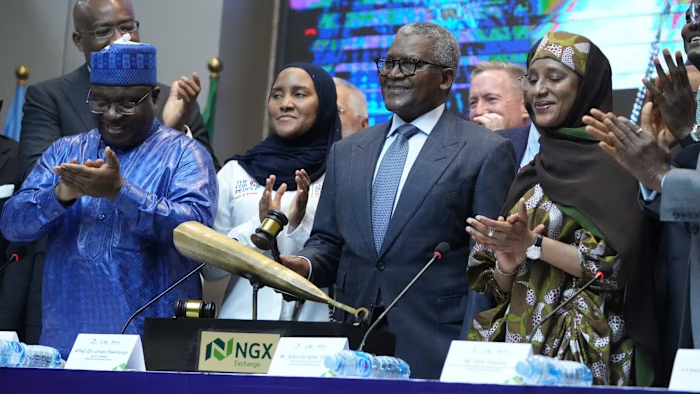
It is the biggest industrial project in Africa in a generation, but Nigerians can now have a small piece of the Dangote Refinery for the price of a soft drink. Aliko Dangote, Africa’s richest man, hopes that up to 10mn people will participate by purchasing at least 10 shares at ₦525 ($0.40) each. That should be within reach of all but the poorest Nigerians, many of whom dabble in crypto and bet on sporting events. The initial public offering will raise $1.6bn, valuing close to a generous-looking $50bn the massive refinery that took a decade to build on swampland outside Lagos.
Both the IPO, the biggest ever in Africa, and the project itself — at 700,000 barrels a day, the world’s largest so-called single-train refinery — are important milestones for Nigeria and the continent. The refinery has ended six decades in which Nigeria, frequently Africa’s biggest oil producer, exported large volumes of crude only to import petrol, diesel and jet fuel. That not only squandered vast amounts of foreign exchange, it also engendered a rentier economy where arbitrage trumped production. The refinery and Dangote’s broader industrial complex also theoretically make Nigeria self-sufficient in fertiliser and polypropylene.
It was a stroke of luck that the refinery was reaching full capacity just as war was starting in Iran. Nigeria has had few petrol shortages and Dangote has supplied other countries with diesel and jet fuel to such an extent that his refinery is credited with playing a material role in keeping European carriers airborne. As margins spread, the refinery has made windfall profits.
The IPO is not without risk, however. A valuation of nearly $50bn for an asset that cost $20bn to build looks steep. It is a premium of nearly 10 per cent over the price of July’s $2.5bn private placement, which implies investors on the street will be paying more than the club of insiders who got first dibs on the listing. The small free float of just 3.3 per cent means liquidity will be tight. Dangote argues that investors are buying a ride on expansion plans that should see it double capacity to 1.4mn b/d by 2028-29.
If this is to be Nigeria’s “Tell Sid” moment — on the lines of the 1986 ad campaign for a privatisation that turbocharged popular capitalism in Britain — ordinary investors need to benefit. It would be unfortunate if they bought an asset priced against current windfalls only to see its value subsequently fall.
Still, Dangote’s stated reasoning that African capital should fund African infrastructure is right. There is as much as $4tn in financial assets in Africa, but little of it is deployed as risk capital for productive investments, with much recycled through high-yielding government debt. Deepening capital markets is an important step towards funnelling some of this money to better uses. Nigeria should push to make Lagos a meaningful financial centre.
More is at stake. Throughout Africa, there is grandiose talk about ending the export of raw materials, from cobalt to cocoa, by processing them domestically. Mostly it is just talk. When action is taken, too often it ignores the realities of shoddy roads and ports and expensive or non-existent power.
Dangote’s success in completing a project that many thought impossible is as much a cautionary tale as a tribute to his bloody-mindedness. He literally had to build the supporting infrastructure around him to make the project viable. Even after it was completed, vested interests, including state companies, ensured he initially struggled to secure the crude oil required to keep it running.
Africa needs more private businesses to succeed. But government policies across the continent — from wanton neglect of public infrastructure to tax shakedowns of successful entrepreneurs — make it all but impossible for them to reach scale. If people are crowing today that Dangote proves it’s possible to make money by investing in Africa, the reverse could also be true. His refinery may be the exception that proves the rule.
