


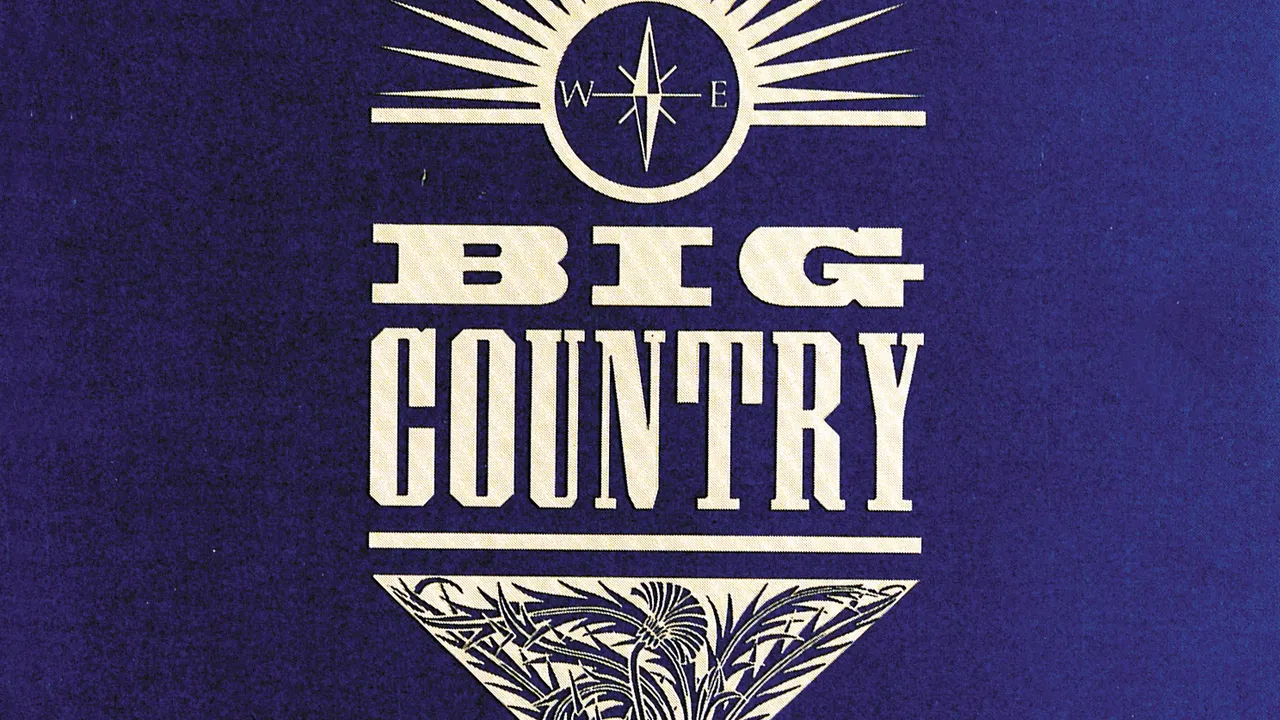
Stewart Adamson looked uncomfortable. It wasn’t that he had never appeared in a music video before. As a lanky 20-something, Adamson had previously jutted around with the Scottish punks who made up his early band, Skids, in the clip for “Into the Valley,” which climbed to No. 10 on UK charts. But in the footage for “In a Big Country,” Adamson looks like your coworker plowing through karaoke, contorting their face into pained shapes after a miserable week at the office. Imagine if, sometime in the winter of 1983, you had muted MTV to make a sandwich or use the bathroom, only to return to this video as it jumped between Adamson’s grave expressions and its inscrutable fist fights, scuba dives, and jet skis. It’d be difficult to guess that the song accompanying the video, “In a Big Country,” was a burst of new wave so triumphant and motivating that you’d feel ready to climb a mountain after one listen.
The pomp and circumstance involved with making music videos bothered Adamson. He’d long been skeptical of music-industry machinations, especially toward the end of his stint in Skids, when he’d been drinking heavily and wandering off ahead of shows. Punk wasn’t supposed to be about personality, Adamson believed, but treating your audience with respect and expressing yourself as directly as you could. It’s easy to hear Adamson wrestle with that tension on Skids songs such as “Hope and Glory” or “Calling the Tune,” where he’s still figuring out how to wrestle plucky, militant licks and bursts of feedback into the group’s otherwise perfunctory punk. Most frustratingly, Adamson’s desire for a steady domestic life clashed with his music ambitions, so he quit the band in 1981. “This was a guy who had a mortgage, a wife and a family,” said Skids vocalist Richard Jobson, “when we were all trying to live some mythic punk lifestyle.”
Adamson fantasized about doing “a twin guitar thing” with his friend Bruce Watson. The two both grew up in Dunfermline and first met while playing in different teenage punk bands; not long after Adamson left Skids, he plugged in a drum machine and asked Watson if he wanted to work on some demos together. For the next two years, Adamson and Watson struggled through label rejections, an aborted stint opening for Alice Cooper with a mediocre backing band, and some uneven sessions with Roxy Music producer Chris Thomas. It took a new rhythm section of studio professionals—Tony Butler, who wrote the motivating bassline on the Pretenders’ “My City Was Gone,” and drummer Mark Brzezicki—and some support from Steve Lillywhite, who produced the first three U2 albums, to arrive at the pastoral arena rock that defined Big Country’s first three albums. And “In a Big Country,” a self-affirmation framed as an advertisement for the majesty of the Scottish highlands, is as pastoral and arena-sized as they come.
Part of what distinguished Big Country was Adamson and Watson’s conscious effort to play their guitars as straight as possible. No bends or blues riffs—“Basically, I’ve heard enough of ‘Johnny B. Goode’ to last me the next 25 years,” Adamson told Rolling Stone in 1983. His soaring guitar part for the band’s only hit in the United States—which interrupts the first verse, scaling the fretboard after Adamson sings, “another season passes by you”—came from mixing an MXR pitch transposer with a dash of distortion and chorus. Few guitar leads have ever sounded as searing as Adamson’s, even if that transposer-affected sound plagued Big Country with the guitars-as-bagpipes designation for the rest of their career.
