Inflation was expected to keep easing, consumers were expected to bend under higher prices, and the next big Fed debate was supposed to be about when rate cuts could begin.
However, Bank of America isn’t telling that story.
The bank sees an economy that still has enough momentum to avoid a classic downturn. According to its mid-year outlook shared with me, spending levels held up, the labor market hasn’t cracked, and growth remains alive and well.
Nevertheless, that resilience is not spreading evenly, and that’s the uncomfortable twist.
The U.S. economy might be strong in the places that matter for inflation but fragile in the places that matter most to households.
That beckons a harder question: What happens when the economy is too hot for relief, but too uneven to call healthy?
What Bank of America said about America’s two economies
Perhaps BofA’s most striking economic call is that the U.S. is essentially running on a couple of different tracks.
In its midyear outlook, the bank described the economy as K-shaped, calling it “reflation for higher income, stagflation for lower income.”
Wealthier households continue to spend at a strong pace, led by stronger balance sheets, asset gains, better job security, and exposure to a market that’s spearheaded by earnings strength and AI investment.
More Tech:
Conversely, lower-income households continue to absorb the harder side of the cycle, with sticky prices, higher borrowing costs, and renewed gas pressure.
The split is clear in BofA’s card data.
For the week of June 6, lower-income spending was up 5.5% year over year, while higher-income spending rose 6.1%.
But the gap gets much wider at the top: Spending by the top 5% rose 7.8%, while spending by the top 1% jumped 9.0%. On May 30, lower-income spending rose 4.0%, compared with 7.6% for the top 5% and 8.6% for the top 1%.
Simply put, the consumer is not universally robust, and the strongest households are simply strong enough to keep the aggregate data looking healthy.
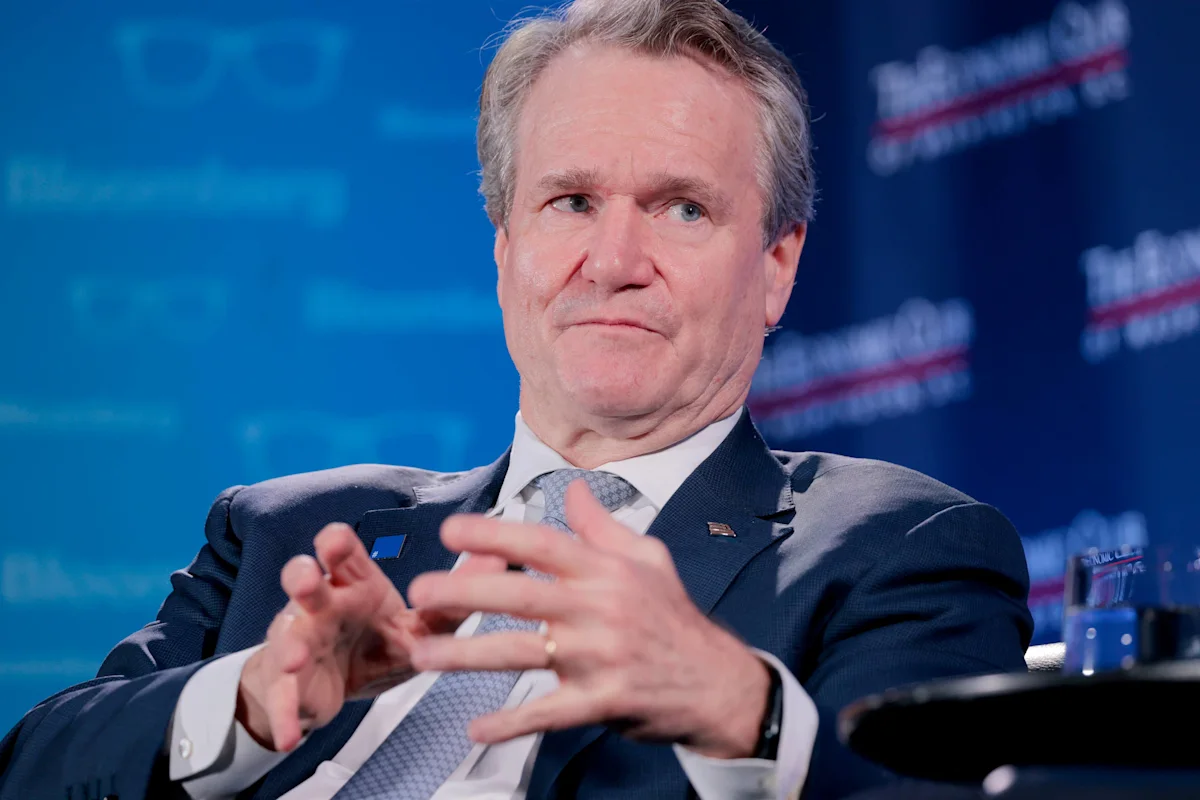
Bank of America warns America’s resilient economy is masking a widening consumer divide.John Lamparski/Getty Images
Why the Fed may have to make the pain worse
Perhaps the most uncomfortable part of BofA’s outlook is that the economy hasn’t weakened enough to justify relief.
In fact, it looks strong enough to create a new rate problem.
BofA sees real GDP growing 2.3% in 2026, with the unemployment rate holding near 4.3%. The same forecast, though, has PCE inflation at 3.5% and core PCE at 3.3%, leaving inflation well above the Fed’s target, even as growth keeps moving.
So the issue is that growth is far from cracking, while labor isn’t breaking either, with sticky inflation still playing a big role.
Speaking of labor, compared with last May, the unemployment rate is flat, core PCE is up 70 basis points, and the policy rate is 75 basis points lower. Consequently, the bank expects 75 basis points of rate hikes this year, as I covered recently.
On top of that, the inflation risk is even deeper than one hot print.
BofA argues that inflation is still “stuck above target,” with underlying measures also holding above 2%. Services demand is still propping up inflation, while tariffs have revived the relentless supply-driven pressure on goods.
The Fed might have to tighten because the parts of the economy that’ve held up continue keeping inflation hot, even if the weak parts feel squeezed.
AI is holding up growth, but it brings its own shock
Bank of America argues AI has become more than a simple tech-stock trade.
In its midyear outlook, the bank argues that booming AI-related components have essentially become a demand shock for the broader economy.
For perspective, AI spending is no longer just lifting the likes of Nvidia, cloud stocks, or the Magnificent 7. It is also helping to support U.S. growth.
To back that argument up with some data, Business Insider, citing Goldman Sachs, states the 2026 AI capex for the four could hit $725 billion, roughly double 2025’s tally.
Moreover, the four major AI spenders lifted Q2 2026 capital spending by 74% year over year to $168 billion, showing the AI buildout is still moving at breakneck speed, even as investors question returns.
BofA estimates AI investment will add 0.4 percentage point to GDP growth this year, while AI investment adjusted for imports rises to 0.7% of GDP in 2026.
In a split economy, that is a massive cushion. Consumers continue to put in the work, but AI capex is also becoming a major engine of domestic demand.
However, AI’s benefits aren’t landing evenly.
BofA says the impact on jobs is already visible in white-collar services, while the productivity payoff remains an open question.
Moreover, that scenario also ties back to stock market risk. If BofA is right on Fed hikes, rate-sensitive companies might feel a lot more pressure.
In fact, the report says half of small-cap debt is short-term or floating rate, while a 75-basis-point hiking cycle could lift Russell 2000 ex-financials net interest expense by 13% of 2025 EBIT in 2027.
Related: Microsoft cuts thousands as Xbox faces rude awakening
This story was originally published by TheStreet on Jul 7, 2026, where it first appeared in the Economy section. Add TheStreet as a Preferred Source by clicking here.