


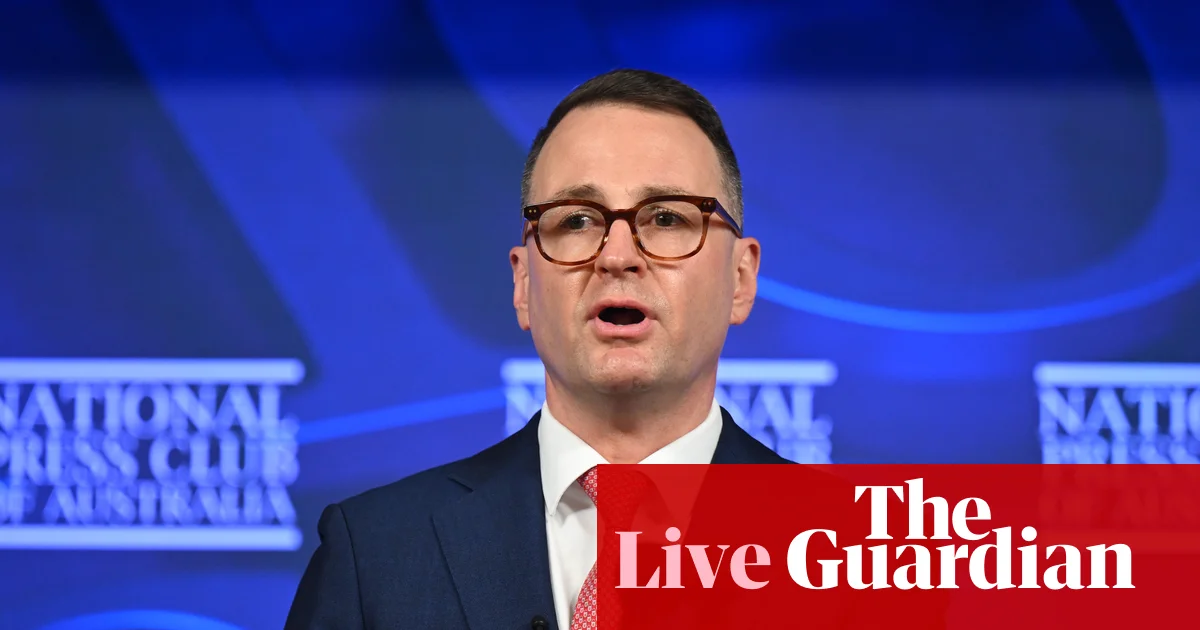
Bragg pushes for a drastically lower top tax bracket
Andrew Bragg’s really going out on a limb here, spruiking ideas that go way further than his party’s policy platform.
He says the top tax bracket – which currently sits at 47% – should be reduced to have a three in front of it.
Top tax brackets are too high and should have a three in front of them, just as they are for small businesses.
We need to get to a flatter tax system for all people and all businesses, otherwise we can forget about getting the next Afterpay or Canva here in Australia.
Moving to his promise to cut the national construction code, he says:
The house won’t be gold-plated but it won’t fall down.
Somehow it feels like the minimum standard of a new house shouldn’t just be … not falling down.
Key events
Pacific nations call for transparency over ballistic missile testing
Pacific Island nations have raised alarm over recent ballistic missile testing in the region and called for greater transparency and reassurance.
The foreign affairs ministers of the Pacific Islands forum (PIF) spoke on Friday, before a joint statement issued by 40 countries including Australia, calling for advanced notice of any missile testing.
In a statement the Australian foreign affairs minister, Penny Wong, said the two statements showed the broad consensus for transparency around testing.
These statements show the broad regional and international consensus – including from PIF foreign ministers – about the need for transparency, reassurance and respect for the sovereignty of Pacific countries. That message should be taken seriously.
Australia will continue to work constructively with international partners to shape a peaceful, stable, prosperous region.
Where has Bragg’s migration target come from?
Andrew Bragg says net overseas migration should be dropped to 180,000 a year over the next four years, but so far no one else in his party has backed that number.
So, he’s asked whether he’s freelancing on the number or it’s actual Liberal policy.
Bragg says it’s not on the official platform, but he wants the debate to move forwards.
We haven’t finalised our complete policy suite as you know. But I thought it was important to move the debate on towards – where the numbers are probably going to hit. That’s the range.
And we backing that up with more to say later. But I think that it is important that we keep the debate moving.
Bragg says the drop in the NOM would come from fewer international students, working holiday visas (eg backpackers) and unskilled workers.
Andrew Bragg: ‘What’s the point of being in politics if you’re not having any fights?’
Bragg is taking the fight to multinational companies, saying he’s willing to make them pay more tax.
He says the income tax system should be flatter, which would be paid for by lower government spending and tapping tech companies for more cash.
How will he do that? He says the government could lower the company allowance for intellectual property.
I’m not a Communist but [how] can you have companies generate so many billions in revenue and transfer the whole thing to Singapore and Ireland?
It’s an accounting trick effectively. You lower the allowance they can make for intellectual property and make a rule that X amount of your revenue has to be subject to tax here or you reduce their allowance on intellectual property. There’s a number of ways to do tax law to ensure you get more money out of these people.
Bragg says at the end of the day Australia is stronger than Netflix or Facebook and can dictate the terms.
What’s the point of being in politics if you’re not having any fights? I’m always sceptical of someone who doesn’t want to fight anyone. The whole point is to try and get a better system.
Thirty-odd billion dollars and only a handful of tax – I just think it’s not a fair and equitable arrangement.
Bragg pushes for a drastically lower top tax bracket
Andrew Bragg’s really going out on a limb here, spruiking ideas that go way further than his party’s policy platform.
He says the top tax bracket – which currently sits at 47% – should be reduced to have a three in front of it.
Top tax brackets are too high and should have a three in front of them, just as they are for small businesses.
We need to get to a flatter tax system for all people and all businesses, otherwise we can forget about getting the next Afterpay or Canva here in Australia.
Moving to his promise to cut the national construction code, he says:
The house won’t be gold-plated but it won’t fall down.
Somehow it feels like the minimum standard of a new house shouldn’t just be … not falling down.
‘I wish I’d done more to stop the madness’: Bragg addresses press club
The shadow housing minister, Andrew Bragg, says it’s fair enough that people want to send a message that the major parties haven’t been good enough, and that it’s a hard ask to get them to vote for a party that’s “buggered” it up.
Before he gets to the policy, Bragg offers a few pretty frank observations of politics and the governing of both major parties.
He likens the Labor party’s national conference (which saw no substantial debate on the floor) to North Korea and accuses the government of contributing “to our malaise by not being prepared to develop enough alternative policy and to wear political risk”.
Australian politics is now fragmented. I understand that people are over the two-party system and it’s a tough ask to say to Australians ‘we buggered it up but please vote for us again’. I do understand how hard that is. As someone who was a backbencher in the [Scott] Morrison government, I wish I’d done more to stop the madness.
The madness started when Canberra gave up on the budget. We consume today’s debt, which is tomorrow’s taxes.
So what does Bragg believe the Coalition should focus on instead? He calls for his party to occupy the “radical centre”.
We do need more and I call this the economic revolution. It’s a call to the renewal of liberalism. We need to be the radical centre.
Small businesses, salary earners and ambitious families and individuals should be our focus.
Prosecution’s case against the alleged Bondi terror attacker expands
Jordyn Beazley
The prosecution’s case against Naveed Akram for his alleged role as a gunman in the Bondi terror attack now includes 12 additional electronic devices and a report on an explosive device.
Commonwealth prosecutor Danielle New outlined what is included in the case to the Downing Centre local court on Wednesday before seeking a two months extension to serve the brief of evidence.
New said the case now included statements from protected witnesses, and:
An additional 12 electronic devices [and] an improvised explosive device testing report are due and need to be reviewed.
New told the court this would be included in the brief alongside “significant data” extracted from seven other electronic devices, extensive medical records, and 800 witness statements.
Judge Hugh Donnelly approved the extension for the brief of evidence, noting it was a “significant matter” and was moving “steadily”. It’s now expected to be served on 28 October.
Akram, 24, and his father, 50-year-old Sajid Akram, allegedly killed 15 people after opening fire at a Hanukah festival at Bondi beach on 14 December.
Akram, who survived a shootout with police, was charged in December with 78 offences, including 15 counts of murder and one count of committing a terrorist act that investigators allege may have been “inspired by Isis”. Sajid Akram was shot and killed by police at the scene.
Akram is yet to enter a plea on the charges.

Penry Buckley
‘It could say he bought a flamingo off me’: Icac witness says ‘no issue’ with invoices from ‘best mate’
Returning to the NSW Icac’s Operation Rosny, the questioning of witness Jeremy Greenwood has focused on Catholic Schools NSW, alleged to have made illegal donations to conservative factional group the Reformers.
In 2021, the schools governing body moved from making payments to Beckington, a lobbying company controlled by Greenwood and Reformer Christian Ellis, to JPG Advisory, a registered lobbying firm controlled by Greenwood.
The inquiry has heard that Greenwood agreed to pay Reformer Jean-Claude Perrottet, who he described as his “best mate”, half of a monthly retainer from Catholic Schools NSW if he was able to secure the contract with the chief executive, Dallas McInerney.
Greenwood admitted that, after the contract was secured, Jean-Claude did no consulting work for Catholic Schools NSW. Asked if Jean-Claude had sent “fake invoices” to suggest he’d done work, including under the guise of consultancy, Greenwood says he would have “no issue” with this.
It could say he bought a flamingo off me. It was just an internal document only for me. It’s how I process it out that matters.
Counsel assisting, Peggy Dwyer SC, asked if he would “claim tax on an invoice that said he bought a flamingo?”
Greenwood apologised for using the phrase. He said he did not know if he claimed the invoices as a business expense but defended any invoices as reflecting a “commission arrangement”.
Stripping out energy efficiency standards will ‘deepen inequality’ says Acoss
The Australian Council of Social Service is “deeply concerned” with the Coalition’s proposal to make energy efficiency optional in building.
The shadow housing minister, Andrew Bragg, announced the opposition would cut the 2,000-page national construction code down to just 80 pages, making essential structural, fire safety and health requirements compulsory but all other features optional.
The Acoss chief executive, Cassandra Goldie, says cutting energy efficiency in homes would leave renters with high power bills.
She said energy performance and accessibility are,“fundamental to health, safety and wellbeing”.
Homes that are freezing in winter, dangerously hot in summer, or inaccessible to older people and people with disability are simply not safe. Making energy performance optional would lock people into higher power bills for decades. Strong building standards reduce energy costs and protect people on low incomes from energy hardship.
Stripping out energy efficiency and accessibility standards would shift costs on to households, deepen inequality and leave future generations with homes that are expensive to run and difficult to live in.
Penry Buckley
‘You need to be respectful’: Icac witness reprimanded
The NSW Independent Commission Against Corruption has continued its investigation into allegations of corruption in the state’s Liberal party today.
The questioning of witness Jeremy Greenwood, who is named in two of Icac’s allegations, has focused on payments made to his company JPG Advisory, including by schools governing body Catholic Schools NSW. As with previous hearings, the commission has heard evidence from emails and text messages exchanged between those named in allegations.
At one point this morning, Greenwood, who is giving his third day of evidence, said to someone in the hearing room: “You’ve been through my emails. Don’t give me that look.”
It is not clear if the comments were directed at counsel assisting, Peggy Dwyer SC, who has had several tense exchanges with Greenwood, or someone else. The presiding commissioner, Fabian Gleeson SC, intervened:
Sorry, Mr Greenwood. Sorry, just everyone pause. Mr Greenwood, you need to be respectful in the way in which you behave, you need to listen to counsel’s questions. You do not direct comments to other people sitting in this room. Do you understand what is expected of you as a witness?
Greenwood: Apologies, commissioner, but I also don’t like having faces pulled at me.
Gleeson: Mr Greenwood, can you answer the question? Listen to the question and answer it. Do you understand what is expected of you in terms of respectful conduct and decorum in this room?
Greenwood: Yes, commissioner.
Gleeson: Because I don’t want to have to explain it to you again. You understand?

Achol Arok
Union echos calls for pay increase for Commonwealth Bank empoyees after CEO’s pay packet increases to more than $9m
The Finance Sector Union (FSU) has reiterated calls for a 5% pay increase for Commonwealth Bank employees after the bank’s full-year financial results revealed that chief executive Matt Comyn’s salary had increased by $2m from the previous year.
The FSU has been negotiating pay deals since early this year, asking for a 5% pay increase for most of the bank’s 37,000 employees, along with better job security and working conditions.
The union says the $9m pay packet, now 150 times that of the average CBA employee, “bolsters the union’s case” for a “new and overdue Enterprise Agreement”.
The FSU national secretary, Julia Angrisano, said “the only decent thing left for CBA to do is accept the FSU’s request”. She said:
The CBA’s remaining Australian workforce is demoralised, struggling to make ends meet and anxious about the future.
CBA ought to be ashamed that some of its full-time employees have to take second jobs. I think most Australians will be appalled to know that finance professionals tasked with looking after their money barely earn more than someone on the minimum wage.
‘Sportsdebt’: independents’ creative push to crack down on gambling ads
The teals have brought some of the best merch I’ve seen in parliament, as they try to pressure the government and opposition to go harder on gambling advertising.
Sporting T-shirts with “debt365”, “sportsdebt” and “ladsbroke”, they have held a doorstop at Parliament House. It’s not the first time we’ve seen the tees – but there’s more of them today with some of their staffers and volunteers also roaming around the building wearing the merch.
The independents have many amendments for the gambling bill but it’s unlikely most – if any – will be supported by the government.
Wilkie contacts Nacc over gambling bill, claiming government ‘improperly influenced’ by wagering lobby

Josh Butler
Independent MP Andrew Wilkie has alleged that “individuals in the Federal Government” had been “improperly influenced by individuals in the private sector” in formulating the gambling legislation, writing to the National Anti-Corruption Commission with his claims.
We’ve contacted the office of the communications minister, Anika Wells, for response.
Wilkie, the Tasmanian crossbencher, claimed he had “referred” the issue to the Nacc. The anti-corruption body is, of course, independent and chooses which issues it will investigate and, while any person can write to the body, there is no obligation to investigate.
In his letter, shared with media today, Wilkie said he was not making “any allegation against any specific individual”. But he claimed he was writing to “express my concern that individuals in the Federal Government, when formulating gambling reform policy, have been improperly influenced by individuals in the private sector, most obviously but not exclusively through donations, gifts, hospitality and personal relationships.”
This has resulted in policy so clearly at odds with research, public opinion and the public interest, that the implementation of such policy could be characterised, in my opinion, as serious corruption in the Commonwealth public sector.
Wilkie attached a newspaper article noting large sums of donations which Labor had received from betting agencies.
Wilkie wrote that while governments “have the right to accept donations, be lobbied and make their own policy decisions”, he claimed “individuals in the Government are acting so egregiously in response to individuals in the private sector that all reasonable limits on government behaviour have been exceeded.”
“If this doesn’t ‘cross the line’, then I dread to think what would,” he said.
