


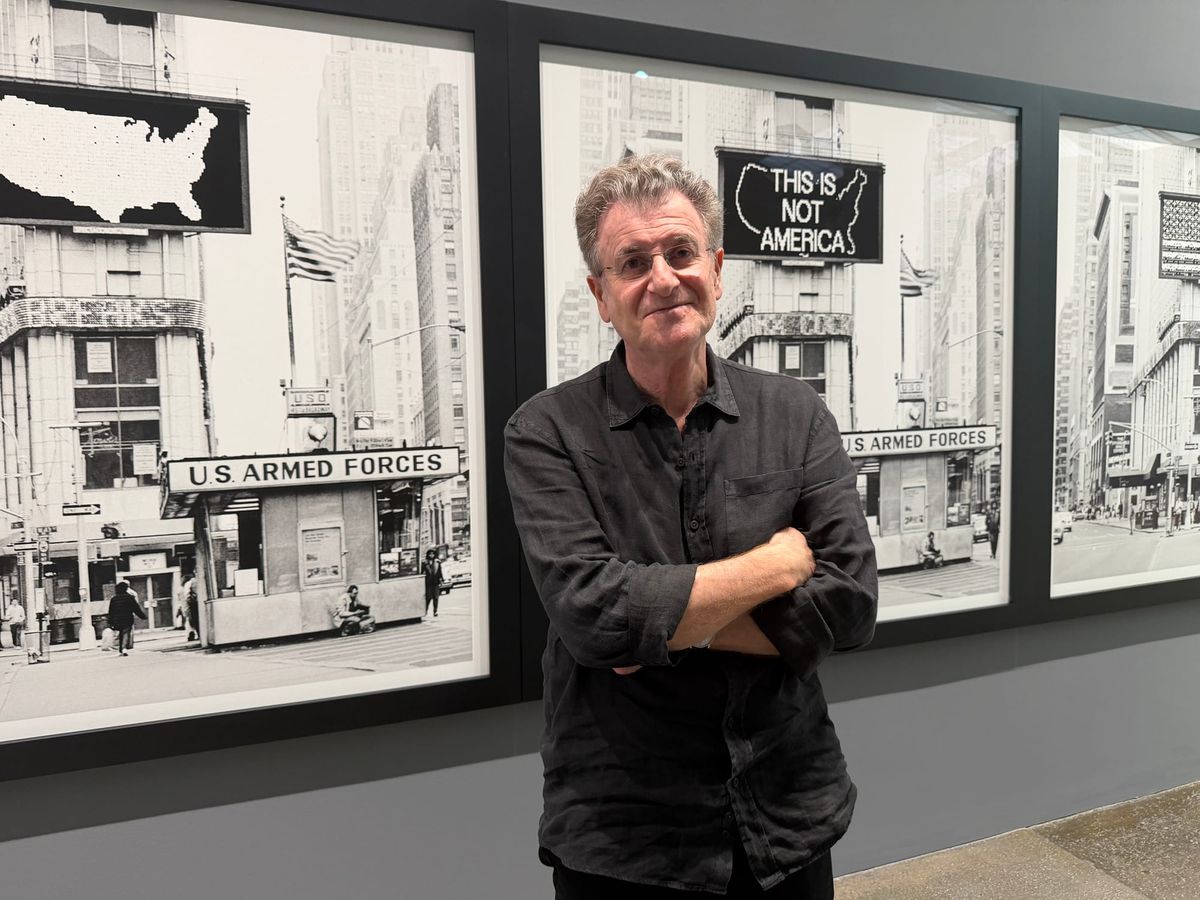
In April of 1987, when Reaganism was running amok and Henry Kissinger was fiddling with world affairs like a puppet master from hell, a relatively unknown 31-year-old Chilean artist named Alfredo Jaar staged his billboard installation A Logo for America smack dab in the heart of Times Square. It instantly became one of the most discussed works of political art in the contemporary canon.
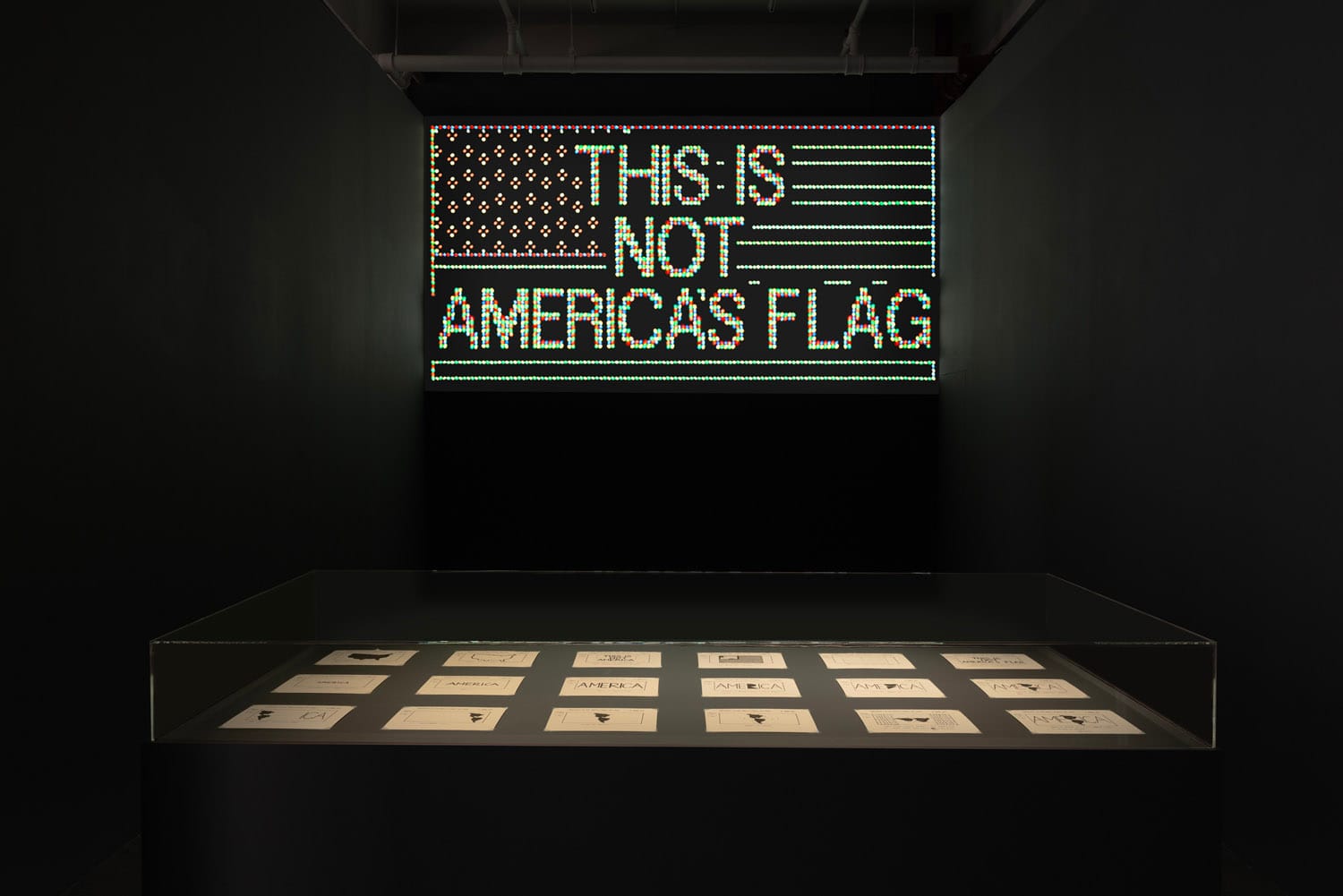
Appearing between ads for tomato sauce and a Mexican restaurant, the 42-second LED animation bewildered New Yorkers with the message “This Is Not America” superimposed on a map of the United States, followed by an image of the US flag with the text, “This Is Not America’s Flag.” Next, the “R” in America shifted into a dancing map of South, Central, and North America.
The message to US citizens and their leaders was simple but provocative: Stop hijacking the name “America” while you’re just one of many countries in it.
Almost 40 years later, the basic fact that America is a continent, not a country, still has to be explained to US citizens who see themselves as the only Americans out there.
And yet, Jaar’s installation became a success, traveling around the world and making a brief reappearance in Times Square for a single minute at midnight in 2014. During Donald Trump’s first presidential campaign in 2016, the artwork was played on large video screens installed on a barge off Miami Beach as a response to the candidate’s racist statements about immigrants.
Now, as the United States marks its 250th anniversary and Trump weaponizes the name “America” in his feuds with various countries — the Gulf of Mexico and Lake Ontario have been renamed Gulf of America and Lake America, and more might be coming — Jaar’s installation takes on yet another meaning as it returns for a third run in New York.
A Logo for America, 1987 at Galerie Lelong in Manhattan is a tribute to Jaar’s historical installation and its enduring relevance. It features related work by other artists, including Joaquín Torres-García’s “Inverted America” (1943), which Jaar cites as a major inspiration for his own piece. At the center of the gallery space is a large video screen that transports visitors back to the Times Square of 40 years ago, providing New Yorkers a shot of nostalgia.
I met Jaar amid the installation of the new show last week for a conversation about America, the US, and his multi-decade art career. I encountered an artist who still cares, still loses sleep over injustice and abuse of power. And though he doesn’t think that artists can change the world, he strongly believes that “we can show it can be different.”
Hyperallergic: It was actually Chilean friends who educated me years ago about paying more attention to the distinction between America and the United States, maybe thanks to your work. Did that discourse exist back in 1987?
Alfredo Jaar: I moved here in ’82, exiling myself from Pinochet’s Chile. It caught my attention that people here were saying, “God bless America” and “Welcome to America.” It was part of the daily language, but they were always referring to the United States, not to America, the continent. I was shocked about that, so I started telling people, “You mean the United States?”
“No,” they would say, “America, America.” So I discovered an incredible ignorance, a brutal ignorance about language and geography.
H: How did the Times Square piece come to be?
AJ: By a miracle. I was a completely unknown artist back then. In ’86, they invited me to do a piece in Times Square, and I thought, “This is my chance to do a public project about this.” I did it purely on semiotic terms. I was not thinking about the larger political issues; I was just trying to change the language: This is not America. America is a continent. But then, the work picked up and had a life of its own and I completely lost control over it.
For example, when the work was shown again in Times Square in 2014, the Guardian did a two-page piece about it, calling it an “anti-Trump sign,” completely missing the original intention behind the work.
H: The simplicity of the work allows it to take on different meanings, making it so enduring. And then there’s the use of the language of advertising, whose whole point is brainwashing the masses.
AJ: Absolutely. I’m an architect who makes art. I never studied art. So for me, it was very natural to start making work in the street. I started doing public projects in Chile during the dictatorship where I asked people on the street, “¿Es usted feliz? (Are you happy?)” I wanted to create a model of democracy within a moment where there was censorship, where people could not give their opinion. And I did other public projects of that kind. So for me it was very natural to intervene in a public space.
H: How did New Yorkers react to the work in 1987?
AJ: National Public Radio (NPR) asked passersby in Times Square how they felt about the work. The most spectacular reaction was someone telling the reporter, “This is illegal.”
H: You might get the same response today.
AJ: True.
H: Well, some 40 years later, do you feel a change in the discourse around the subject of America versus the US?
