


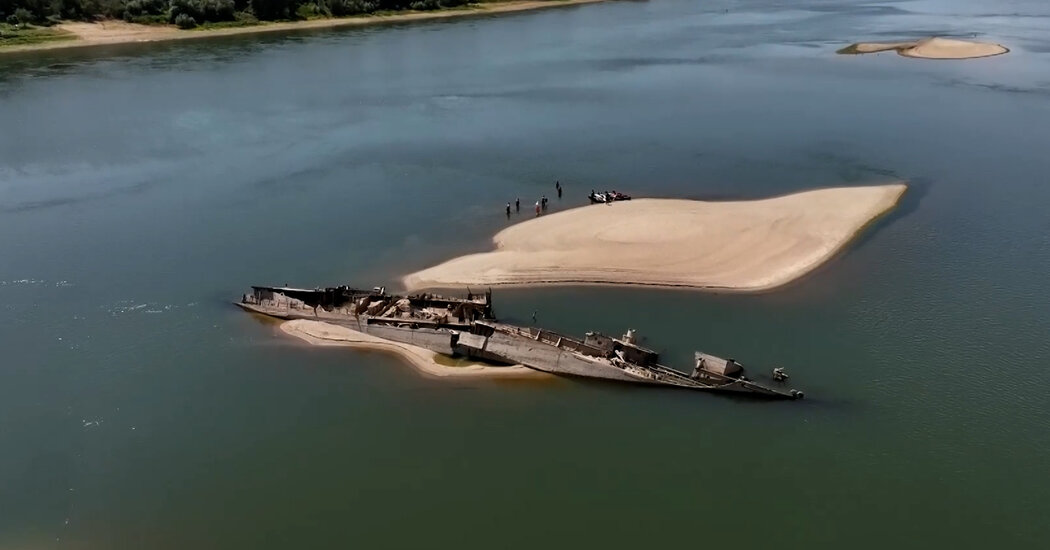
Serbia this week started pulling a sunken Nazi-era fleet out of the Danube River, where lowered water levels caused by extreme heat have exposed some of the vessels and created a headache for captains trying to navigate around them.
Near the end of World War II, Germany sank more than 200 of its own ships in the Danube in eastern Serbia, trying to block the Soviet Union’s forces as they advanced up the river. One or two rusted hulks have peeked above the water’s surface nearly every summer.
This year, however, residents of the nearby port town of Prahovo have counted at least a dozen — the latest visible sign that heat waves in Europe are becoming more frequent and more brutal.
“The wrecks appear almost every year, sometimes more, sometimes less,” said Igor Skodric, a local fisherman. “But this year the water level is extremely low, so ships have emerged that do not usually appear every year.”
The Danube, Europe’s second-longest river, winds through 10 countries, from Germany’s Black Forest to the Black Sea. Record heat in Central and Eastern Europe has led to lower water levels in the vital shipping route, making it difficult to navigate. In Serbia on Friday, temperatures hovered between 35 and 37 degrees Celsius, or 95 and 98.6 degrees Fahrenheit.
On Thursday, the Serbian government removed the first of the sunken Nazi-era vessels, a milestone in an effort that began in 2020 and which the government said at the time could cost 23 million euros.
The ships sunk by the Germans included minesweepers, patrol boats and artillery vessels, as well as tugboats, transport barges, landing craft and various support vessels. They were part of a convoy that retreated up the Danube toward Hungary and Austria in September 1944.
The receding water levels have made the salvage operation even more urgent. Some of the wrecks are believed to carry unexploded ordnance, posing additional risk to passing boats and making a salvage mission more dangerous.
“For the first time in 80 years, we have raised one of those ships today, and now we are going to raise all of them,” President Aleksandar Vucic of Serbia said on Thursday. He added that 80 of the ships would be salvaged, promising a cleanup afterward that could make the waters of the Danube in Serbia “as clear as they are in Vienna.”
The falling water levels have already slowed trade, Mr. Vucic said last week. Some parts of the river had become so shallow that the authorities had to create temporary channels.
“If the Danube drops another 30 centimeters — we are finished,” Mr. Vucic said in a statement last month.
Heat is also scorching other countries in the region. In Hungary, the Danube’s receding levels nearly forced the shutdown of the Paks nuclear power plant, Prime Minister Peter Magyar said on social media on Thursday. In Poland, where temperatures reached over 40 degrees Celsius (104 degrees Fahrenheit), Prime Minister Donald Tusk urged companies to let employees work from home or take precautions to protect them.
Farther upstream, the Slovakian police detonated a 1,543-pound World War II bomb that appeared as the Danube receded. The police said that weapon was identified as a British naval air mine from approximately 1944.
Serbia has not officially declared a drought, but the Danube’s levels are more than three feet lower than they would usually be at this time of year, according to Milenko Jovanovic, a meteorologist. Crops like wheat, soybeans and sunflowers have also suffered, he said.
“A meaningful recovery would require several consecutive days of widespread rainfall,” said Mr. Jovanovic, who is a founding member of the Expert Council of the National Ecological Association, a nongovernmental organization. “Unfortunately, such a weather pattern is not currently in sight.”
In Prahavo, Sasa Markovic, who navigates river vessels, noticed in the spring that the Danube was already low. Mr. Markovic said he recognized several of the vessels that are now visible, including the wreckage of two submarines.
In the autumn of 1944, German forces retreating to Central Europe used the Danube to transport troops, personnel and equipment, according to Bojan Dragicevic, an author and the producer of the documentary series “The Hidden Danube.”
Unable to pass much of the fleet through the Derdap Gorge, also known as the Iron Gates, between Serbia and Romania, captains decided to sink the ships, hoping to slow the Soviet forces advancing on them. Historians believe 218 vessels, including patrol boats, minesweepers and barges, were sent to the riverbed.
“The wrecks represent a kind of time capsule,” Mr. Dragicevic said. “After more than 80 years, the Danube is still revealing stories that have not yet been fully told.”
Zoran Lavric, who transports hazardous waste down the Danube, said he expected water levels to fall even more over the next two months. Jokingly, he expressed hope that the river might yield a discovery more enticing than war wreckage.
“Maybe something else will emerge,” he said. “Perhaps a chest of gold.”
