


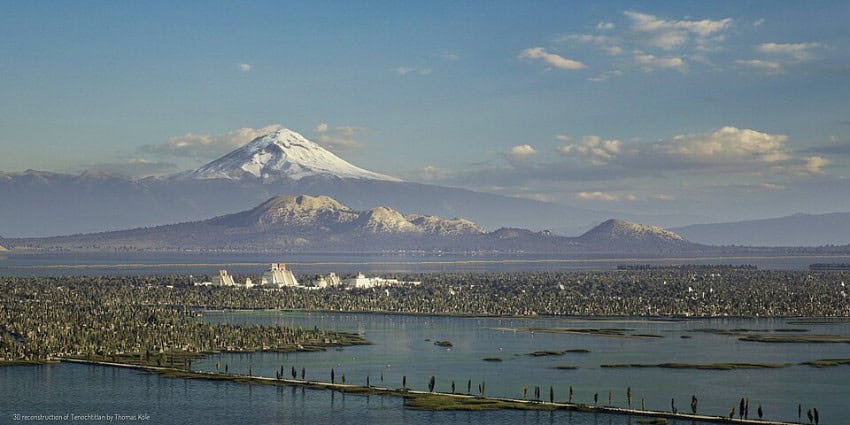
The place we recognize today as Mexico City — known in pre-Hispanic times as Tenochtitlán — has always been fascinating and cosmopolitan. Modern Mexico City is defined by its various hotspots, the different languages that drift across its streets, and cultural exchange on every corner.
But 500 years ago, the landscape was not that different.
Before the Spanish ever set foot in the Mexica capital, it was already lauded as one of the most important cities in the Americas, and it remained so after the conquest. In short, half a millennium ago, a city built in the middle of a lake fell so that an amphibious, metaphorical city could rise.
As the commemorative plaque at Tlatelolco states: “On August 13, 1521, heroically defended by Cuauhtémoc, Tlatelolco fell to Hernán Cortés. It was neither a triumph nor a defeat; it was the painful birth of the mestizo people that is the Mexico of today.”
An aquatic city
Everyone who has been to Mexico City during the rainy season knows that a trip across downtown is something of an odyssey. The city’s weather has not changed for thousands of years; what has changed is its inhabitants’ approach to it.
Tenochtitlán’s settlement on an islet in the middle of a lake made it unique, requiring the Mexicas to develop technology that remains innovative to this day: chinampas and a complex freshwater system.
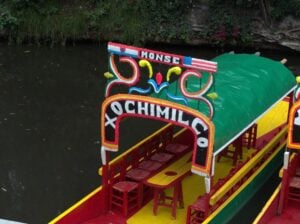
These conditions allowed crops to be cultivated around the city, boosting trade between different neighborhoods and establishing a symbiosis between humans and the natural environment. What we now call “bad weather” was eagerly awaited 600 years ago: the storms that made crops grow and the lake level rise.

The unveiling of a treasure
Drs. Antonio Rubial and Jessica Ramírez conducted extensive research on the city’s transformation, distinguishing Mexico-Tenochtitlán from any other major American city where the Spaniards chose to settle.
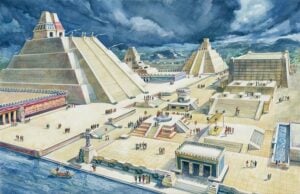
Given its impressive organization, Tenochtitlán was one of the most attractive urban centers in the Americas for the Spanish; however, the choice was not random. The city already possessed a perfectly coordinated political, social, economic and cultural system.
“Unlike Peru, where Lima, the Spanish city, and Cuzco, the Indigenous one, occupied two distinct sites, the founding of Mexico City on top of Tenochtitlán created a dual society within the same space: a Spanish center and an Indigenous periphery,” the authors state in their book, “Amphibious City: Mexico-Tenochtitlan in the 16th Century.”
As the experts describe, beyond precious materials, the Spanish found something far more valuable: an organized society they could leverage to extract resources from a new land — the direct ancestor of the city we inhabit today.
An amphibious city
Tenochtitlán’s grid layout reveals that it was a city of hierarchies. Its neighborhoods were carefully planned, featuring their own markets, schools and workshops. Canals were maintained to facilitate the transport of people and goods, while causeways and bridges stitched the whole thing together.
Ramírez looks to the past to remind us that today’s challenges stem from the dissolution of the environmental dynamics that locals maintained before the conquest. According to the researcher, the transformation was radical.
With these changes, the landscape underwent a profound metamorphosis. Massive logging to provide wood for colonial construction became a decisive factor in weakening the soil, which historically propped up lighter, balanced structures. What had once been crop fields became cathedrals in less than a century.
Likewise, a lack of understanding regarding water management played a fundamental role in mutating the ecosystem where the imperial capital had thrived. The destruction of the Nezahualcóyotl dike was a major blow, as it was a crucial mechanism for separating fresh and salt waters. Once this system ceased to function, food production changed completely.
A heart that beats, even after the conquest of the Americas
Despite the dramatic shifts the capital of the Mexica empire underwent throughout its existence, the identity of Mexico-Tenochtitlán survived the passage of centuries.
More than 500 years after the fall of Tenochtitlán, chinampas still survive, albeit with difficulty, on the city’s outskirts; markets remain filled with dozens of languages; and a city that once thrived over a lake continues to defy ever-growing urban development.
Ancient canals became the avenues traversed today by thousands of cars, while public squares remain gathering spots for surrounding communities. Its physical structure was altered, but its spirit never disappeared.
Where to find the ancient city
As the plaque at Tlatelolco reminds us, the fall of Tenochtitlán was “neither a triumph nor a defeat; it was the painful birth of the mestizo people that is the Mexico of today.”
This relationship between what’s dying and what’s being born is a classic dichotomy in Mesoamerican philosophy. We have to feed the deities of death in order to create life. In this symbiotic relationship, something always remains.
Removed from traffic and noise, Mexico City’s ‘floating gardens’ like another world
That’s why we can still see evidence of the old Tenochtitlán, not only as pieces in museums but as archaeological windows throughout the city. So, it is no surprise that the Museo de la Ciudad de México is guarded in one of its corners by a pre-Hispanic Quetzalcóatl, and the Centro Cultural de España en México holds an underground calmécac (the school for young nobles).
Despite much of the ancient city being swallowed up by conquest, its roots, much like its ancient waterways, run deep underground while also being reflected in the city’s surface, reminding us of the duality that defines the amphibious Mexico City.
Lydia Leija is a linguist, journalist and visual storyteller. She has directed three feature films, and her audiovisual work has been featured in national and international media. She’s been part of National Geographic, Muy Interesante and Cosmopolitan.
