


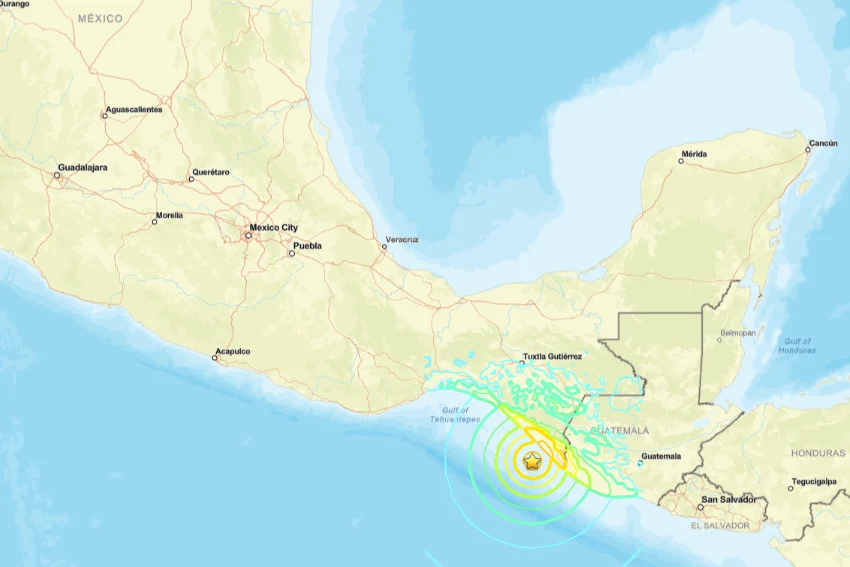
A powerful earthquake followed by five significant aftershocks rattled southern Mexico on Friday morning, prompting emergency evacuations in major cities and the activation of state and federal security and verification protocols.
President Claudia Sheinbaum spoke to the governors of Chiapas and Tabasco, saying in a social media post afterward that no initial damage had been reported. However, the Pacific Tsunami Warning Center issued an alert for Mexico’s southern Pacific coastline and Sheinbaum advised residents of Oaxaca and Chiapas to stay away from the ocean until late afternoon.
The epicenter of the initial earthquake, which the National Seismological Service registered at M7.4 on the Richter scale (with the M standing for magnitude), was located about 58 kilometers off the coast of Puerto Madero, Chiapas.
The earthquake was recorded at just before 8:49 a.m. at a depth of 10 kilometers, and was felt with strong intensity in the Tabasco state capital of Villahermosa about 500 kilometers (310 miles) to the north as well as in Antigua, Guatemala, about 300 kilometers (185 miles) to the east.
Five aftershocks occurred in the next 68 minutes, according to the U.S. Geological Survey: an M5.3 at 9:14; an M5.1 at 9:19; an M6.0 at 9:20; an M5.0 at 9:30; and an M5.1 at 9:57.
The tremors caused the emergency evacuation of hundreds of workers in various public and private buildings in Villahermosa, as well as the immediate activation of security and verification protocols by authorities.
Personnel from the Energy Ministry, the state-controlled oil company Pemex, the Governors Palace and the municipal City Hall took up positions at the designated shelters, while the Tabasco State Civil Protection Institute (IPCET) began structural review work.
Monitoring by emergency services was ongoing throughout the morning, while the authorities urged citizens to remain calm, ignore rumors, follow only official sources and report any potential structural damage to 911.
The federal Security Ministry (SSC) in Mexico City reported that residents in some areas of the capital felt the earthquake, but explained that it was not necessary to activate the seismic alarm because the tremors did not represent a risk to the city.
Even so, SSC agents were conducting patrols and preventive tours in different parts of the city, and helicopter overflights were being carried out.
Additionally, the National Coordination of Civil Protection is maintaining communication with state and municipal Civil Protection units, as well as with members of the National Emergency Committee.
With reports from El Universal, El Heraldo and Informador
