


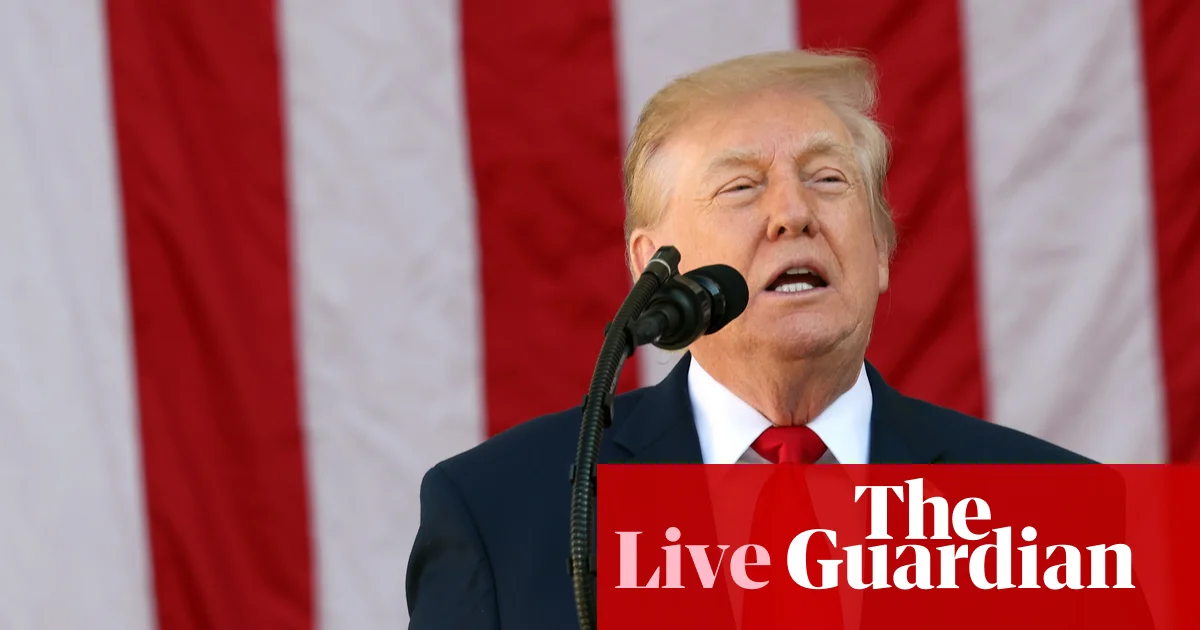
Trump defends Iran war with a big lie, and deflects blame for midterm losses with false claims about crowd sizes
In a friendly, softball interview with the sports pundit Stephen A Smith on Thursday at the White House, Donald Trump defended the Iran war with a big lie, and deflected blame for his party’s midterm losses with misinformation.
On Iran, Trump falsely claimed, as he has repeatedly, that the war he started in February was essential to prevent Iran from obtaining a nuclear weapon.
In fact, US intelligence agencies reported to Congress in 2025 that it was their assessment that “Iran is not building a nuclear weapon” and that the country’s supreme leader at the time, Ayatollah Ali Khamenei “has not reauthorized the nuclear weapons program he suspended in 2003”.
Three months after that assessment was written, Trump ordered the US bombing of suspected uranium enrichment sites in Iran, which could be used for peaceful energy purposes or weapons making, and declared in June 2025 that “Iran’s key nuclear enrichment facilities have been completely and totally obliterated.”
Speaking to Smith on Thursday, however, Trump claimed that the war he started with Iran just eight months later, in February, was necessary because of “the nuclear weapon that they were two weeks away from having”.
There is no public evidence that Iran had restarted the nuclear weapons program it suspended 23 years ago, but the rhetorical device of claiming that the regime was close to having a weapon has been deployed, for three decades, by Israel’s prime minister, Benjamin Netanyahu.
In the same interview, the president also sought to deflect blame from himself for the losses by Republican candidates for the US Senate in at least nine states he visited for campaign rallies in the closing weeks of the midterm campaign: North Carolina, South Carolina, Georgia, Mississippi, Texas, Kansas, Iowa, Michigan and Ohio. (He also visited Alaska to campaign for the Republican incumbent, who seems to be on track to lose as well.)
Asked by Smith what happened in the elections, Trump pointed to the candidates and reminded Smith that he won all of those states as a presidential candidate two years ago (before his popularity plummeted as a result of his decision to raise the cost of goods and fuel for Americans by imposing tariffs on imports and then attacking Iran).
He then suggested that he was still popular in all of those formerly Republican states that responded to his rallies by voting to reject the candidates he campaigned for. “I think I still have it,” Trump told Smith. “You saw with the rallies, I mean, the rallies were packed. We’d have 15, 20, 25,000 people at every rally,” he added, repeating a false claim he made at most of those rallies, which were, in fact, held in smaller venues, not all of which were filled to capacity.
In San Antonio, Texas, for instance, a spokesperson for the the venue Trump spoke at, Freeman Coliseum, told reporters the White House requested a three-quarter-house setup, so the hall was set up with 6,844 seats. In Greenville, North Carolina, he spoke to 5,000 people at the Pitt-Greenville Airport a fire marshal told the local News & Observer. In Port Huron, Michigan, he packed a small hockey arena with a capacity of 3,000 people. In Chillicothe, Ohio, Trump claimed that there were 42,000 people in attendance at a university sports center that holds 2,400 spectators.
Key events
Ariana Baio
in Denver
Congressman Jamie Raskin, a Maryland Democrat and the incoming chair of the House judiciary committee, told reporters on Thursday that one of his first priorities will be investigating the Trump administration firings of career justice department employees.
“That’s something that is central,” Raskin said of the firings that have taken place over the last two years.
The Maryland congressman said he expects, with majorities in both chambers of Congress, Democrats will have more authority to hold the administration accountable through the “power of the purse.”
Raskin is in Denver with other Democrats to discuss the next steps after winning majorities in the House and Senate.
Trump defends Iran war with a big lie, and deflects blame for midterm losses with false claims about crowd sizes
In a friendly, softball interview with the sports pundit Stephen A Smith on Thursday at the White House, Donald Trump defended the Iran war with a big lie, and deflected blame for his party’s midterm losses with misinformation.
On Iran, Trump falsely claimed, as he has repeatedly, that the war he started in February was essential to prevent Iran from obtaining a nuclear weapon.
In fact, US intelligence agencies reported to Congress in 2025 that it was their assessment that “Iran is not building a nuclear weapon” and that the country’s supreme leader at the time, Ayatollah Ali Khamenei “has not reauthorized the nuclear weapons program he suspended in 2003”.
Three months after that assessment was written, Trump ordered the US bombing of suspected uranium enrichment sites in Iran, which could be used for peaceful energy purposes or weapons making, and declared in June 2025 that “Iran’s key nuclear enrichment facilities have been completely and totally obliterated.”
Speaking to Smith on Thursday, however, Trump claimed that the war he started with Iran just eight months later, in February, was necessary because of “the nuclear weapon that they were two weeks away from having”.
There is no public evidence that Iran had restarted the nuclear weapons program it suspended 23 years ago, but the rhetorical device of claiming that the regime was close to having a weapon has been deployed, for three decades, by Israel’s prime minister, Benjamin Netanyahu.
In the same interview, the president also sought to deflect blame from himself for the losses by Republican candidates for the US Senate in at least nine states he visited for campaign rallies in the closing weeks of the midterm campaign: North Carolina, South Carolina, Georgia, Mississippi, Texas, Kansas, Iowa, Michigan and Ohio. (He also visited Alaska to campaign for the Republican incumbent, who seems to be on track to lose as well.)
Asked by Smith what happened in the elections, Trump pointed to the candidates and reminded Smith that he won all of those states as a presidential candidate two years ago (before his popularity plummeted as a result of his decision to raise the cost of goods and fuel for Americans by imposing tariffs on imports and then attacking Iran).
He then suggested that he was still popular in all of those formerly Republican states that responded to his rallies by voting to reject the candidates he campaigned for. “I think I still have it,” Trump told Smith. “You saw with the rallies, I mean, the rallies were packed. We’d have 15, 20, 25,000 people at every rally,” he added, repeating a false claim he made at most of those rallies, which were, in fact, held in smaller venues, not all of which were filled to capacity.
In San Antonio, Texas, for instance, a spokesperson for the the venue Trump spoke at, Freeman Coliseum, told reporters the White House requested a three-quarter-house setup, so the hall was set up with 6,844 seats. In Greenville, North Carolina, he spoke to 5,000 people at the Pitt-Greenville Airport a fire marshal told the local News & Observer. In Port Huron, Michigan, he packed a small hockey arena with a capacity of 3,000 people. In Chillicothe, Ohio, Trump claimed that there were 42,000 people in attendance at a university sports center that holds 2,400 spectators.
Trump defends Jensen Huang, claims Chinese woman he had an affair with might not have been a spy
Taking time out of his busy schedule of posting on social media, Donald Trump sat down for a lengthy podcast interview on Thursday with the sports pundit Stephen A Smith to express sympathy for Jensen Huang, who resigned as chief executive of Nvidia after reports of extramarital affairs with an alleged Chinese spy and two company employees.
Asked by Smith, a bombastic commentator who has floated the idea of entering politics himself, if Huang should have stepped down, Trump sighed deeply before saying: “Well, the big thing is, was the woman a spy? And I don’t know if that’s been determined yet, but if the woman was a spy, yes. If the woman was not a spy, perhaps it would be different.”
Trump also defended Huang, who sat at his table at a White House state dinner for China’s president, Xi Jinping, in September as “a tremendous talent”.
“I can tell you this, somehow he’ll end up in his feet,” Trump added. “I mean, I know him; I know him pretty well. I always thought of him as a fine man.”
“I spoke to him yesterday,” he president continued. “He’s he’s going through hell.”
“He called me as the president – I’m president – and he called me and he said, ‘What I’ve done to my wife and family is, is- that’s what he talked about,” Trump told Smith.
A return to normal politics: Darline Graham meets with South Carolina senator-elect Annie Andrews
During the final stretch of South Carolina’s Senate race, Darline Graham laced into her Democratic opponent Annie Andrews, calling her “bat shit crazy,” at a rally with Donald Trump, in what came off as a feeble attempt to match the president’s bravado.
After Andrews’s stunning win, in a seat left vacant by Graham’s late brother, Lindsey Graham, the two appear to be civil.
Graham smiled as she stood next to Andrews, in a Thursday photograph on X.
“I am committed to ensuring a smooth transition, and I wish her and her team the best,” Graham captioned the post.
Democrat Cindy Holscher elected Kansas governor to replace term-limited Democrat Laura Kelly
Democrat Cindy Holscher has been elected Kansas’ next governor, narrowly defeating Republican Ty Masterson to keep the office in her party’s hands and extend a massive wave of Democratic victories across the country.
Democrats had already secured a majority of governorships in US states for the first time in two decades, even prior to the narrow win in Kansas, where Holscher had already declared victory but the Associated Press did not call the race until Thursday.
Holscher, a state senator, promised to halt new data centers and overcame a flood of money that Republicans poured behind Masterson, the president of the Republican-controlled state senate. She will succeed outgoing governor Laura Kelly, a Democrat who was barred from running for a third term by term limits.
Kelly, a centrist Democrat, had opposed the more progressive Holscher in the Democratic primary, and endorsed her rival, state senators Ethan Corson, but campaigned for the party’s nominee in the general election.
In a campaign ad supporting Holscher last month, Kelly described Masteron as an extremist and assured voters the Democrat would “govern from the middle”.
Masterson, who was endorsed by Donald Trump, remains the Kansas state senate’s Republican leader.
Retaining the governor’s mansion was the third in a series of big wins for Kansas Democrats, after Adam Hamilton was elected to the US Senate, defeating the Trump-backed incumbent Roger Marshall, and Chris Mann defeated the state’s incumbent Republican attorney general Kris Kobach.
Kobach has helped sow doubt about US elections and served as vice-chair of Trump’s short-lived commission on election fraud in 2017, when he tried, and failed, to find evidence to support Trump’s baseless claim that he had not lost the popular vote in the 2016 election.
Mann, a former police officer, had narrowly lost to Kobach in 2022.

Ariana Baio
in Denver
Rob Sand, the governor-elect of Iowa, said Democrats should be cautious about spending too much time pursuing Trump administration investigations, claiming voters want to see progress, not rehashing of old wounds.
“Every time I read, right now, about more investigations of things that have already been reported on in the media, I’m thinking, why do we need to investigate that? It’s already been reported on. Why don’t you do something actually productive or better people’s lives,” Sand told reporters on Thursday in Denver at the What’s Next conference on the future of the Democratic party.
Sand recalled that while serving in the Iowa State Auditor’s office, the team typically did not pursue investigations that had been fully reported on because the public was already aware of potential corruption or misuse of taxpayer funds.
“I think that’s a pretty simple guideline for people,” Sand said. “Put your time into doing something that’s actually going to improve people’s lives and not just remind them of a bad thing that the other side did.”
Sand, who largely campaigned on a platform of being independent and called for the end of the two-party system, said he’s chosen to come to the What’s Next conference because he liked the organization behind it, Majority Democrats.
“I’m here for a day,” Sand said. “I think it’s important to talk about what we did in Iowa and anytime I can spread the message about making politics, making government, not redder or bluer, but redder and truer, I want to take that opportunity.”
Senate Republicans press ahead with confirmations of federal judges nominated by Trump
While votes are still being counted in one tightly contested Senate election, the race in Alaska where Democrat Mary Peltola now holds a 3,975 vote lead over the nearest Dan Sullivan – the one who is the Republican incumbent – the outgoing Republican majority in Washington is using its final weeks in charge to stack the federal courts with as many judges nominated by Donald Trump as possible.
The Senate has already voted on Thursday to confirm one conservative, Gregory Cook, to be a US district judge in Alabama, and to move to final votes on Trump’s nominations of two judges he previously installed on the federal bench – Daniel Domenico and Anna St John – to serve on federal appeals courts.
The vote on St John’s nomination began with a flub by the senator presiding over the Senate, Darline Graham, the South Carolina Republican who is still serving out the remainder of her late brother Lindsey’s term, which ends in January, despite losing the seat to Democrat Annie Andrews last week.
Reading aloud from a piece of paper in front of her, Graham called the vote to end debate on St John’s nomination by mistaking the abbreviation for saint in her name, with the one for street. “The question is,” Graham said, “is it the sense of the Senate that debate on the nomination of Anna Street John of Louisiana to be United States judge for the fifth circuit shall be brought to a close?”
The Alliance for Justice (AFJ), a progressive judicial advocacy group, strongly opposed all three nominees.
Cook, who worked as a volunteer attorney in the 2000 Bush v Gore legal battle, is described by the AFJ as “a lifelong conservative who has consistently aligned himself with extremist ideologies in pursuit of more political power” whose “track record demonstrates a commitment to corporate interests and the spread of conservative ideology — not justice.”
Domenico, who is described by the AFJ as a potential supreme court nominee, was nominated to the US district court in Colorado by Trump in 2019. This year, Trump picked him to serve on the US court of appeals for the 10th circuit in Denver.
In January, when Trump nominated Anna St John to serve as a federal judge for the US district court for the Eastern District of Louisiana, the AFJ wrote that she “has spent her legal career silencing women, attacking LGBTQ+ rights, and cutting off corporate accountability for everyday people.” Before being confirmed to that role, and then nominated to a federal appeals court in New Orleans, St John led the Hamilton Legal Law Institute, which the AFJ calls “a far-right extremist organization that routinely files lawsuits to attack civil rights, undermine consumer protections, eliminate gender equality, and deny basic human rights”.
In her confirmation hearing for her elevation the the appeals court in August, St John refused to say that Trump lost the 2020 election and refrained from characterizing the January 6 2021 Capitol riot as an insurrection.
Ariana Baio
in Denver
Democrats from across the country have gathered at the What’s Next conference in Denver to discuss what the party should do moving forward – now that they’ve secured majorities in the US House and Senate, and won control of the governor’s offices in a majority of states.
The conference, hosted by the group Majority Democrats, is bustling with excitement. In the outdoor space, there’s a six-piece jazz band playing upbeat variations of Americana songs, flanked by a colorful food truck.
The main stage event will be livestreamed, starting at 2:30 Mountain Time.
In the further annals of Donald Trump not changing a thing since last week’s midterm election defeat, he also mused earlier today on Truth Social: “Will the Seditious Six ever be prosecuted?”
“What they did was a great violation to our Country and its Constitution!” the president added.
It’s a reference to six Democratic lawmakers who last year published a video reminding members of the military and intelligence community that they can refuse illegal orders, amid concerns that Trump would attempt to use them against his political adversaries.
Here’s what senator Mark Kelly had to say about Trump’s latest threat:
The American people delivered a massive rejection of Donald Trump’s chaos and corruption last week. Now he’s again threatening to prosecute people who stand up to him because he’s afraid of being held accountable. Donald Trump has tried and failed to intimidate me for a year now. His threats won’t stop me from doing my job.
Immediately after Republicans suffered a drubbing in last week’s midterms, Donald Trump made some comments indicating he’d considering working with the incoming Democratic majorities in the Senate and House of Representatives.
Just about everything he’s done since – from appointing immigration hardliner Stephen Miller his chief of staff to threatening one of the top Democratic investigators – indicates he’s not looking to change much at all. Further evidence arrived this afternoon in the form of a Truth Social post, where the president says he’d like to work with Chuck Schumer on fighting corruption – but only in states led by Democrats.
“Billions of Dollars are being stolen on an hourly basis. Hopefully his words will ring true! It will be an honor to work with him on this very big Democrat problem that, when solved, will literally balance the Budget of the U.S.” the president writes.
Little he writes in that sentence appears to be true. There are 8,760 hours in a year, and the Government Accountability Office estimated in 2024 that between $233 bn to $521 bn are lost to fraud annually – so certainly not billions “on an hourly basis,” as Trump wrote. Meanwhile, there are unanswered questions around how Trump has gone about increasing his wealth since he’s been president:
Democrats may have ridden voter concerns over the war with Iran to their largest congressional majority in years in last week’s midterm elections, but Donald Trump today announced that the US is no longer bothering to find peace with its Middle Eastern adversary. Here’s more, from the Guardian’s Andrew Roth:
Donald Trump has said that the US is no longer seeking a deal to end the war with Iran and ordered JD Vance, who had spearheaded recent efforts to restart negotiations with Iran, to focus on domestic politics instead.
In a post to his social media site on Thursday, Trump said he was redirecting the vice-president to focus his “complete and total attention on the Massive Corruption and Crime taking place in Democrat run Cities and States throughout the U.S”.
Vance had reportedly been talking to intermediaries in Iran and Qatar about restarting negotiations to end the war, which began in February when the US and Israel launched joint strikes on Iran. Iran responded by closing access to the strait of Hormuz, which led to a steep increase for the cost of fuel around the globe.
But on Thursday Trump appeared to shut down the negotiations, redirecting Vance to focus on domestic issues and downplaying the need for a final deal.
“We don’t need a deal with Iran,” Trump wrote. “Those days have long since passed. We’ve got their money, Hundreds of Billions of Dollars, and we’ve got their Strait!”
We reported earlier that Ukraine’s president has said that Starlink, the satellite internet service it relies to counter Russian drone attacks, has slowed down, hampering its defenses.
Democrats are already expected to investigate a number of the activities of Elon Musk, who controls Starlink, and whether the service is being deliberately throttled for Ukraine could be on their list. While many of these inquiries are sure to be strictly partisan affairs, Michael McCaul, an outgoing House Republican who supports defending Ukraine against Russia, just signaled his support for this particular line of questioning, writing the following on X:
I am deeply concerned by reports that Ukraine’s access to Starshield has once again been restricted. These capabilities play a critical role in Ukraine’s defense against Putin’s relentless missile and drone attacks, which target civilian homes, parks, hospitals, and energy infrastructure.
With peace negotiations on the horizon, maintaining Ukraine’s momentum and leverage is more important than ever. I urge a full investigation into why these disruptions have now occurred twice and call for measures be put in place to ensure it does not happen again.
Donald Trump’s health secretary, Robert F Kennedy Jr, is facing potential legal trouble after a Democratic senator opened an inquiry into whether the lied to Congress, citing reporting by the Guardian. Here’s more, from the Guardian’s Michelle R Smith:
A top Democratic senator has launched an investigation into evidence that Robert F Kennedy Jr “unlawfully lied” in his 2025 confirmation hearings to become the US health secretary, citing a report by the Guardian.
Ron Wyden of Oregon, the incoming chair of the powerful Senate finance committee, is seeking extensive records from Children’s Health Defense (CHD), the non-profit anti-vaccine group Kennedy has used as a vehicle to fuel his political rise, including all documents related to a 2019 trip Kennedy took to Samoa.
“We are beginning an investigation into evidence that Secretary of Health and Human Services Robert F Kennedy, Jr unlawfully lied to Congress on multiple occasions,” Wyden said in a letter to the group that was sent on Wednesday and obtained by the Guardian. The letter was also signed by Angela Alsobrooks, a Democratic senator from Maryland.
In the letter, the two lawmakers cited reporting by the Guardian that indicated Kennedy lied about his reasons for going to Samoa in 2019, a trip that occurred just months before a measles outbreak killed 83 people in the Pacific island nation, mostly children under age five.
The trip, which Kennedy made as the chair and chief legal counsel of CHD, became one of the most criticized events in his career before he entered government. Critics, including Samoan officials, have said Kennedy’s presence emboldened anti-vaccine activists in Samoa, worsening a vaccination crisis. Kennedy has denied the allegations, saying he never gave any public statement about vaccines or discouraged Samoans from getting vaccinated.
The Trump administration faces an investigation of its scheme to take a 15% cut from any Nvidia chip sales going to China, as part of a deal to secure export licenses for the semiconductors.
Under the scheme, Nvidia chips made in Taiwan could be sold to Chinese companies if they were imported to the US first for a security review. This also made them subject to a 25% tariff under section 232 of the Trade Expansion Act of 1962, which was aimed at dealing with imports that threaten national security. The commerce secretary could then grant an export licence to sell the chips to China.
Two Democratic senators are now demanding Trump officials retain all records relating to the scheme as the fallout from now former Nvidia CEO Jensen Huang’s affair with a suspected Chinese spy continues to grow.
Senate finance committee ranking member Ron Wyden and House ways and means committee ranking member Richard E. Neal said they were beginning to investigate following reports of the affair – which led to Huang’s resignation on Thursday. One focus of the investigation appear to be report that both commerce secretary Howard Lutnick and Donald Trump were briefed about the relationship but granted export approvals anyway.
In a statement, Wyden and Neal said:
The Trump administration’s ostensible attempt to mask an unconstitutional export tax as a national security tariff action – benefitting both Nvidia and the Chinese government – raises serious concerns within our committees’ jurisdiction over matters relating to taxation and tariffs.
Congress wrote Section 232 to give the president a tool to take action against imports he has determined to pose a national security threat; Trump’s use of the statute appears to have done the opposite, undermining US national security and putting Americans at risk.
