


One of the matchups in the WNBA semifinals is set. The Atlanta Dream secured their spot Wednesday as they swept the Washington Mystics with a 93-75 victory.
The No. 4 Dream will face the No. 8 New York Liberty in the semifinals. The Liberty knocked off the top-seeded Minnesota Lynx on Tuesday.
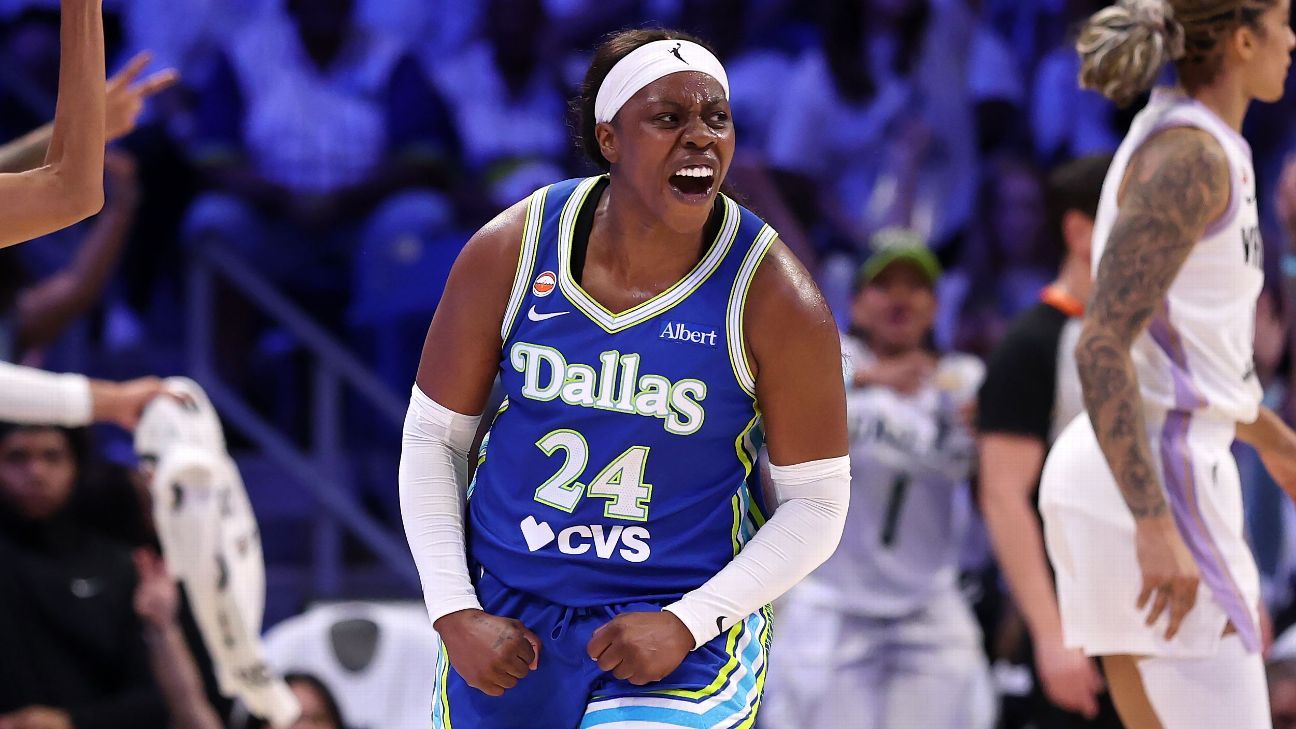
The other side of the bracket won’t be decided until Friday. Fueled by Arike Ogunbowale’s single-game, WNBA playoff-record 45 points, the No. 7 seed Dallas Wings rallied to upend the No. 2 Golden State Valkyries 108-100 in overtime.
They’ll meet again in a decisive Game 3 on Friday (9 p.m. ET, ESPN2) at Golden State. The winner advances to the semifinals against the winner of Thursday’s Indiana Fever-Las Vegas Aces Game 3.
The semifinals open Sunday. Atlanta, headed to its first semifinals since 2018, will host the Liberty in Games 1 and 2 of the semifinals.
ESPN takes a look at how Atlanta advanced, Dallas extended its series and Ogunbowale made history.
How the game was won: Two words: Arike Ogunbowale. The Dallas guard’s 45 points are the most in a playoff game in WNBA history, and propelled the Wings to force a Game 3. The eight-year veteran had a number of jaw-dropping shots throughout the night: a 3-foot jumpshot to end a 5-minute Dallas scoring drought. A corner 3-pointer with a defender’s hand in her face to tie the score with four seconds left in regulation. A banked-in 3-pointer to open overtime. Then there was the back-breaking shot with 1:40 left in OT to all but seal the game for the Wings. She scored 13 of the Wings’ 21 points in clutch time, according to ESPN Analytics. At 29 years, 212 days old, Ogunbowale is also the oldest player in league history with a 40-point game in playoff history, which has happened just seven times.
This kind of performance from a vet was exactly what the Wings needed, and she wasn’t the only one to step up. Alysha Clark scored 21 points off of the bench on 6-of-7 shooting, including three 3-pointers. Meanwhile, fresh off of a historically efficient Game 1 (21 points on 9-for-10 shooting), Paige Bueckers struggled, and was held to 10 points on 3-of-13 shooting. Heading into the series, Golden State’s No. 1 defensive goal was to eliminate Bueckers. Even though she started the series strong, the Valkyries were pleased that all of her points were earned, not given, and none of her teammates helped enough.
But it was a different story in Game 2. The Wings looked far more comfortable from the jump and corrected the biggest mistake Bueckers said they made Sunday: let their made or missed shots dictate their defensive efforts. On Wednesday, they picked the Valkyries up on defense in a full-court press, pushed in transition and were more aggressive in cutting to the rim.
Gabby Williams did everything she could for Golden State, finishing with a career-high 36 points, five 3-pointers, seven assists, six rebounds and four steals. She and Ogunbowale became the first opponents to each score at least 35 points in the same game in WNBA postseason history.
The most decisive moment of the night came with just three seconds left in regulation. With the score tied at 93, Williams was called for a foul on Aziaha James. But after a challenge from Golden State coach Natalie Nakase, the officials overruled their initial call, stating that since there was no clear possession, there was no foul and there would be a jump ball at center court. This led the game into overtime. Fittingly, it started with a difficult bank 3-pointer from Ogunbowale.
What it means for Dallas: The Wings showed what they’re made of to force overtime, stave off elimination and secure a winner-take-all Game 3 back in the Bay Area on Friday. It was a remarkable turn of events after they struggled mightily in Game 1, trailing by as many as 36 before losing by a slightly more respectable 24-point margin. The way Dallas was able to win on an off night from Bueckers showed the Wings are more of a complete team than some have given them credit for. Of course, Ogunbowale’s 45-point heroics made that possible, as she further cemented herself as one of the most clutch shooters in women’s basketball history.
What it means for the Valkyries: Golden State has to defend home court — which the Valkyries have done all season long. Expect Ballhalla to be pure insanity as the Valkyries look to close out a playoff series for the first time in franchise history. Even though they lost Game 2, the Valkyries should be encouraged by what they have shown so far in the first round. In Game 1, they had a historic scoring night and blew out the Wings. In Game 2, they held Bueckers to 10 points and still saw an elite offensive night from Williams. Offense was always the big question for the Valkyries, so seeing the scoring so far this series is a good sign. Williams has established herself as one of the anchors of the Valkyries defense, but also their big-time scorer — and they will look to her to lead them again in Game 3. — Kendra Andrews

How the game was won: Allisha Gray was the biggest factor for the Dream. The guard had a team-high 22 points and kept making big plays every time the Mystics threatened to come back. Point guard Jordin Canada also was key, finishing with 19 points, 11 assists and seven rebounds. The experience of the Dream’s players vs. the Mystics was expected to be a factor in this series, and that’s how it played out. Gray is in her 10th season and Canada is in her ninth, having won WNBA titles in 2018 and 2020 with Seattle. When the Dream needed to lock down in Games 1 and 2, the veterans knew how to do it.
In a foul-plagued game — 53 combined — Dream guard Rhyne Howard fouled out with 6:03 remaining in the game. She left with 15 points, but Atlanta didn’t struggle without her. All five Dream starters finished in double figures. It wasn’t surprising that the Dream lost the board battle; they were second to league-leading Washington in the regular season in rebounds per game. But the size of the rebounding margin — 42-27 for the Mystics — was a little surprising. Still, the Dream held the Mystics to 38% shooting and for the most part controlled the game, even if Washington stayed in it until Atlanta shut the door with a 28-17 edge in the fourth quarter.
What it means for the Dream: For the first time since 2018, the Dream are in the semifinals. They lost in the first round the last three years. Last season was particularly frustrating, because they lost Game 3 at home to Indiana. This year, they didn’t let it get to a Game 3. While they trailed by five at halftime of Game 1, they owned the second half of that contest. A strong performance in back-to-back games sends them confidently into a matchup with the New York Liberty, who swept their first-round series against the top-seeded Minnesota Lynx.
The Liberty are the No. 8 seed, but this is a case where numbers are deceiving. New York had its ups and downs in the regular season, but no one really thought of the Liberty as a typical No. 8 seed. The Dream won the regular-season series 2-1, with the last two games coming in the final week of the season at New York. Atlanta won both, 95-84 on Sept. 21 and 83-65 on Sept. 23, although the Liberty’s Breanna Stewart didn’t play in that last game.
New York won its first WNBA title in 2024. Atlanta has been swept in all three of its WNBA Finals appearances (2010, 2011 and 2013).
What it means for the Mystics: As ESPN colleague Kareem Copeland said, the Mystics were playing with house money in this postseason. Lots of teams clamor to be underdogs, but Washington really was. At the start of the season, few picked the Mystics to make the playoffs, yet they ended up with the No. 5 seed. As the youngest team (by average age) in the WNBA, the Mystics are ahead of schedule. Most of their players had never appeared in the postseason before, and now they have that experience.
Center Shakira Austin, who moved into elite status in 2026, struggled in her final game of the season, finishing with nine points and three rebounds. But the entire season is something for her to build upon. Sonia Citron (25 points, seven rebounds) and Kiki Iriafen (15 points, 16 rebounds) did all they could Wednesday to extend the series. What a year it has been for that duo, who were the No. 3 and No. 4 picks of the 2025 draft. They not only helped get the Mystics back into the playoffs for the first time since 2023, but they also were part of the gold-medal-winning U.S. team at the FIBA Women’s World Cup.
Iriafen just turned 23 last month, and Citron will be 23 on Oct. 22. Austin is 26. That is a young trio who Mystics fans should be excited to watch in 2027. — Michael Voepel
