


This article is an on-site version of our FirstFT newsletter. Subscribers can sign up to our Asia, Europe/Africa or Americas edition to get the newsletter delivered every weekday morning. Explore all of our newsletters here
Good morning and welcome to FirstFT. In today’s newsletter:
-
Oil hits $100 for the first time since July
-
AI researcher warns labs are ‘gambling’ with the future of humanity
-
The challenges of getting Donald Trump’s ‘Golden Dome’ off the ground
-
The rise and fall of Leon Black
You can listen to today’s top news stories in the FT News Briefing podcast.
Oil prices have risen above $100 a barrel for the first time since July as an escalation of hostilities in the Middle East raises fears about global supplies.
Brent crude, the international oil benchmark, rose 2.1 per cent to just over $100 a barrel this morning, topping the key level for the first time since July 24.
The rise comes as the US and Iran battle for control of the Strait of Hormuz, through which about a fifth of the world’s oil and gas passed before the conflict, with the warring parties exchanging tit-for-tat strikes on shipping in the region.
US forces said they “destroyed” five Iranian crude oil tankers yesterday. The US strikes were in retaliation for the Islamic Revolutionary Guard Corps targeting an American warship with ballistic missiles twice over the past two days, said US Central Command.
Earlier today, Iran said that in response it had targeted two US vessels and eight oil tankers, “inflicting heavy damage”. In addition, its Revolutionary Guards said 10 ships that had “attempted to cross the prohibited and unsafe area of the Strait of Hormuz” had been targeted. The IRGC also said it launched ballistic missile strikes on the US Al-Azraq air base in Jordan.
The escalation in the Middle East comes as traders and analysts warn of a renewed supply crunch in oil markets as countries draw down strategic reserves.
-
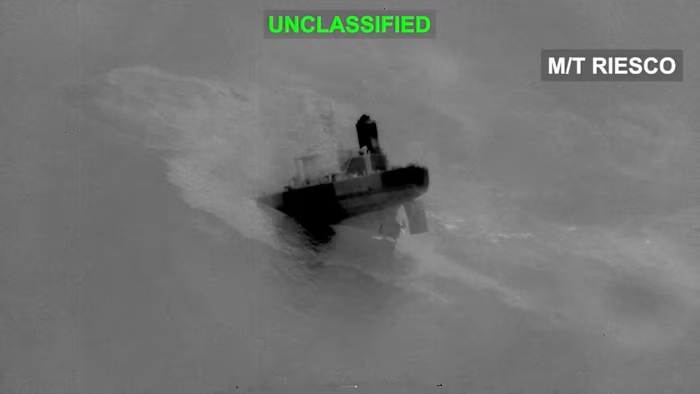
More on the Strait of Hormuz: The US military operation to de-mine the strait involves Navy Seal divers, robot boats and specialised underwater craft.
Here’s what else we’re keeping tabs on today:
-
Apple launch: New chief executive John Ternus is set to unveil his first new products as chief executive, including a $2,000 foldable iPhone.
-
US politics: A two-day Republican midterm convention begins in Dallas, Texas, where President Donald Trump will try to put a lid on internal tensions within his party.
Join senior leaders from across the global entertainment industry at the FT Business of Entertainment Summit on September 24. Explore the trends shaping the future of film, television, gaming and music. As an FT newsletter subscriber, you can get 10 per cent off your pass with code FTsub10 or automatically applied at checkout.
Five more top stories
1. Scott Bessent has warned traders not to bet against the yen. Speaking at an event in Texas on Tuesday, the US Treasury secretary said: “I have asymmetric information. I am the house now.” His comments follow the unusual joint US-Japan intervention in the yen at the end of July and are the latest sign of the US Treasury’s growing activism in financial markets. The yen, however, reached a seven-month high against the dollar today.
2. UK airports have warned that passengers face another day of travel disruption after an air traffic control system failure forced airlines to ground more than 1,000 flights yesterday. The UK’s air traffic control system was thrown into chaos after a software failure stopped many flights at the UK’s busiest airports from landing and taking off.
3. The US has banned Canadian dairy products and other imports, including motorcycles and most alcoholic beverages, as it continues to expand a trade war with its northern neighbour. The ban on imports worth “billions” of dollars would take effect in three weeks, US officials said.
4. An Anthropic researcher has resigned from the AI lab, warning that the unchecked race to build self-improving superintelligence could destroy humanity by the end of the decade. Jacob Coxon, a 27-year-old British researcher at the San Francisco-based company, said Anthropic and its main competitor, OpenAI, were “gambling” with the future of humankind. It follows an earlier report in the FT that Anthropic declined to submit its latest model to Britain’s AI Security Institute for testing.
5. A defence start-up whose backers include US tech billionaire Peter Thiel’s Founders Fund is building three factories in the US, Germany and Israel to mass-produce long-range weapons designed to counter threats from China, Russia and Iran. Washington-based Covenant told the FT it was emerging from two years in secretive “stealth mode” in the company’s first media interview.
The holes in Trump’s ‘Golden Dome’
Donald Trump wants to build a “Golden Dome” in space that would prevent missiles launched by foreign adversaries from striking the US, realising an ambition that has long fascinated American presidents. Formidable engineering, financial and political obstacles stand in the way.
We’re also reading . . .
Chart of the day

School students’ reading scores have plunged across the developed world, as widespread access to AI and social media has harmed teenagers’ ability to concentrate, a report published by the OECD has found. Reliance on AI tended to produce worse scores in science for both pupils and education systems, the research showed, with 37 per cent of students prioritising “common sense” over scientific reasoning.
Take a break from the news . . .
Milan is basking in its fresh status as a hub for wealthy homebuyers looking for a European base, attracted by its flat-tax regime and high standard of living. Six city insiders share their house-hunting hacks.

Thank you for reading and remember you can add FirstFT to myFT. You can also elect to receive a FirstFT push notification every morning on the app. Send your recommendations and feedback to [email protected]
Recommended newsletters for you
The State of AI — A series of conversations between the Financial Times and MIT Technology Review on the geopolitics of tech. Sign up here
