


Like most music icons, Dolly Parton explored a variety of genres and styles in an extraordinary discography that began with her 1967 debut album — the country-flavored Hello, I’m Dolly — and concluded with the conceptual sass of Rockstar in 2023. Even though she never recorded in Spanish, Parton’s creative path crossed into Latin culture repeatedly — and she influenced countless artists in the Latin music world.

She frequently attracted Spanish-language stars and found camaraderie among them: Case in point, in 1994, Spanish superstar Julio Iglesias invited her to record a duet of the 1991 Diana Ross hit “When You Tell Me That You Love Me.” True to its Nineties roots, the arrangement was appropriately bombastic (don’t miss the electric guitar solo in the bridge.) Iglesias’s rico suave, international-playboy crooning style found its perfect counterpart in Parton’s fiery vocals.
In 2020, it was legendary Puerto Rican singer and guitarist José Feliciano who sought her out. He was in Nashville recording sessions for Behind This Guitar, Feliciano’s last studio LP to date. Producer Rick Jarrard suggested “Eagle When She Flies,” a self-penned composition that Parton had included as the title track of a 1991 album. Even though it was recorded remotely, their new version of the song is incredibly soulful, the effortless meeting of two legends who were clearly meant to harmonize together.
“After hearing it the very first time, I knew exactly what Dolly was saying, knowing certain women who are precisely what the song is about,” Feliciano stated at the time. “I needed to echo that myself. I am blown away, and so honored, really, that she offered to sing it with me. Dolly herself is a magnificent eagle.” When Parton turned 75 in January of 2021, Feliciano posted on social media a sweet homemade video performing “Happy Birthday” for her. “Thank you for sharing your music with me and the world,” he added.
Parton’s music also influenced many Latin stars who grew up in the U.S. Earlier this year, country singer Kat Luna recorded a Spanglish take of Parton’s 1973 farewell ode “I Will Always Love You” as a way of “staying true to my country roots and my Latin roots.” And in 2020, Chiquis Rivera teamed up with Becky G for a groovy cumbia version of the anthemic “Jolene,” which has been also covered by a number of mariachi ensembles.
“I was fascinated by the idea because it brings together our two worlds,” Becky G told Telemundo. “When they ask me where I am from, I always say that I’m Mexican. However, country music was always heard in my house, and our ‘Jolene’ is that. It has the essence of Dolly with a little bit of our itch.”
It was Rivera who initially reached out to Dolly’s camp asking for permission to record the song. “Dolly is an icon in music and for women,” she said. “She is an example to follow, and it is an honor to sing this song in Spanish.”
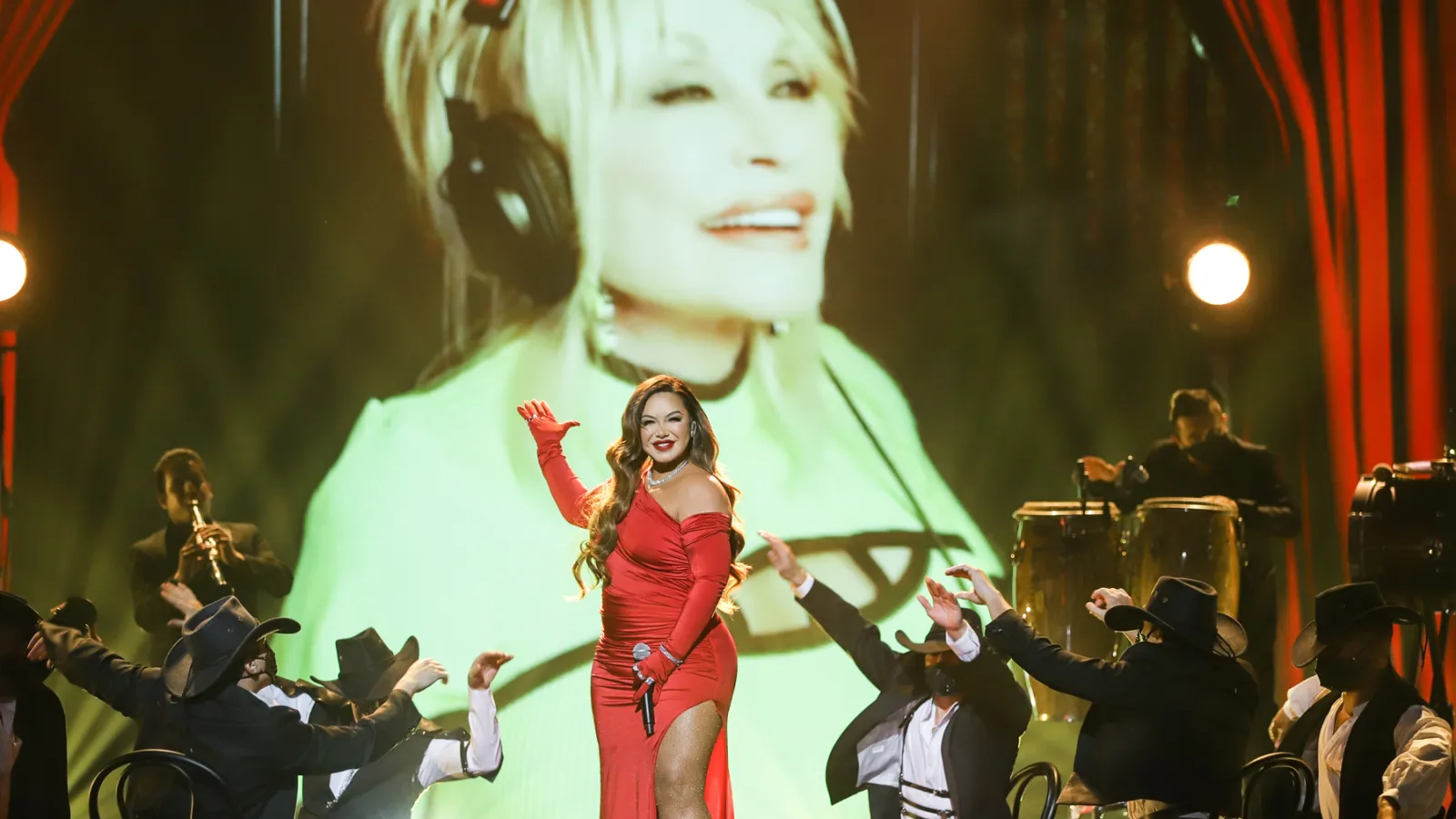
In May of 2021, Rivera got to perform “Jolene” with none other than Parton herself during Ellas y su Música, a two-hour celebration organized by the Latin Recording Academy. Though Parton appeared remotely on a screen, she brought her zest to the show. “Buenas noches, y’all,” Parton enthused before the song. “I would never pass up the opportunity to celebrate women in music in any language. We owe it to ourselves to stick together and lift each other up.”
At a personal level, Parton was involved in literacy efforts and social justice throughout her life. She brought this to her music: In 1980, her concept album about the working life, 9 to 5 and Odd Jobs, included a delicate cover of “Deportee (Plane Wreck at Los Gatos),” Woody Guthrie’s 1948 protest song about the racist treatment by the media of migrant workers who perished in a plane crash. “Goodbye to my Juan, goodbye Rosalita/Adiós mis amigos, Jesús and María,” she sings during the chorus in a calm, reflective tone.
She also kept Spanish-speaking families in mind on her groundbreaking Imagination Library project — providing a book per month to millions of children from birth until kindergarten — making sure that bilingual titles were included in its catalog.
Her death prompted an outpouring of tributes from the Latin music community. “Dolly was so much more than an extraordinary artist, songwriter and entertainer,” wrote Gloria Estefan on a lengthy Instagram post published in both English and Spanish. “She was a force of nature whose enormous talent was matched by an even bigger heart.”
One of the most touching tributes came from her longtime peer Linda Ronstadt. “I am deeply saddened by the passing of my friend Dolly Parton,” Ronstadt wrote on her Facebook page. Now retired, the Mexican American star stormed up the charts in 1987 with Trio, her Grammy-winning album in tandem with Parton and Emmylou Harris, followed by Trio II in 1999.
“One of the most extraordinary musical experiences of my life was recording with her,” said Ronstadt. “The world is a poorer place without her.”f
