


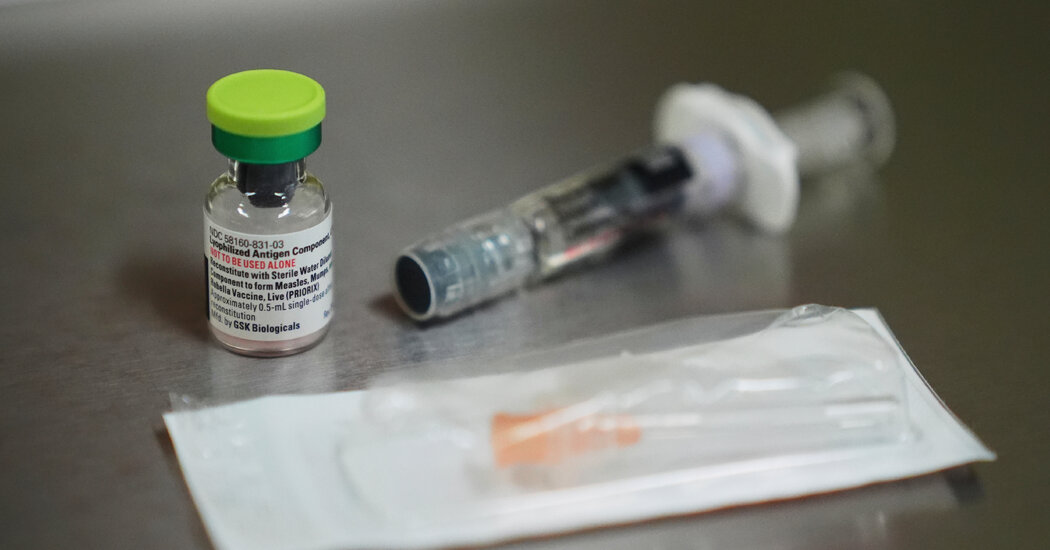
Two unvaccinated people in Pennsylvania have died from measles, as a large outbreak there continues to spread, the state’s Health Department reported on Tuesday morning. They were the first measles deaths this year in the United States.
The deaths come during a record-setting year for measles in the United States: More cases have been reported in 2026 than in any year since the virus was declared eliminated in 2000.
Outbreaks have popped up all over the country. Lancaster County, Pa., where both patients lived, has been at the center of an outbreak that has so far hospitalized 70 people and infected more than 390, a third of whom were children. Some public health experts believe this number to be a vast undercount because the area is home to large Mennonite and Amish communities that tend to avoid traditional health care.
Health officials, citing privacy reasons, did not say whether the two patients were children or adults.
Measles deaths are extremely rare in the United States. But the virus’s recent resurgence has caused a handful of fatalities. Two school-aged children and one adult died last year from measles complications, the first such deaths in the country in a decade.
“These five deaths that have occurred since 2025 are extremely, extremely rare in the modern era,” said Dr. Amesh Adalja, an infectious disease doctor at the Johns Hopkins Center for Health Security. “They’re also a harbinger of what is happening as this virus takes hold again in the United States.”
Public health experts are especially concerned because the school year is beginning, giving the virus more opportunities to spread among unvaccinated children, said Dr. David Kimberlin, a pediatric infectious disease expert at the University of Alabama at Birmingham.
The best way to protect against measles is with two doses of a vaccine, which is usually administered to children as a combination measles-mumps-rubella, or M.M.R., shot. Two doses of the vaccine prevent more than 97 percent of measles infections.
Nationwide, routine childhood vaccination rates have been on the decline, dipping below the 95 percent benchmark that experts say is necessary to stave off outbreaks. Within some pockets of Lancaster County, the vaccination rate is much lower: Just a quarter of people within the local Amish community had been vaccinated against measles, according to a 2025 estimate. Since the start of the outbreak, the state has run 91 different pop-up vaccination clinics, which have administered more than a thousand doses of the M.M.R. vaccine.
At a news conference, Gov. Josh Shapiro of Pennsylvania, a Democrat, said the federal government was partly to blame for the hesitancy surrounding vaccinations.
“When the information we see coming from the federal government in some cases isn’t driven by facts and by science,” he said, “it makes it even more confusing for parents, and that has a serious impact.”
Earlier this month, President Trump made the unsubstantiated claim that vaccinating against measles, mumps and rubella at the same time could be “quite lethal.” The nation’s health secretary, Robert F. Kennedy Jr., has long underplayed the seriousness of measles infections and spread misinformation about vaccines. In one instance, in 2021, Mr. Kennedy visited a farm in Lancaster County and told the Amish community there that health authorities wanted them to vaccinate “because they cannot stand the fact that you are healthy.”
Mr. Kennedy reached out to state officials on Tuesday morning and offered to send staff to aid in controlling the outbreak, Mr. Shapiro said, adding that he had declined the offer.
“I was very, very blunt with him,” Mr. Shapiro said. “I made very clear that his actions and the rhetoric that’s coming from this administration are having a negative impact on communities across America, particularly right here in Pennsylvania.”
In a statement posted on X, the Department of Health and Human Services said the Centers for Disease Control and Prevention is “working closely with state and local health departments to strengthen response efforts,” adding that the M.M.R. vaccine provides the most effective protection against measles.
While most measles cases are mild, roughly 1 in 5 unvaccinated people in the United States who contract the virus lands in the hospital. The virus is especially dangerous for children. Up to 3 out of 1,000 children with measles die from respiratory and neurological complications, according to the C.D.C. Roughly 1 in 20 children with measles goes on to develop pneumonia, which is the leading cause of death from measles among children. In rare cases, children can also experience brain swelling, which can leave them with lifelong hearing damage or intellectual disabilities.
There are no treatments for measles, though researchers are trying to develop some. In November, a panel of international experts will meet to determine whether the United States has officially lost its elimination status.
“Because measles was largely eliminated in the commonwealth for more than three decades, people are not familiar with this disease and don’t fully understand the potential severity of the illness,” said Dr. Debra Bogen, Pennsylvania’s health secretary.
