


Ana Paula Ruiz Gatica has dedicated much of her life to singing. From a very young age, at the Colegio Sagrado Corazón in the Pedregal neighborhood, one of the most exclusive schools for girls in Mexico City, “I participated in devotional singing to Jesus,” she told Mexico News Daily in an interview, which was translated for publication.
At age 14, she took her first yoga class. By 2016, she bought a ticket to India to study for nine months at the Kaivalyadhama Institute, the first yoga school to conduct research demonstrating the benefits and uses of the practice. And her path changed completely.
“I stopped seeing yoga as a series of postures and understood it for what it is — a holistic path that includes ethics, breathwork, meditation, singing, philosophy, ritual and devotion,” she said. She chose the path of devotion.
A more traditional approach
Ruiz Gatica acknowledges that during a trip to Thailand in 2015, she studied with Bikram Choudhury, the controversial Indian teacher who introduced hot yoga to the West. After years of study in India and other Asian countries, she returned to Mexico with the intention of bringing back some of what she learned “without diluting it, without embellishing it and without turning it into a product.”
At some point during that journey, she publicly became Ana Prana. That name, along with a series of courses she promotes with Yogendra Sharma, who holds a doctorate in Hispanic literature from the National Autonomous University of Mexico (UNAM), and Deepak Bhardwaj, an award-winning international yoga champion, has earned her more than 20,000 followers on Instagram.
Ruiz Gatica, Sharma and Bhardwaj promote yoga teacher training courses with a more traditional approach. When asked what she means by that, Ruiz Gatica explains that it refers to “the original texts, to the practices transmitted from teacher to student in a living chain.” Today, she and her two partners organize retreats and ceremonies woven through the chanting of devotional Indian music — or “meditation through the chanting of mantras.”
‘A tool of the mind’
From Sanskrit, mantra translates as “tool for the mind,” used to achieve a profound contemplative state. In Mexico City, as in other cosmopolitan Western capitals, this tradition of devotional chanting has intersected with New Age practices. Therefore, it is not uncommon to find kirtan events, or devotional chanting, that also include cacao ceremonies. Sometimes, DJ sets are featured to keep the evening going. The entrance fee for these events can start at US $30.

This type of fusion, however, is not seen on the holy days of the Sanatana Dharma tradition, the set of practices, philosophical schools and rites known in colonial times as Hinduism. Furthermore, these ceremonies are performed as part of the lunar calendar cycle.

Despite how other yoga centers in town practice kirtan ceremonies, Ruiz Gatica’s events focus mainly on the devotional dimension, as she aims for her ceremonies to be “a bridge between living Indian tradition and contemporary Western life.”
Gupta Navaratri in Mexico: The 9 secret nights
Recently, through her Instagram account, Ruiz Gatica announced a meditation cycle centered on Gupta Navaratri, the nine secret nights of the Brahmanic tantra tradition.
Unlike the large public festivals held along the banks of the Ganges River in India, these nine nights are meant to be kept secret — meaning they are practiced privately at home. For the 2026 edition, which took place July 15-23, Ruiz Gatica led the rituals online.
For this series of sacred nights, she underwent two weeks of preparation studying the Devi Mahatmyam, a sacred text of 700 verses written in the fifth or sixth century A.D. that describes the principal aspects of the Mother Goddess in all her forms. She accompanied her study with a daily practice of asana and pranayama — yoga postures and breathing techniques — “to sow the seed of sadhana (spiritual practice).” Ruiz Gatica is certain that, without these preparations, “the nine nights wouldn’t have landed in the same place.”
Each of these nine nights is dedicated to a specific goddess of the tantric tradition, or Mahavidya. Each represents a raw aspect of divinity in the Hindu tradition, such as time, radical offerings or the void.
Deepening connections
Once the preparations were complete, participants connected for nine consecutive nights via Zoom. “Each night,” she said, “we shared the energy of a specific Mahavidya and deepened our connection to that energy through mantra.”
After years of “holding sacred spaces,” as she describes it, Ruiz Gatica knows that many participants are women seeking a connection to spirituality through yoga. They may start a journey through postural yoga but wish to continue on the path of devotion, as she did.
Their age range is broad, from 25 to 65, and like her, these women have found something on the path of Bhakti, or ecstatic devotion in India, through guided meditations and chanting. “It’s a space for those who feel the calling,” she said. “Nothing more, nothing less.” Gupta Navaratri might just be the opportunity to dive deeper.
A shared connection with the mother
In previous articles for Mexico News Daily, the overflowing love Mexicans feel for the Virgin of Guadalupe has been discussed. This awe of the mother is not fear, but rather an ecstatic admiration. Ruiz Gatica believes this is a characteristic shared with the veneration of the goddesses in the Sanatana Dharma pantheon in all its forms.
Therefore, she believes there is a recognition of this same devotion that extends to female deities belonging to other cultures: “(In Mexico, there is) a living relationship with the sacred feminine that not all Western cultures maintain. When a Mexican woman encounters Kali, Lalita or Durga, there is a part of her that says: ‘I know this. This relationship with the mother is not new to me.’”
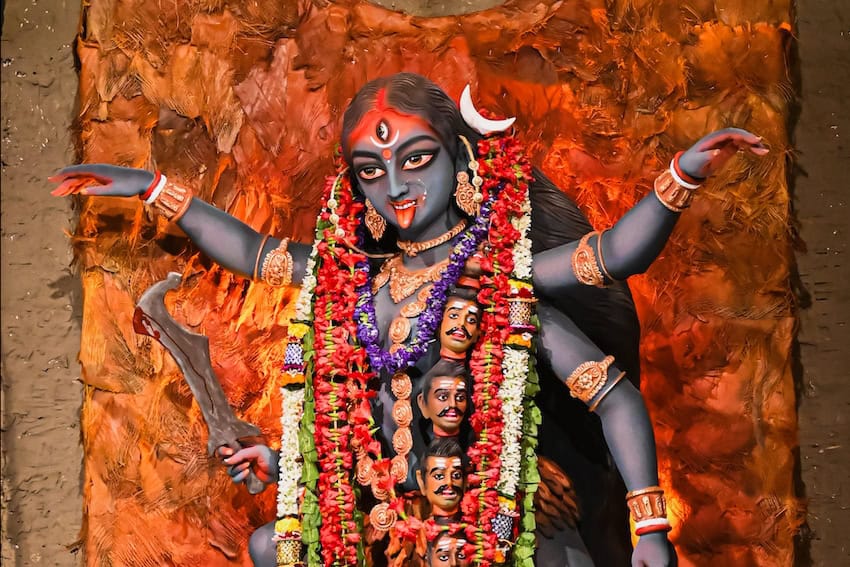
One of the goddesses venerated during Gupta Navaratri is Maa Kali, the goddess of destruction and time. Besides being one of the most revered tantric goddesses in Bengal in eastern India, she is also one of the Mahavidyas. She is depicted with a bare torso, flowing hair and wild eyes — an image far removed from the self-sacrificing representation of Our Lady of Guadalupe.
Separating goddesses from feminism
Perhaps that is also why Western women sometimes label her a feminist. Regarding this interpretation, Ruiz Gatica does not consider “Kali to be a ‘feminist goddess’ in the modern political sense of the term.” On the contrary, she says that would remove her from her cultural and religious context.

“Reducing Kali — or any goddess — to a feminist icon can be, paradoxically, part of the very problem of separation that she comes to break down. It is putting her into yet another category. Locking her in another box.”
It is also interesting that a large part of the devotion to the Black Mother, as she is also known in India, is comprised of men. This branch of Shaktism, or the veneration of the Mother Goddess, has roughly 300 million followers worldwide, according to census figures.
Therefore, it is clear that the goddess, in her destructive and transformative form, does not adhere solely to the Western logic of change and political renewal; ultimately, she is the force of time. “She doesn’t operate only on women,” Ruiz Gatica said. “She operates on consciousness itself.”
Andrea Fischer contributes to the features desk at Mexico News Daily. She has edited and written for National Geographic en Español and Muy Interesante México, and continues to be an advocate for anything that screams science. Or yoga. Or both.
