


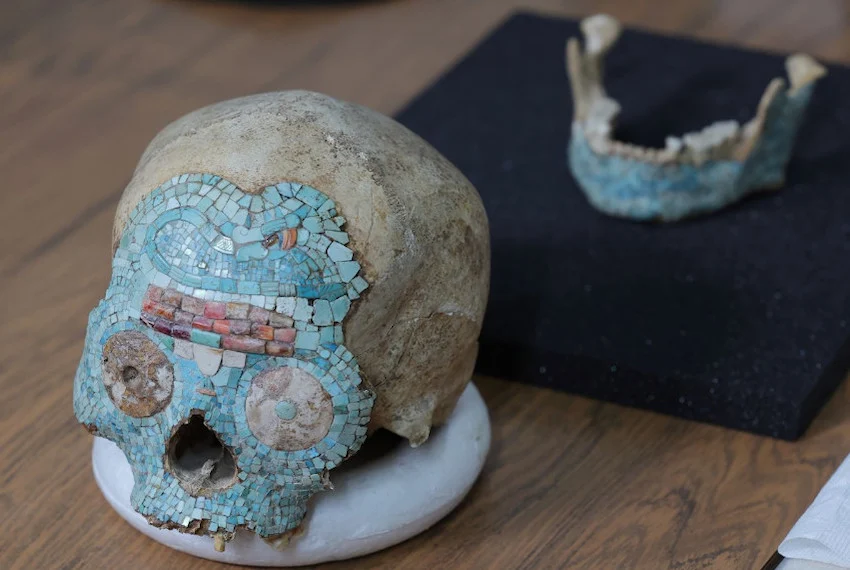
The National Institute of Anthropology and History (INAH) has confirmed that a turquoise-adorned skull returned to Mexico from the Netherlands is a pre-Columbian human skeletal remains from Mexican territory.
Although the exact origin of the skull has not yet been determined, its characteristics and the materials used to decorate it indicate it could possibly be from the Late Postclassic period (1200 to 1521 AD).
Ongoing analysis being conducted by INAH specialists suggests it likely came from a region that currently includes parts of the states of Puebla and Oaxaca.
The skull — adorned with a striking mosaic of turquoise, shell, jadeite and rock crystal — was returned to Mexico in May 2025 after spending some 60 years in a museum in the Netherlands.
The piece, acquired on the art market in 1962, had been on display at the World Museum (Wereldmuseum) in Leiden. The process of repatriation began to take shape in late 2023 after the Dutch museum contacted the Mexican Embassy in the Netherlands to address the issue.
A decade earlier, the Wereldmuseum had begun working with the French Center for Research and Restoration of Museums to determine its authenticity, prompting the decision to contact Mexican authorities.
Culture Minister Claudia Curiel de Icaza said that the recovery of the skull “demonstrates that collaboration between authorities and civil society can translate into actions of historical justice.”
Curiel also praised the Nohivi Ñuu Savi collective — an Indigenous grassroots group that focuses on protecting Mixtec rights, history, and culture, and bringing sacred heritage back to Mexico — for their contributions to the repatriation effort.
The Mixtec peoples are a major indigenous Mesoamerican group inhabiting the Mixteca region spanning the states of Oaxaca, Puebla and Guerrero.
In a press statement, INAH described the skull as being “partially covered with tesserae, like a mosaic, forming the schematic design of a snake on the frontal bone.” Tesserae are individual tiles used in creating a mosaic.
INAH analysis has identified the presence of modern adhesive substances, used to fix some areas of the tesserae, which may be due to a decorative rearrangement or reuse of the same by the original owner, before it was acquired by the museum.
Anthropologist Olaf Bello Cardoso hopes that further studies can serve to identify the person behind the turquoise mosaic and to understand if it was part of an offering dedicated to a principal figure.
With reports from El Cronista, El Imparcial, Ancient Origins and Heritage Daily
