

Introduction & Market Context
Unipar () presented second-quarter 2026 results on August 7 that showed a dramatic recovery in profitability, driven by surging international chemical prices and the successful completion of a major plant modernization project. The Brazilian chlor-alkali and PVC producer reported adjusted recurring EBITDA of R$ 402 million, up 177% from the first quarter, even as shares slipped 1.4% to $3.52 following the announcement.
The results reflected a quarter of sharp swings in the global chemicals market. International PVC prices jumped 53% from the prior quarter while caustic soda prices rose 26%, helping offset a 34% increase in European ethylene costs and currency headwinds from a 4% appreciation of the . The company’s Cubatão plant reached full operational capacity in April, two months after the technology upgrade was completed.
Quarterly Performance Highlights
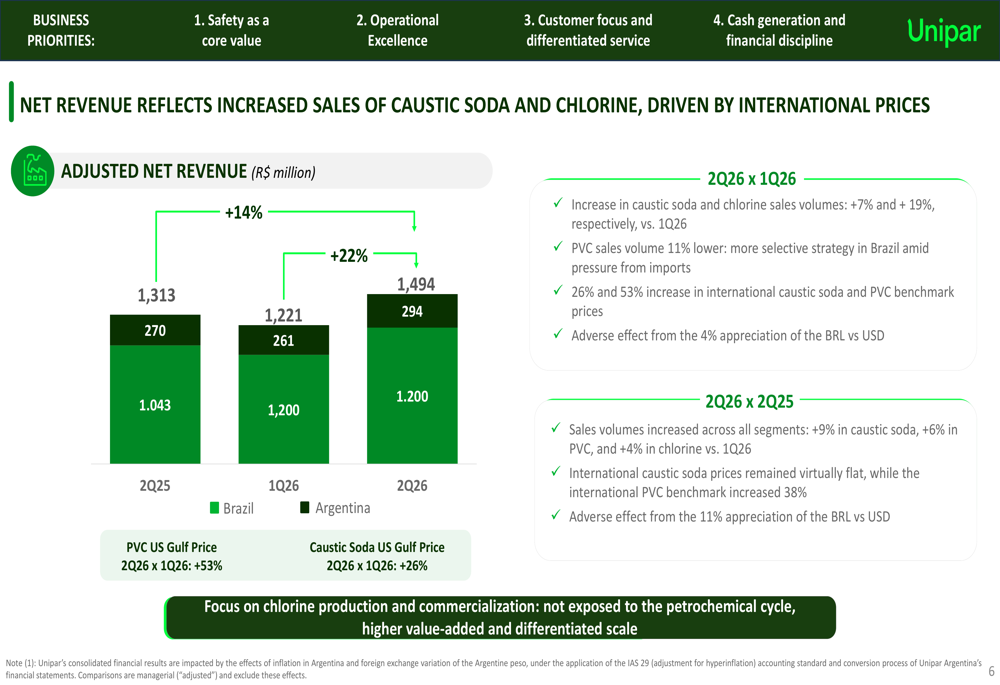
Net revenue climbed to R$ 1,494 million in the second quarter, up 22% from the prior year and 14% sequentially. The increase came despite an 11% decline in PVC sales volume from the first quarter, which management attributed to a selective sales strategy in response to import pressure in Brazil. Caustic soda volumes rose 7% sequentially and 9% year-over-year, while chlorine sales jumped 19% from the prior quarter.
As illustrated in the following overview of key performance metrics, the company delivered strong improvements across multiple financial and operational measures:
Net income reached R$ 123 million, more than tripling from R$ 37 million in the first quarter. Operating cash generation strengthened to R$ 347 million from R$ 316 million in the prior period, demonstrating the company’s ability to convert earnings improvements into cash despite higher working capital requirements from rising input and product prices.
The company’s leverage ratio improved to 2.50 times net debt to EBITDA from 2.58 times in March 2026, while its cash position of R$ 1.4 billion provided coverage for 34 months of debt amortization. Management highlighted that resilient operating cash generation and the normalization of strategic capital spending enabled the reduction in leverage.
Operational Excellence
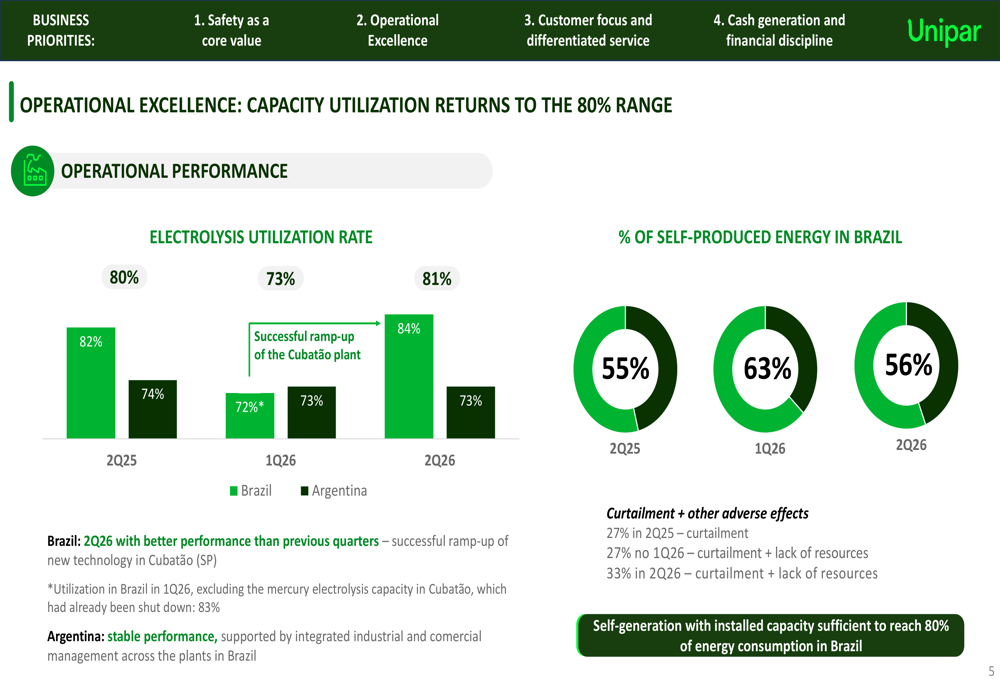
Operational performance showed marked improvement during the quarter, with Brazil’s electrolysis utilization rate reaching 84%, supported by the successful ramp-up of the modernized Cubatão plant. This represented a significant recovery from the 72% utilization rate in the first quarter, which had been depressed by the shutdown of mercury electrolysis capacity during the technology upgrade.
The following chart illustrates the company’s capacity utilization trends and self-generation of energy across recent quarters:
CEO Rodrigo Cannaval emphasized the importance of the Cubatão project: “We have completed all the startup steps and have been operating at full capacity since April.” The modernization improved reliability, reduced raw material consumption and lowered emission intensity, delivering both environmental and economic benefits.
Self-produced energy represented 56% of Brazil operations in the second quarter, down from 63% in the first quarter due to curtailment and resource constraints. The company noted it has installed capacity sufficient to reach 80% of energy consumption in Brazil, providing a strategic advantage in managing power costs.
Revenue and Cost Dynamics
The sharp increase in net revenue was driven primarily by the surge in international benchmark prices for key products. PVC prices on the U.S. Gulf Coast rose 53% from the first quarter, while caustic soda prices increased 26%, reflecting supply tightness and geopolitical tensions affecting global chemical markets.
The company’s revenue evolution and key drivers are shown in the following breakdown:
CFO Alexandre Jerussalmy highlighted the company’s strategic positioning: “We are a chemical company that produces PVC, not a petrochemical company that produces chlorinated compounds.” This statement underscored management’s effort to emphasize chlorinated products as a more stable business line less exposed to petrochemical cycles.
However, the revenue gains were partially offset by currency headwinds. The 4% appreciation of the Brazilian real against the dollar during the quarter reduced the reais-denominated value of export sales and dollar-linked domestic prices. On a year-over-year basis, the currency impact was even more pronounced, with an 11% appreciation of the real.
Cost pressures intensified during the quarter, with adjusted cost of goods sold rising 4% sequentially to R$ 974 million. The increase reflected higher caustic soda and chlorine sales volumes, as well as the sharp rise in raw material costs. European ethylene benchmark prices climbed 34% while costs increased approximately 30%.
The evolution of the company’s cost structure is detailed in the following analysis:
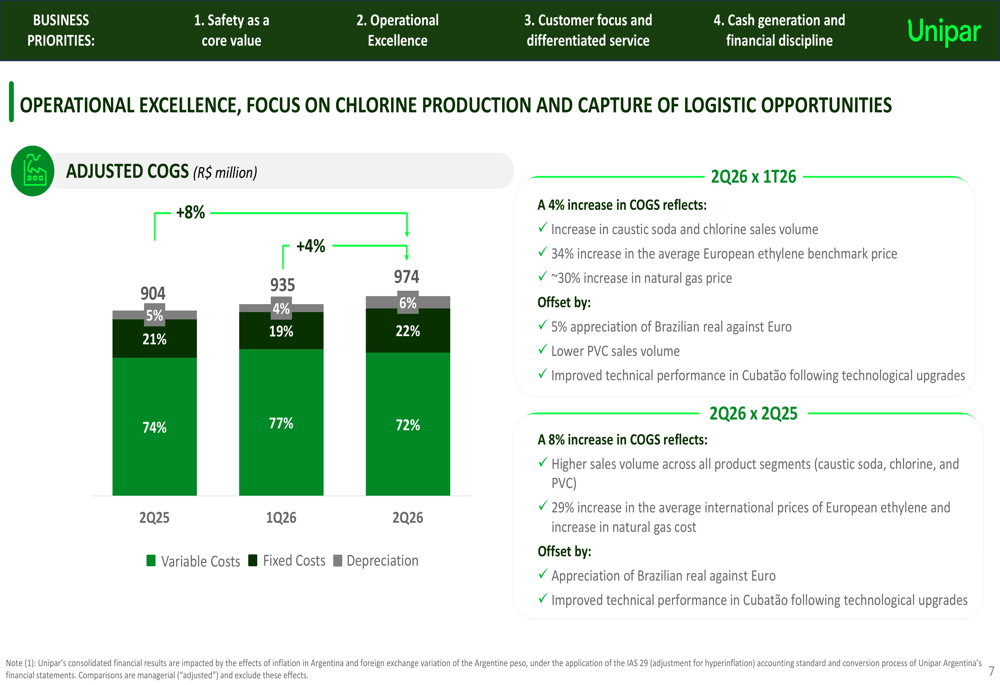
The cost increases were partially mitigated by the 5% appreciation of the , which reduced the local currency cost of ethylene imports, as well as improved technical performance at the Cubatão plant following the technology upgrades. The modernization project delivered tangible efficiency gains that helped protect margins despite the input cost inflation.
Profitability Analysis
The combination of stronger pricing, higher volumes in key products and operational improvements drove the dramatic expansion in profitability. Adjusted recurring EBITDA of R$ 402 million represented a margin of 27%, up from just 12% in the first quarter. On a year-over-year basis, EBITDA rose 31% from R$ 306 million in the second quarter of 2025.
The following waterfall charts illustrate the key drivers of EBITDA growth on both a sequential and year-over-year basis:
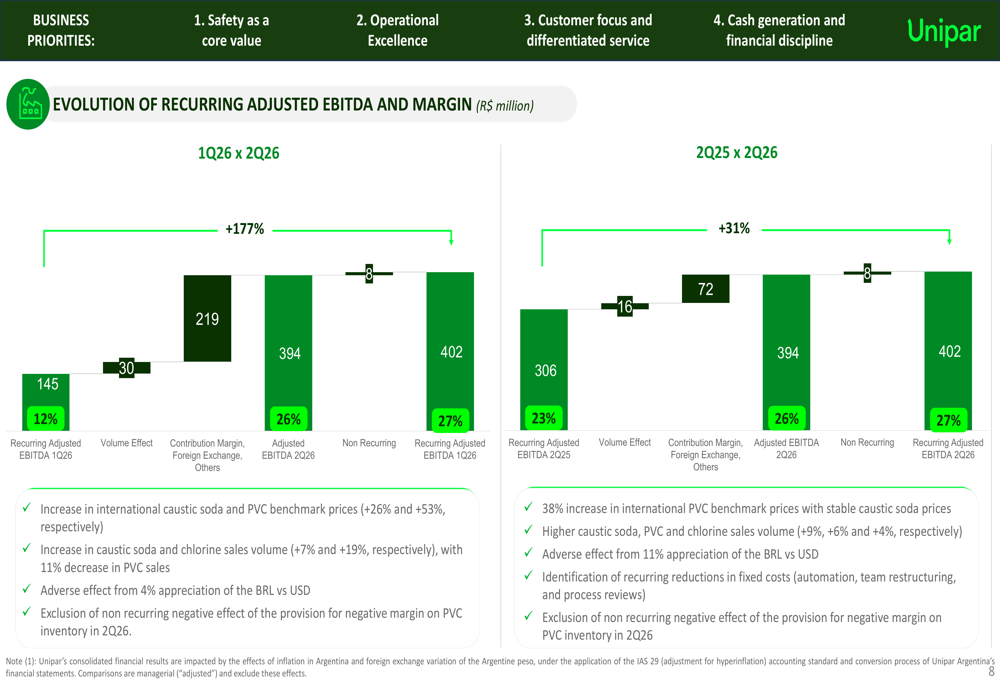
The sequential improvement of R$ 257 million in recurring EBITDA was driven by R$ 30 million from volume effects and R$ 219 million from contribution margin, foreign exchange and other factors. The volume contribution came primarily from the 19% increase in chlorine sales and 7% rise in caustic soda volumes, which more than offset the strategic reduction in PVC sales.
Management noted that the quarter included a non-recurring negative provision of R$ 5 million related to negative margin on PVC inventory, which was excluded from the recurring EBITDA calculation. This reflected the continued pressure on PVC margins in Brazil from import competition, particularly from Egypt, which has replaced the United States as a primary source of imports.
Financial Strength and Debt Management
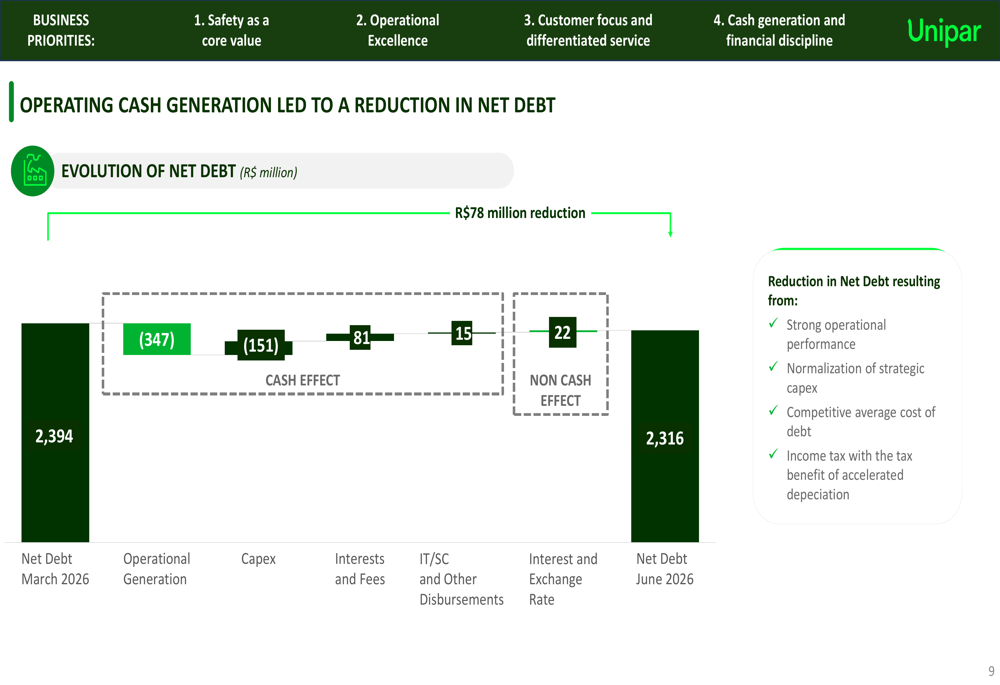
Strong cash generation enabled the company to reduce net debt by R$ 78 million during the quarter, from R$ 2,394 million in March to R$ 2,316 million in June. Operating cash generation of R$ 347 million was the primary driver of debt reduction, while capital expenditures of R$ 151 million reflected the normalization of strategic project spending following completion of major initiatives.
The evolution of net debt and its key components is shown in the following breakdown:
The company’s debt profile remained well-structured with an average term of 67 months and 90% of obligations maturing from 2029 onward. The average cost of debt stood at CDI plus 40 basis points per annum, reflecting competitive terms and the company’s access to capital markets.
A detailed view of the company’s debt profile and maturity schedule is presented below:
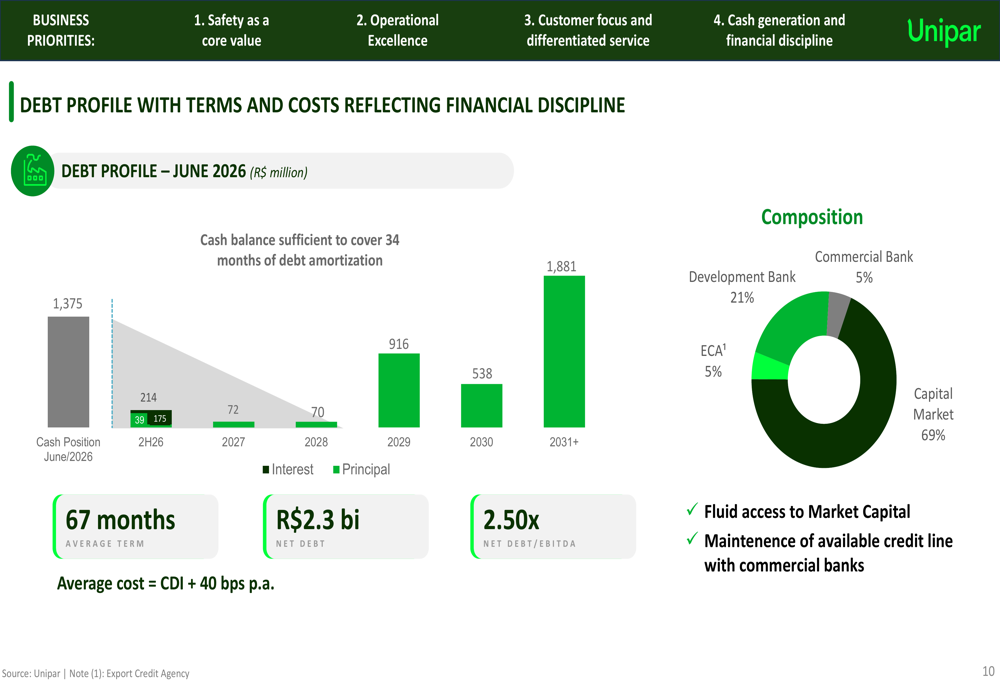
The debt composition showed diversification across funding sources, with 69% from capital markets, 21% from development banks, and 5% each from commercial banks and export credit agencies. Management emphasized the company maintains fluid access to capital markets and available credit lines with commercial banks, providing financial flexibility.
Strategic Initiatives
The second quarter marked the completion of two major strategic projects that are expected to drive future competitiveness. The Cubatão phase-out project, which replaced mercury-based electrolysis technology with modern membrane cells, achieved full production capacity in April, marking a successful ramp-up. The project resulted in greater reliability, lower raw material consumption and reduced emissions.
The second phase in Camaçari developed capacity for chlorine liquefaction, enabling purification with high value-added. Operations began in July 2026, providing greater flexibility in chlorine allocation between different product applications.
The company’s completed and ongoing strategic projects are outlined in the following summary:
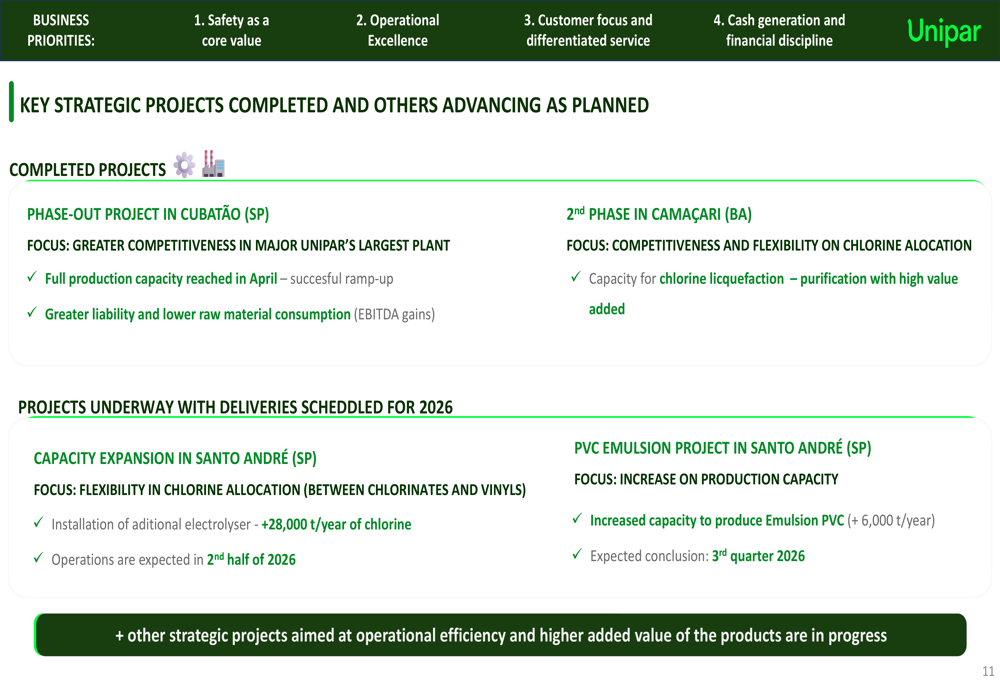
Two additional projects remained underway with expected completion in 2026. A capacity expansion in Santo André will add 28,000 tons per year of chlorine production through installation of an additional electrolyzer, with operations expected in the second half of 2026. A PVC emulsion project at the same location will increase capacity by 6,000 tons per year, with completion anticipated in the third quarter.
Management indicated that capital expenditures for 2026 are expected to normalize at R$ 500 million to R$ 600 million, well below the R$ 1.1 billion spent in 2025 when major modernization projects were underway. Spending is expected to remain at normalized levels in 2027.
Forward-Looking Statements and Outlook
Looking ahead, management identified deleveraging as the primary financial priority through the end of 2026. The company expects to achieve this through operating cash generation, lower tax payments resulting from accelerated depreciation benefits, normalized capital spending and working capital control.
On capital allocation, management reiterated the current dividend policy calls for a 25% payout of annual net income, with any distribution above that level subject to internal discussion based on liquidity, debt profile and leverage considerations. This conservative approach reflects the company’s focus on financial discipline during a period of market volatility.
The company emphasized that operational excellence and safety remain core priorities alongside the strategic focus on chlorinated products. Management highlighted that chlorinated compounds offer higher value-added and differentiated scale compared to PVC, with less exposure to petrochemical cycles.
Market Context and Challenges
Despite the strong operational and financial results, Unipar’s shares fell 1.4% to $3.52 following the presentation, suggesting investors took a cautious view of the results. The stock trades at a price-to-earnings ratio of 13.7 with a market capitalization of $601 million, according to data from InvestingPro. The shares remain 28.9% above their 52-week low of $2.82 but 28.9% below the 52-week high of $4.95.
Several challenges tempered the positive results. Import pressure on PVC in Brazil remains a significant concern, with competition intensifying from Egyptian producers. Management acknowledged that tariff policy could shape future competitive dynamics in the domestic market. The company’s selective sales strategy, which resulted in an 11% decline in PVC volumes during the quarter, reflected efforts to maintain pricing discipline rather than chase market share.
Currency volatility also presents an ongoing risk. While the 4% appreciation of the real during the second quarter created a headwind, further strengthening or weakening of the currency could significantly impact results given the company’s exposure to dollar-linked pricing and imported raw materials.
Raw material cost inflation represents another key challenge. The 34% surge in European ethylene prices and 30% increase in natural gas costs during the quarter compressed margins despite the strong improvement in product pricing. Any reversal in the favorable pricing environment for PVC and caustic soda could pressure profitability if input costs remain elevated.
Nevertheless, the company’s operational improvements from the Cubatão modernization and strategic focus on chlorinated products provide a stronger foundation for navigating market cycles. Management’s emphasis on cash generation, financial discipline and strategic capital allocation suggests a measured approach to balancing growth investments with shareholder returns during a period of uncertainty in global chemical markets.
Full presentation:
This article was generated with the support of AI and reviewed by an editor. For more information see our T&C.
