


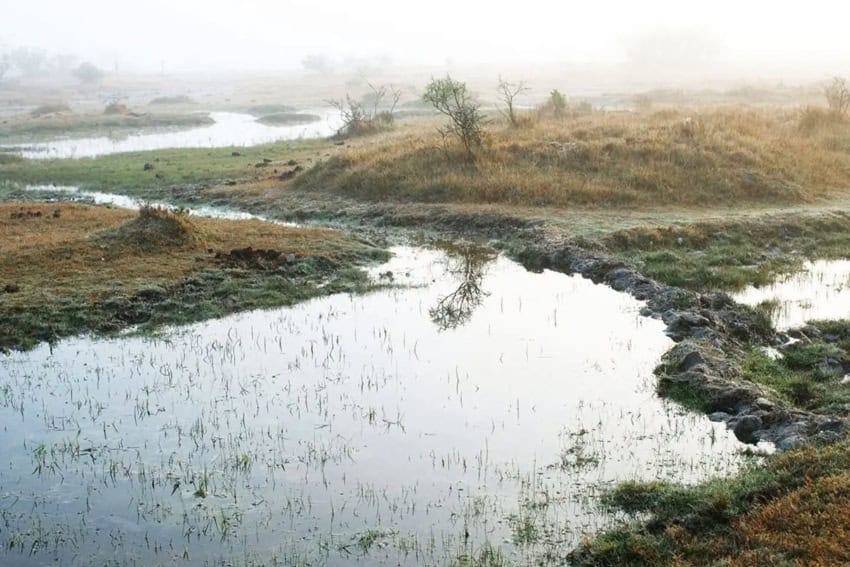
In Wirikuta, water is more than a resource. For the Wixárika people, who have made pilgrimages to this sacred desert for millennia, water is the connecting force, linking the Pacific Ocean, the clouds, the desert springs and the prayers offered for rain and the renewal of life.
But beneath that sacred landscape, the water is disappearing faster than nature can replace it.
From Aug. 6 to 8, farmers, Wixárika representatives, artists, environmental defenders, government officials and water specialists will gather in the communities of Estación Catorce and San Antonio de Coronados, San Luis Potosí, for the first Festival del Agua del Altiplano Potosino–Wirikuta.
An inaugural gathering
The gathering will combine scientific and legal discussions with theater, music, workshops and activities intended primarily for residents of the surrounding rancherías. Organizers hope to make visible a crisis that is unfolding largely out of sight — and to press authorities for concrete action.
“It is an effort, through art and culture but also through the strength of science, to generate dialogue, share information and create ties that can inspire greater communication among communities over the long term, and more organization to care for life,” said Alhelí Pérez, coordinator of the support collective Sincronía Wirikuta and one of the festival’s organizers.
The immediate concern is the Vanegas-Catorce aquifer, which underlies nearly 4,382 square kilometers of the arid Altiplano Potosino. A 2024 report by the National Water Commission, or Conagua, calculated that the aquifer receives an average annual recharge of 28.4 million cubic meters. Meanwhile, the Public Registry of Water Rights, or REPDA, records 36.3 million cubic meters in annual groundwater extraction rights.
That leaves an official deficit of 7.94 million cubic meters per year. Conagua’s report concludes that no water remains available for new concessions. Agriculture is the principal groundwater use in the aquifer, where average annual rainfall is just 316 millimeters.

The water crisis in Mexico
The numbers place Wirikuta within a much broader Mexican water crisis. Across Mexico’s arid north, prolonged drought, rising temperatures and the overallocation of water are intensifying pressure on rural communities and ecosystems.
Juan Manuel Ledón, executive director of the environmental consulting organization EcoSite and a specialist in water quality and security, said the pressure on the Vanegas-Catorce aquifer reflects a national system that has historically favored users with the money and influence to secure extensive, long-term water rights.
“Water began to be turned into a commodity, with entities and users possessing greater financial capacity acquiring the water concessions,” Ledón said. “In some cases, those large users held concessions lasting from 50 to more than 100 years, and water began to be hoarded.”
Conagua administers those rights through a highly centralized system, he said, while weak transparency and limited public participation make it difficult to detect or stop irregular concessions and excessive extraction.
An invisible limit beneath the desert
Tunuari Chávez González, an environmental geographer with a master’s degree in environmental law who has studied Wirikuta’s water system for years, describes groundwater as the desert’s “invisible limit”: the system connecting springs, vegetation, soils, wildlife and human communities far beyond the boundaries drawn on an official map.
Chávez said deeper pumping is increasingly reaching warmer, more mineralized groundwater, bringing salts toward the surface and contributing to declining soil moisture and stress on desert vegetation.
“We are facing a very serious environmental situation, an increasingly grave one,” he said. “Water tables are becoming progressively depleted.”
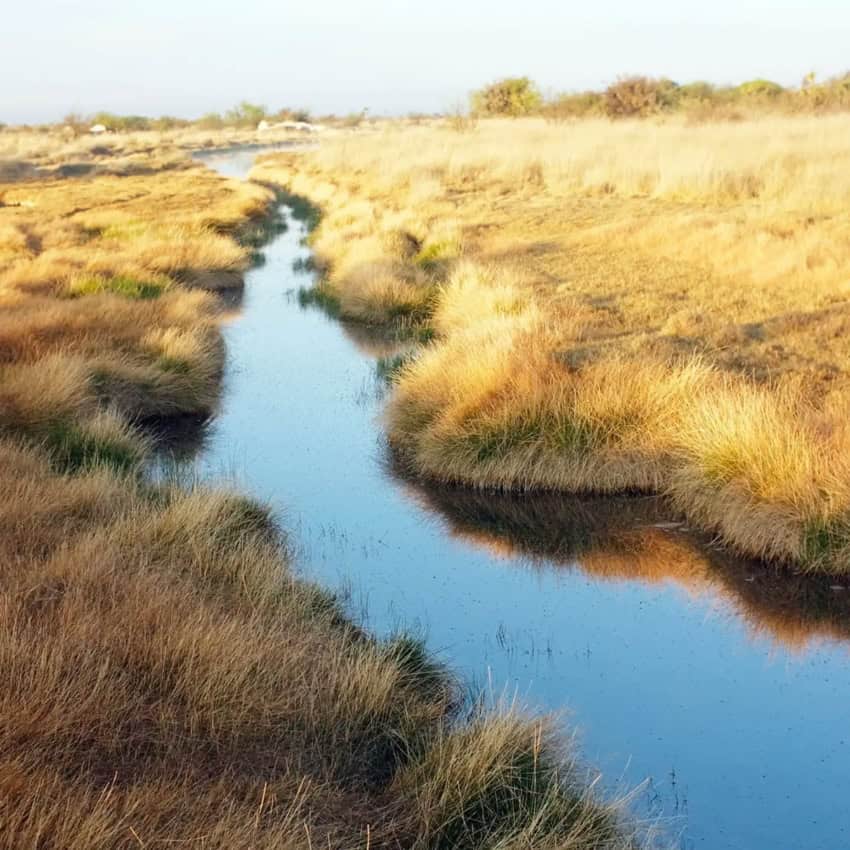
The region’s industrial tomato and chile production, along with large poultry and hog operations, depends on groundwater. Meanwhile, Chávez said, some local communities receive water only intermittently.
He pointed to Wadley, a railway community in the municipality of Catorce that he has visited many times, as an example of the disparity.
“There is a very serious and deeply troubling problem when we add the fact that today far more water goes to washing pig pens than to people.”
Residents there may receive household water only two or three days a week, he said, forcing families to store enough for the days when none arrives.
Inequalities in water service
The danger is not limited to diminishing quantity. As Mexico News Daily has previously reported, groundwater in parts of arid and semiarid Mexico contains naturally occurring arsenic and fluoride, and pumping from greater depths can increase communities’ exposure to poor-quality water.
Ledón said such inequalities are common in rural and Indigenous regions across Mexico. Municipal water utilities typically concentrate their services in larger towns, while distant rancherías and settlements depend on wells, water hauling or small systems managed collectively by residents.
He said Mexico’s weakest institutions are often the municipal governments and water utilities charged with delivering water and sanitation. Their leadership may change every three years, frequently leaving them without the technical expertise, continuity or money required to maintain reliable systems.
At the same time, Conagua controls water concessions through a much more centralized federal structure, while users with greater financial and political resources have historically been better positioned to secure long-term rights.
The result, Ledón said, is a system in which rural communities bear responsibility for managing scarce local supplies but have little influence over the larger decisions that determine how much water may be extracted around them.
“Priority must be given to access to safe water for human consumption — above all for drinking, preparing food and cooking as the basic uses,” Ledón said. “Cases like those we have discussed, in which commercial or private interests are prioritized, severely limit and undermine the possibility of guaranteeing access to water for human consumption.”
A farmer’s view of a changing landscape
Eduardo “Lalo” Guzmán has lived and farmed in the village of Las Margaritas for more than 25 years and has participated in the defense of Wirikuta through decades of disputes over mining, land and water.
He said the growth of industrial tomato and chile production began farther south in the Altiplano more than 30 years ago. As wells declined and soils became increasingly saline, he said, operations moved north through Villa de Arista, Cedral and Vanegas and eventually into the municipality of Catorce.
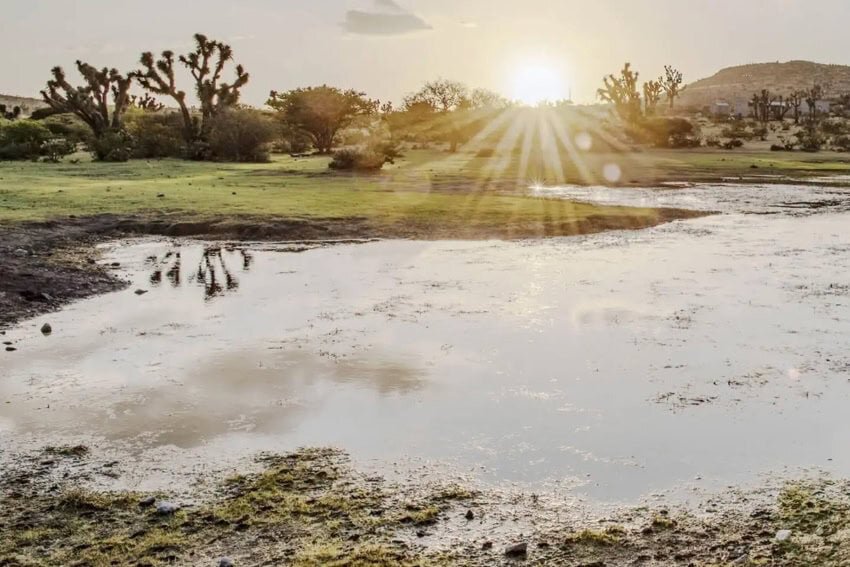
The greenhouses and industrial farms depend on wells and controlled irrigation, while local subsistence farmers continue to plant according to the arrival — or absence — of seasonal rains.
“The situation of the farmers each year is that they possess a great virtue: perseverance,” said Guzmán. “They will plant whenever rain comes. They will cast their seed, and even if it does not grow, the following year they will try again and keep trying.”
Guzmán said organizers want the festival to be attended primarily by residents of the desert communities rather than becoming another event drawing large numbers of outside visitors to Wirikuta. Funds are being raised to help families from remote rancherías pay for gasoline, transportation and meals.
Pérez said visitors from Oaxaca, Veracruz, Guanajuato and Jalisco will also share experiences from territories confronting mining and agroindustrial expansion. Organizers hope those exchanges will help residents understand that the pressures they face are part of a larger pattern — and that communities elsewhere have developed their own strategies for responding.
Protections on paper
The Vanegas-Catorce aquifer is partially covered by a groundwater restriction dating to 1964, which permits limited extraction for domestic, agricultural, industrial and other uses. Conagua’s newer availability calculation, however, applies to the aquifer as a whole and says its existing registered extraction already exceeds its average recharge.
Local residents have accused authorities of allowing new wells or water rights to continue appearing despite that negative balance. Guzmán said residents have reported suspected wells to Conagua and received contradictory information about whether permits existed.
Ledón did not assess the specific allegations in Wirikuta, but said similar problems persist because information about concessions is difficult to obtain and public participation in water governance remains weak.
“One of the key issues concerns transparency and access to information in the management of concessions,” he said.
Once irregularities are identified, he added, authorities must take corrective or punitive action rather than merely recording them.
Conagua did not respond to Mexico News Daily’s questions about how it reconciles the aquifer’s negative availability with any recent water-rights approvals, transfers or new wells; how it monitors actual pumping; or what enforcement actions it has taken in the region. The agency also did not acknowledge receipt of the request before publication.
The lesson of Cerro de San Pedro
Enrique Rivera Sierra, the San Luis Potosí representative of the federal Agrarian Ombudsman’s Office, believes the legal tools to defend Wirikuta already exist.
He cited Article 27 of the Constitution, Mexico’s Agrarian and National Water laws, Indigenous consultation rights and the series of decrees protecting Wirikuta. The central problem, he said, is enforcement.
“The Catorce and Vanegas aquifers are overexploited; we all know that,” he said. “Legally, the National Water Commission should not grant more concessions of this kind and should review those already granted, including how these agroindustrial companies and egg producers came to hold them.”
Rivera’s warning is shaped by another environmental conflict in San Luis Potosí. He was a prominent opponent of Minera San Xavier’s open-pit gold and silver mine at Cerro de San Pedro, the mountain represented on the state capital’s coat of arms.
Amid surveillance, physical attacks and efforts to implicate him in criminal activity, Rivera left Mexico in 2007 and went into exile in Canada. After reviewing evidence of the persecution against him, Canada granted him refugee status in 2010, finding that he could again be persecuted and might not receive a fair trial if returned. He later came home and eventually joined the federal government.
“The defense of Cerro de San Pedro was historic, and although they ultimately got their way, that struggle became an emblem of what must never again be allowed to happen in any territory in the world — and especially here in San Luis Potosí.”
For Rivera, the lesson is that official recognition and favorable laws cannot restore a landscape once the damage has become irreversible.
Beyond three days
Festival participants will discuss rainwater harvesting, ecological restoration, water rights and community organization. Art and ceremony will accompany the scientific and legal presentations, reflecting Wirikuta’s inseparable cultural, ecological and spiritual dimensions.
Ledón said harvesting rainwater can provide an important emergency or supplementary source for household consumption, including in relatively dry regions. But the longer-term response must address the activities driving groundwater deficits and restore the wider watershed and water cycle.
“What is needed is to think — or rethink — in terms of restoring the ecosystem and the water cycle,” he said.
That requires more than infrastructure, he said. It means strengthening community water systems, making concession data transparent, coordinating agencies and allowing local knowledge to shape decisions.
The organizers do not expect a three-day festival to refill the Vanegas-Catorce aquifer. Their more immediate goal is to make the crisis visible — to residents living above it, to the officials responsible for regulating it and to people facing similar struggles elsewhere in Mexico.
For Ledón, Wirikuta’s broader lesson lies in changing who is heard when water decisions are made.
“The principal lesson lies in approaches and solutions based in community, science and nature: changing the paradigm and learning to listen to and appreciate existing ancestral knowledge, practices and wisdom.”
Tracy L. Barnett is a Guadalajara-based freelance writer and the founder of The Esperanza Project.
