


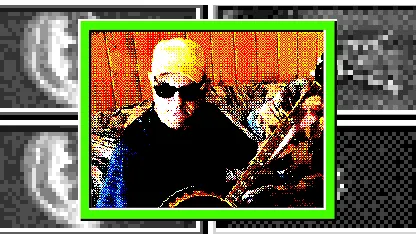
But MacLeod also seems genuinely concerned about how AI will displace workers, worsening an already bleak economic situation where “people with goddamn master’s degrees can’t get a job and afford an apartment in the city that they’re living in.”
“Believe me, my optimism is tenuous,” he says. “The world is kind of shit, but I hold onto it anyway. There’s no way we will have [our basic everyday] problems in 500 years. Everything’s gonna be solved. How we get there is gonna hurt, and not everyone’s gonna come out OK.”
MacLeod grew up in Sobieski, a tiny town in Wisconsin. His dad worked in a paper mill and has collected tractors. As a kid, MacLeod noodled on the piano; his brother bought him a Casio keyboard from a pawn shop when he was 9, which he hooked up to his PC to record.
In 2000, he started releasing tracks for free on Incompetech. This was in the era of mail-order CD clubs, when radio stations would pay $100 a month for one or two CDs full of background music to produce ads or stings. “I was like, How about $0?” MacLeod says. Since the start, he’s relished the idea of making something that puts other people out of business.
Often, compositions came from MacLeod watching a YouTube video, thinking the music sucked, then trying to make something more suitable. He would email the themes to the video makers. The popular 2014 tune “Carefree” spawned because MacLeod noticed nearly all the themes on the royalty-free site AudioJungle had ukulele, marimba, and kumbaya vibes. He thought it’d be funny to make a kind of noxiously happy nothing-song: “I was making fun of 80 people simultaneously.”
Royalty free music was such a thing in the early 2010s. Anyone who was a tween around this time remembers the blandly euphoric drops of NoCopyrightSounds, even if you can’t put a name to them, like the classic royalty-freEDM anthem “My Heart.” MacLeod came to dominate the instrumental space in this era through quality, name recognition, and sheer volume; he released so many tunes that at one point he started paying Fiverr freelancers to title them. The new fans were matched by a swarm of new haters upset at how he was devaluing music online and making it harder for composers to charge for their work.
