


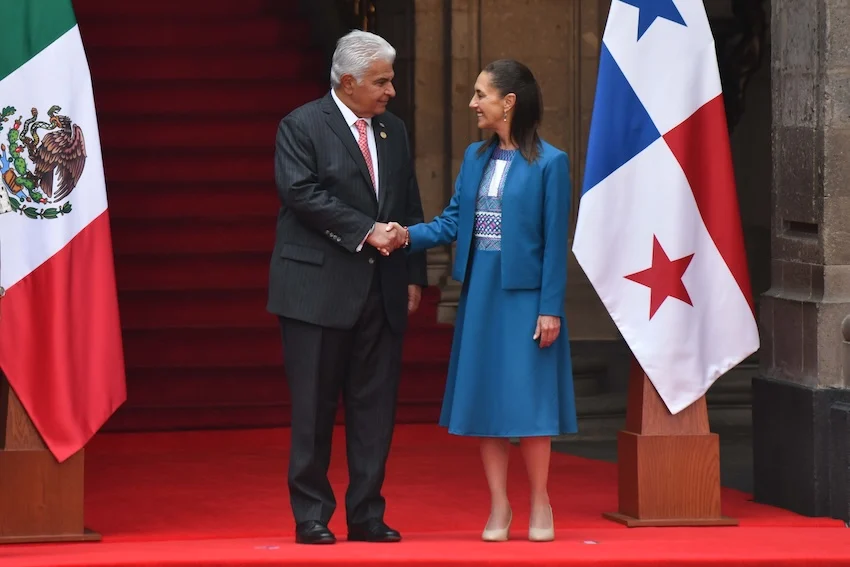
After a meeting in Mexico City on Wednesday with Panamanian President Juan Raúl Mulino Quintero, President Claudia Sheinbaum expressed the Mexican government’s support for the Panama Canal neutrality protocol.
Her remark during a joint press conference with Mulino at the National Palace comes after U.S. President Donald Trump’s repeated threats to retake control of the canal, which was formally transferred to Panama on Dec. 31, 1999. Two weeks ago, Trump said that the United States wouldn’t let China take control of the Panama Canal, a vital shipping route that connects the Pacific and Atlantic Oceans.
On Wednesday, Sheinbaum said: “As I stated in the bilateral meeting we had, we support the Panama Canal neutrality protocol.”
The protocol is attached to the 1977 “Treaty concerning the permanent neutrality and operation of the Panama Canal,” whose first article states that “[t]he Republic of Panama declares that the Canal, as an international transit waterway, shall be permanently neutral in accordance with the regime established in this Treaty.”
Sheinbaum also spoke about the importance of “respect for the sovereignty” of nations. As she is staunchly opposed to any kind of foreign intervention or interference in Mexico, the president makes it clear she also objects to foreign meddling in the domestic affairs of other countries. Just as she has spoken out against the United States embargo against Cuba, Sheinbaum would almost certainly resist any serious attempt by the U.S. to retake control of the Panama Canal.
On Wednesday, Mulino thanked Sheinbaum for her support of “national sovereignty” and of the Panama Canal as a “neutral tool of world trade.”
‘A new stage of cooperation, trust and friendship’
Early in her press conference remarks, Sheinbaum said that Mulino’s visit to Mexico reconfirms the “solid friendship” between Mexico and Panama.

She subsequently said there is a “shared willingness” to build an even closer relationship based on “mutual respect, dialogue and cooperation.”
At the end of her address, Sheinbaum thanked the Panamanian president for his willingness to “continue writing together with Mexico a new stage of cooperation, trust and friendship between our peoples and nations.”
In earlier remarks, she said that “Panama and Mexico are two nations deeply united by history, culture, and a shared vision of the role that Latin America and the Caribbean should play in the world.”
“We share the conviction that the great challenges of our time can only be addressed through collaboration, understanding, and the strengthening of our sovereignties and our institutions,” Sheinbaum said.
Referring to commonalities between the two countries, the president highlighted that both Panama and Mexico have an “interconnection” between the Pacific and Atlantic Oceans. Panama has the Panama Canal while Mexico has a modernized railroad across the Isthmus of Tehuantepec between Salina Cruz, Oaxaca and Coatzacoalcos, Veracruz.
Sheinbaum also noted that there is Panamanian investment in Mexico and Mexican investment in Panama.
In addition, she thanked Panama for its “extraordinary cooperation” on efforts to eradicate the New World screwworm, whose presence in cattle in Mexico led the United States to shut its border to Mexican livestock.
The “biological control model” of the recently opened sterile fly plant in Chiapas is based on that of the Pacora plant in Panama, Sheinbaum said.
“Every week we receive pupas from this plant … in order to develop the flies that are going to address the serious screwworm problem,” she said.
“We recognize the technical experience of your country, so … we have the idea of continuing with the exchange of information and the relationship on all agro-industry issues,” Sheinbaum said.
She also said that her meeting with Mulino, president of Panama since 2024, would allow Mexico and the Central American nation to “deepen and relaunch our cooperation in strategic areas” such as trade, investment, infrastructure, security, tourism, culture, education and innovation.
#Envivo | Visita oficial del presidente de Panamá, José Raúl Mulino.
— Relaciones Exteriores (@SRE_mx) July 15, 2026
“Mexico recognizes the strategic role that Panama plays as a crossroads between continents and oceans, as well as its contribution to regional and international trade,” Sheinbaum said.
“We are living in a time when the world is facing profound economic and geopolitical transformations. In this context, cooperation between our countries takes on renewed importance.”
Mulino: Panama and Mexico are ‘bridge nations’
After arriving in Mexico on Tuesday with his wife, Maricel Cohen, and members of his cabinet, Mulino was given an official reception at the National Palace on Wednesday.
At his joint press conference with Sheinbaum, the Panamanian leader said it was an “honor” to be in Mexico, a country he described as an “economic, productive and cultural power of our continent.”
He went on to say that “Panama and Mexico are two bridge nations.”
“Mexico is the bridge between North America and Latin America. Panama is the bridge between two oceans and between the two halves of this continent,” Mulino said.
“We are, because of our vocation and geography, countries that unite,” he said.
After thanking Sheinbaum for her support of Panamanian sovereignty and the neutrality of the Panama Canal, Mulino said he spoke to the Mexican president about the importance of more countries in the region supporting Panama and adhering to the Panama Canal neutrality protocol.
“Current events demonstrate — as I have mentioned to the president — that these types of instruments provide protection against uncertainty and safeguard assets that not only belong to the state where they are located, but also serve the world and the international supply chain,” he said.
Mulino also talked up Panama as an investment destination, including for Mexican companies.
“Panama today is an investment-grade economy with projected growth of around 4% this year,” he said, adding that the country is a well-connected logistics, aviation and finance hub.
“We have a special [tax] regime for headquarters of multinational companies, under which more than 190 global companies already operate,” Mulino said.
“Of those, only two are Mexican. Hopefully the Mexican presence increases,” he said.
“… This afternoon I will meet with Mexican businesspeople and I’ll do it with genuine enthusiasm,” Mulino said.
“I’m a natural-born promoter. I’ve promoted my country my entire life, because governments sign agreements, but those who create jobs, move freight and build prosperity are investors and companies,” he added.
The Panamanian president, a center-right politician who served as security minister between 2010 and 2014, also weighed in on security issues.
“I would like to address an important issue, namely regional security,” he said.
“In this regard, Madam President, I would like to congratulate you, as well as your government and the army, on the operation carried out in Guadalajara last February,” Mulino said, referring to the operation targeting Jalisco New Generation Cartel (CJNG) leader Nemesio “El Mencho” Oseguera Cervantes, who was actually fatally shot by soldiers well south of Guadalajara in the municipality of Tapalpa, Jalisco.
The CJNG moves drugs through Panama and sends narcotics to Europe and other destinations from the Central American nation that adjoins Colombia, a major cocaine producer.
Mulino said that together with the Organization of American States, he is planning a regional security meeting in Panama aimed at “coordinating actions and strengthening intelligence systems in order to stop the growth of [the flow of illicit] goods, violence and drug trafficking resources.”
“Mexico must be an important actor at that meeting,” he said.
“I reiterate the invitation so that, once a date is set, this beloved country is represented,” Mulino said.
