


Art Review
A survey of the conceptual artist reveals his deep engagement with institutional machinations, though it sometimes feels like inside baseball.
LOS ANGELES — Walking through the exhibition Michael Asher at the Museum of Contemporary Art, Los Angeles, one may mistake the artist for a donor. The small solo show takes over two galleries, and Asher’s name is most prominently mounted above the opening that separates the rooms, like a deep-pocketed patron who bought their legacy.
Asher, who passed away in 2012, was not wealthy like the Annenbergs or the Sacklers, famous benefactors who coaxed museums into naming wings after them. He was a conceptual artist and longtime educator at CalArts, and his reputation endures despite the lack of sellable objects he produced. Asher was more interested in the way museums looked and operated, and his exploration of these behind-the-scenes machinations helped establish “Institutional Critique” as a category of conceptual art. Asher could reveal the power, money, and influence an institution had on shaping cultural capital by mimicking its architectural style, signage, or catalogs. Without many traditional art objects to display, like paintings or sculptures, Michael Asher relies primarily on archives and ephemera to show how the artist stealthily exhibited in museums, galleries, and kunsthalles.
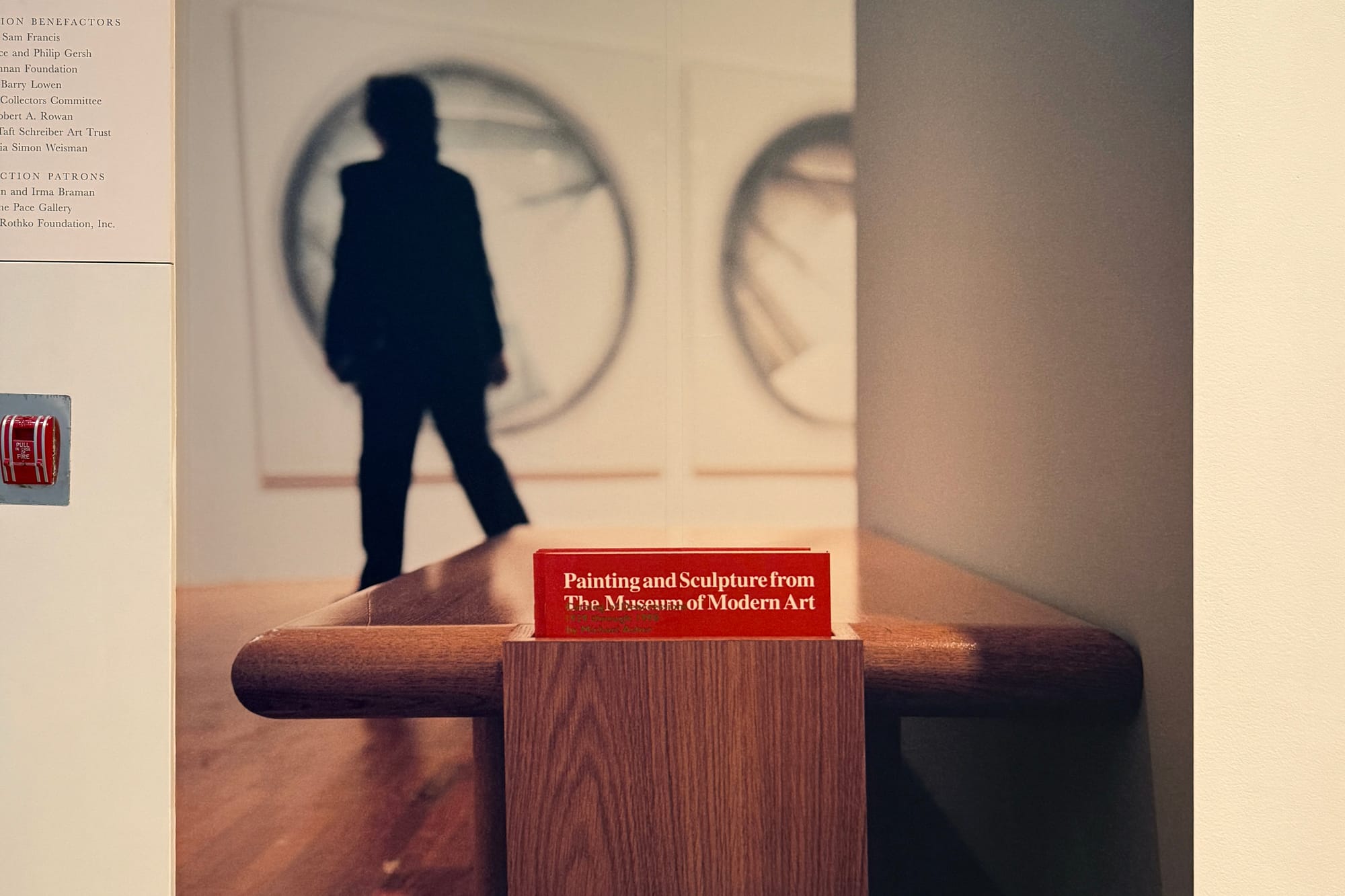
“Painting and Sculpture from the Museum of Modern Art: Catalog of Deaccessions 1929 through 1998” (1999), an unassuming red book created for an exhibition at the Museum of Modern Art in New York, is a perfect example. The catalog, which nearly replicated MoMA’s graphic design style, listed 403 paintings and sculptures the museum had quietly offloaded. The public is often made aware of a museum’s splashy new acquisitions — just look at the buzz around LACMA’s new wing and the way they announced Jeff Koons’s “Split-Rocker” (2000) — but rarely does anyone hear about, or even realize, that institutions reduce their collections. Asher’s catalog reveals that MoMA sold canonical paintings, like Cézannes, to raise money for new works. As a product of the ’90s, the catalog also sparked a craving for the unseen; there was no way to Google the art and decide for oneself whether or not it should be deemed a lesser work. Asher’s list suddenly made these marginal pieces more intriguing, and curators became anxious that the public would demand the unseen works be returned to MoMA’s collection.
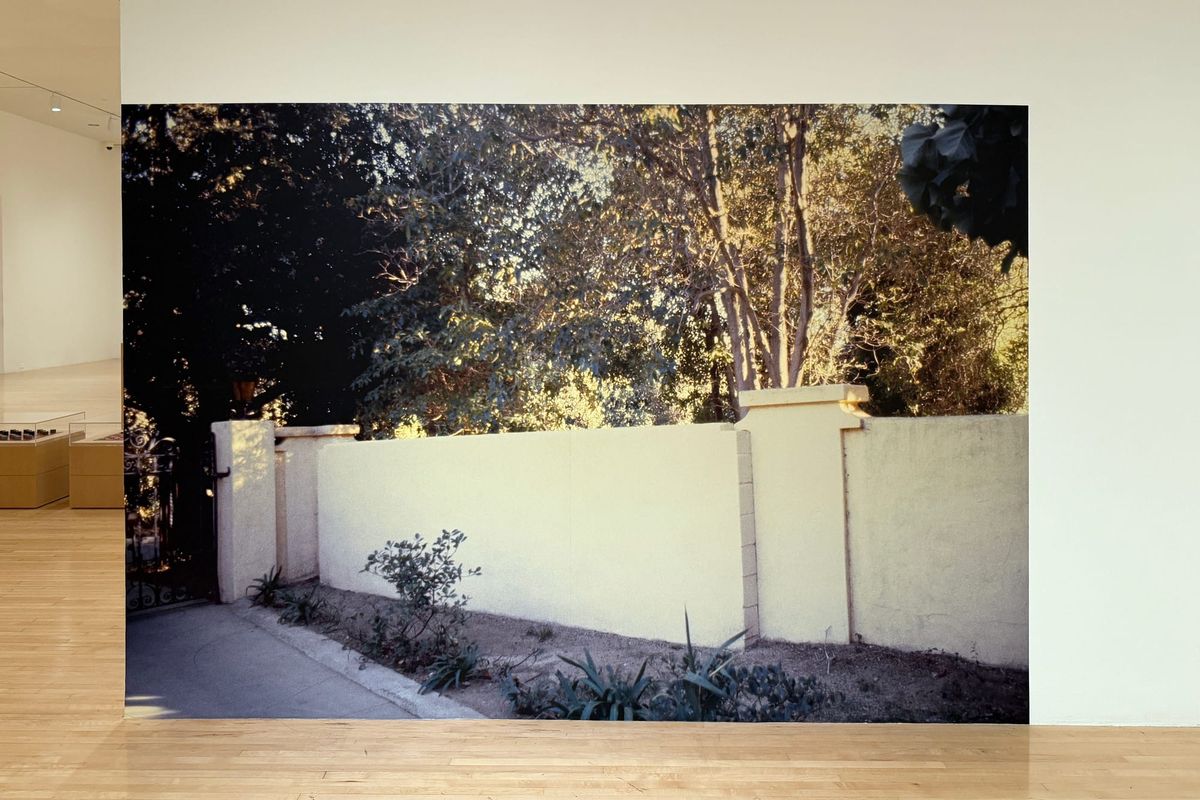
While I personally love the way Asher illuminated registrar systems, his work sometimes feels like inside baseball. The exhibition doesn’t include any labels next to the large vinyl photographs mounted to the walls or the memorandums protected by glass cases, leaving very little context for a casual visitor. In the first gallery, curatorial wall text abuts a box of catalogs that patrons are encouraged to scour during their visit. The booklet extensively explains each piece of art, but there is no map to facilitate a self-guided tour, and its pictures do not replicate what’s actually displayed in the museum. It takes a moment to realize that the four pages dedicated to “Grinstein Collection” (1979), which includes a photograph of Asher’s friend and renowned land artist Richard Serra pointing at redwood logs, correspond to the gallery’s tight presentation of a sales record, two architectural schematics, and a large blown-up photograph of a cement wall bathed in sunshine and surrounded by trees.
“Grinstein” was Asher’s only private art commission and one of just three permanent works he made during his entire career. The piece, commissioned by collectors Elyse and Stanley Grinstein for their home, replaced a concrete wall with decorative columns with an exact replica. The border established Grinstein’s property line, but Asher’s new wall was offset by 11 inches (~27.9 cm), ceding land to the neighbors, and theoretically lowering the home’s market value by reducing its square footage. But wouldn’t the fact that the home contains Asher’s only private commission actually boost the home’s list price?
Michael Asher may be largely inscrutable to the casual viewer, but there are a few typical art objects in this exhibition. These include two red and black checkerboards, part of Asher’s early series No Title (Checkers) (1965–66) — custom pieces that look like readymades, foreshadowing his dedication to replication and mimicry. Another piece is a remnant from “May 22” (1991), a limited-edition paperweight Asher created for Le Nouveau Musée in Villeurbanne, France, while their building was being renovated. The museum’s makeover was clouded by anxiety about gentrification in a traditionally working-class neighborhood, a controversy Asher did not shy away from. The dark, cast-iron mold, made from a smelted furnace that had been discarded by the museum, was used to imprint a message onto the paperweight. Asher’s text urged locals to fight eviction, and included contact information for two housing rights nonprofits.
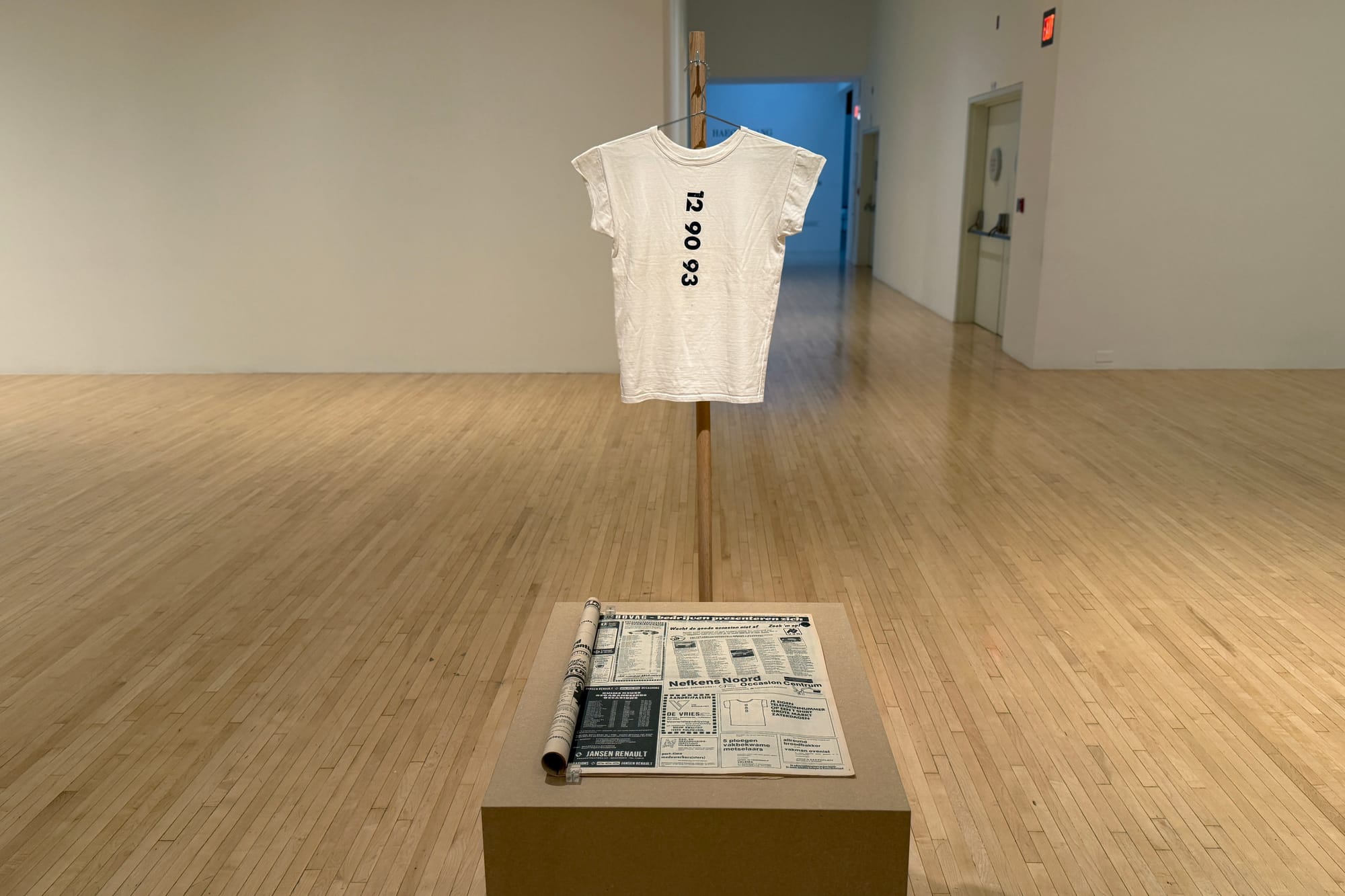
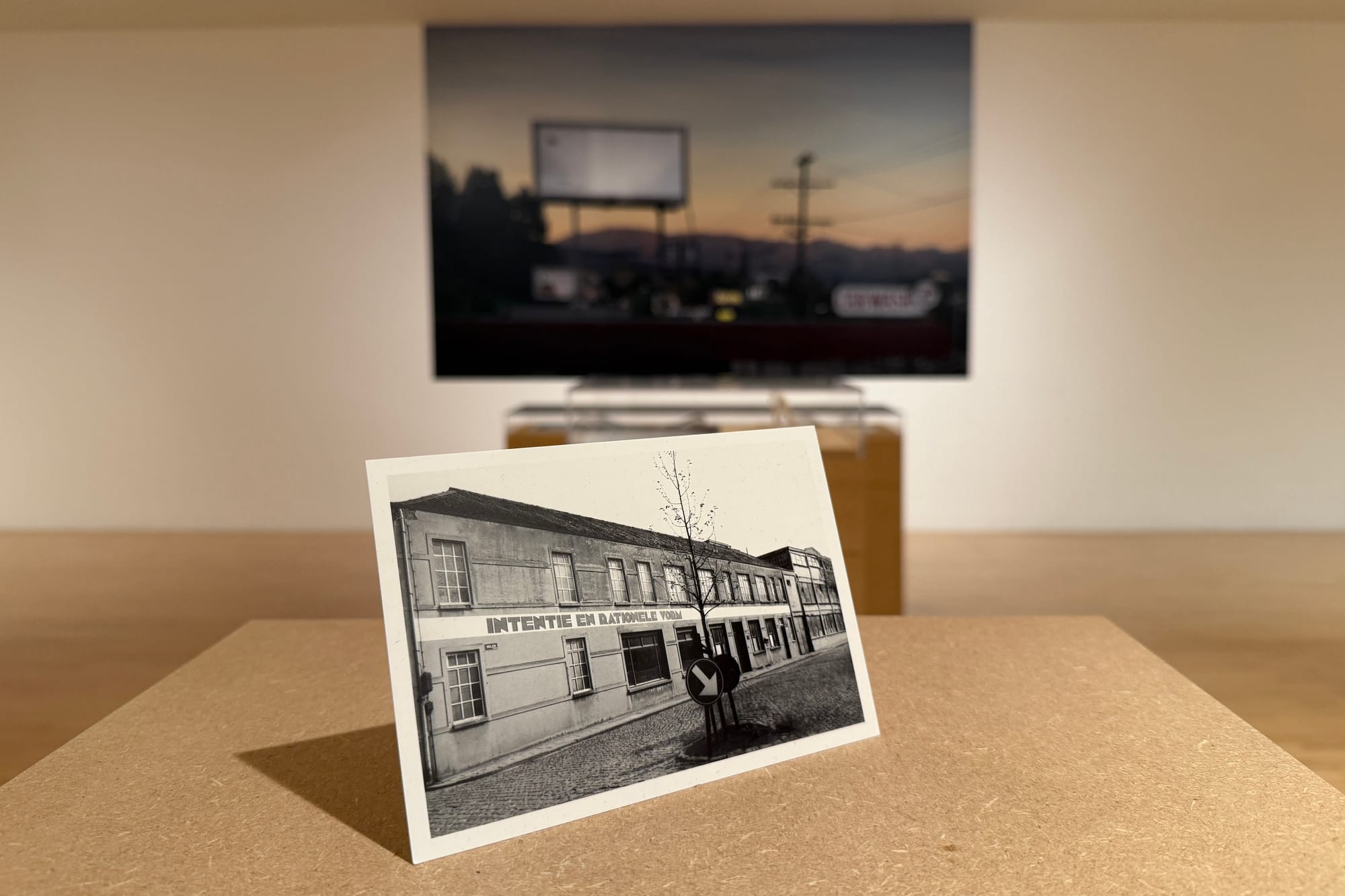
One of the most representative works in the show is a white T-shirt with a Dutch phone number hanging above a newspaper opened up to a classified ad. In Dutch, it tells would-be buyers they can get their custom tee at a farmer’s market on Saturdays (if you’re looking for the translation, you can only find it by reading the catalog). No branding appears on the ad — not Asher’s name, nor the nonprofit Corps de Garde, which invited Asher to do the piece. Once again, Asher didn’t waste time with didactics or context. If people wanted the shirt, they would simply seek it out.
Asher’s success can’t be measured through metrics or sales. Instead, his achievements lie in setting up a thought experiment and seeing it the whole way through. To truly appreciate him, a viewer must approach his work with the same dedication to research he poured into his practice.
Michael Asher continues at the Museum of Contemporary Art, Los Angeles (250 South Grand Avenue, Downtown, Los Angeles) through August 2. The exhibition was curated by Jay Sanders and Stella Cilman.
