


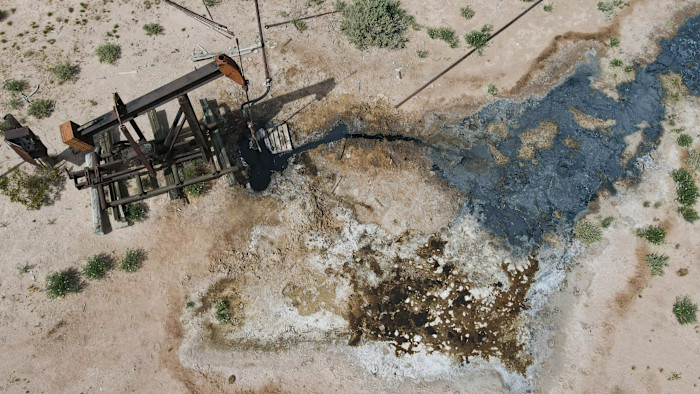
A growing number of US states are creating laws to allow abandoned oil and gas wells to be more easily repurposed for clean energy, as they seek alternatives to limited federal funding for well plugging.
Texas and New Mexico passed bills to ease the repurposing of derelict wells last year, and Alabama this year. Pennsylvania has a similar bill awaiting approval, and Oklahoma hopes to pass legislation on it next year.
The US government’s funding programme for plugging abandoned wells, established under the Biden administration, has been criticised for leaving taxpayers to bail out oil and gas companies, and for not going far enough.
Instead, states are stepping up to find ways to turn an expensive and polluting problem into a new opportunity.
Underground energy storage and heat generation are the most viable approaches to repurposing wells. A smaller number of wells are suitable for geothermal power generation. Some sites are also being explored for carbon capture and storage.
“If we can repurpose these wells to be productive again in terms of a clean baseload energy source like geothermal, that’s obviously a huge win,” said state representative Arvind Venkat, lead sponsor of Pennsylvania’s legislation.
There are around 4mn abandoned oil and gas wells across the US, according to the Environmental Protection Agency. The Interstate Oil & Gas Compact Commission (IOGCC) reported that states had identified 141,000 so-called orphan wells — unplugged wells with no known owner — as of 2023.
A study published in the journal National Science Review last year found that these abandoned oil and gas wells in the US emitted 200,000 tonnes of methane in 2022, equivalent to the annual carbon dioxide emissions of 1.3mn cars.
About 14mn people in the US live within a mile of a documented orphan well, said Adam Peltz, a director and senior attorney at the non-profit Environmental Defense Fund. The wells can leak, contaminating groundwater and emitting carcinogenic air pollutants such as benzene, he added.
Some of the wells were drilled during the oil booms of the 19th and 20th centuries when there was little regulation. But many are more recent and their abandonment is the result of corporate negligence.
Although states typically require oil and gas companies to plug end-of-life wells, some operators offload the sites to smaller producers or other third parties to avoid clean-up costs.
Last year New Mexico’s attorney-general sued three oil executives for allegedly handing off hundreds of unproductive oil wells to shell companies, which then declared bankruptcy.
The American Petroleum Institute, the oil and gas trade group, said it had “strong industry standards to advance the permanent closure and remediation of these largely historic wells”.

Biden’s Infrastructure Investment and Jobs Act provided $4.7bn for states to identify and plug orphan wells. Although the programme was temporarily frozen by the Trump administration, the US Department of the Interior says much of the funding is now available again.
But plugging an orphan well can cost as much as $250,000, according to a report by the IOGCC, with an average expense of about $40,000 per well.
Nick Archer, the state representative sponsoring Oklahoma’s well repurposing legislation, likened relying on federal funds to solve Oklahoma’s orphan well problem to “looking [to buy] a Cadillac with a used Volkswagen budget.”
Despite receiving one of the highest amounts of federal funding for well plugging, it would take Oklahoma on its own more than 200 years to plug all known orphan wells in the state, according to the Oklahoma Corporation Commission.
Lawmakers hope that making it easier for abandoned wells to be repurposed will create more appetite for solving the problem. “If the marketplace can repurpose [abandoned wells] for a profitable purpose, they’re likely to step in . . . even in the absence of government funds”, said Venkat.
The laws introduced by New Mexico and Texas make it easier for states and companies to convert abandoned oil wells for energy production and storage. Much of the legislation introduced this year follows in their footsteps, and typically receives bipartisan support.
Archer, a Republican, said: “This issue unites people because everyone can see the math. A 200-year plugging backlog is not a partisan talking point.”
However, not all wells are suitable candidates for repurposing. The well borehole must be sufficiently deep and the casing intact, which may rule out some of the older orphaned wells. And the technology required to repurpose oil and gas wells for clean energy is still in its infancy.

Some start-ups are looking to change that. Gradient Geothermal, a Colorado based start-up, converts waste geothermal heat from oil and gas wells into electricity. The group mostly works with producing wells, but they are currently studying which orphaned wells in Colorado could be repurposed.
Johanna Ostrum, Gradient Geothermal’s chief operating officer, said that under the right conditions, repurposing an existing well site provides a “tremendous cost saving” versus drilling a new borehole, but the economic case “varies wildly”.
A study conducted by Gradient Geothermal in the Colorado town of Pierce found that it was technically possible to establish a geothermal district heating and cooling network using existing oil wells, with possible savings of about $200,000 in energy costs per year. But the project would cost around $11mn before incentives, and $5mn with incentives.
Even if it takes time to come to fruition, states welcome any step towards reducing abandoned well counts. If repurposing “takes one [abandoned well] off the list . . . it was well worth the effort”, said Archer.
Advocates, meanwhile, say it is positive that states are realising more must be done to tackle a longstanding problem.
Curtis Shuck, chairman of the Well Done Foundation, a well plugging non-profit group that has plugged 120 orphan wells across the US, said that if the country is to clean up its orphaned wells, “it’s going to take a lot of this creative type of legislation”.
