


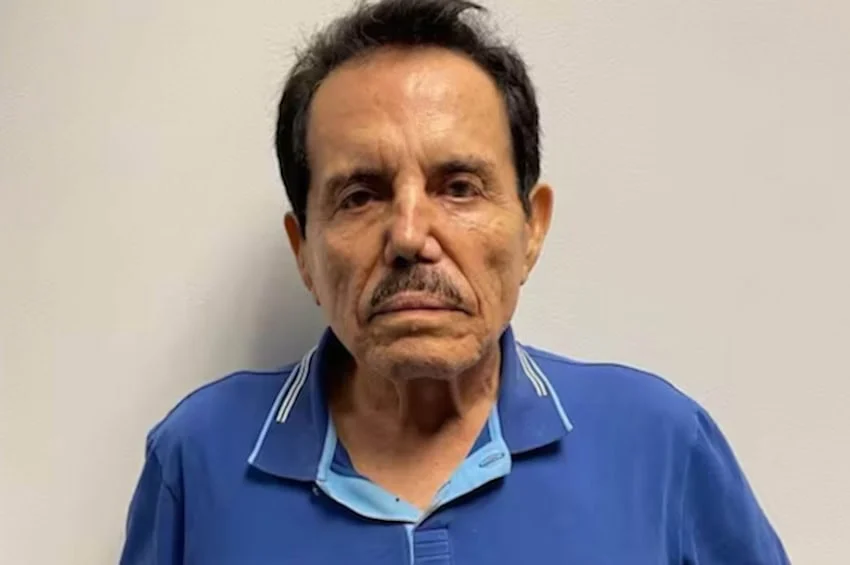
Ismael “El Mayo” Zambada García, the Sinaloa Cartel leader who last year pleaded guilty to drug trafficking charges in a U.S. court, needs — and deserves — to be incarcerated in a prison where he can receive adequate medical care for his various health issues.
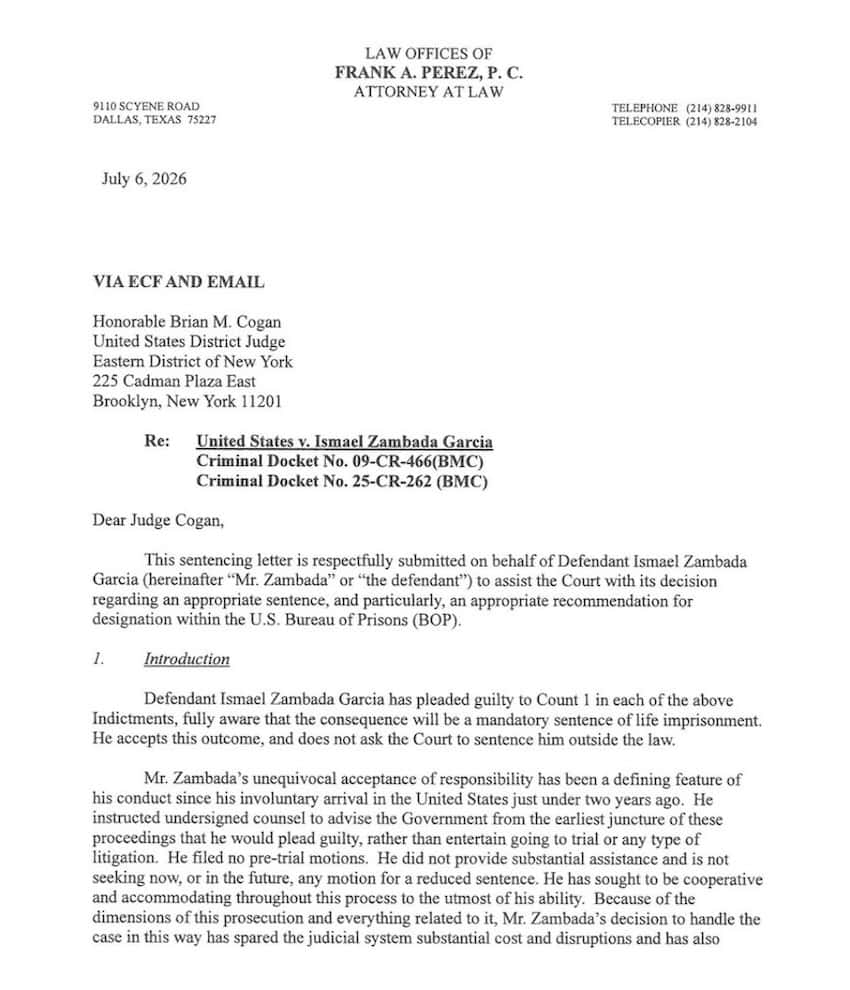
That’s the crux of a letter Frank A. Perez, Zambada’s lawyer, sent this week to Brian M. Cogan, federal judge on the United States District Court for the Eastern District of New York.
(Frank Perez)
At the start of the July 6 “sentencing letter,” Perez wrote that its purpose was to “assist the Court with its decision regarding an appropriate sentence, and particularly, an appropriate recommendation for designation within the U.S. Bureau of Prison (BOP)” for Zambada, who was arrested in New Mexico in July 2024 after he was kidnapped by Joaquín Guzmán López, a son of convicted drug lord Joaquín “El Chapo” Guzmán, and forced onto a light plane that flew him to the United States.
After noting that his client pleaded guilty, the Dallas-based lawyer said that Zambada — who is set to be sentenced on July 20 — was “fully aware” that the consequence would “be a mandatory sentence of life imprisonment.”
“He accepts this outcome, and does not ask the Court to sentence him outside the law,” he wrote.
“Mr. Zambada’s unequivocal acceptance of responsibility has been a defining feature of his conduct since his involuntary arrival in the United States just under two years ago,” Perez added.
Later in the letter, the lawyer noted that Zambada is 76 and “contends with a complex of age-related health issues.”

“… The request made here is that, within its ability and discretion, this Court recommend designation to a BOP facility suitably equipped to address the defendant’s need for medical treatment, such as FMC [Federal Medical Center] Butner, FMC Rochester, MCFP Springfield, or a similar secure medical or administrative facility within the BOP,” Perez wrote.
“… Given the medical issues documented in the record, the defense respectfully asks that those issues be expressly considered as part of the designation process along with all security, administrative, and institutional factors BOP is required to assess,” he wrote.
Zamada’s health issues are redacted in the publicly-available version of Perez’s letter. However, an unredacted section of the letter states that the conditions “are progressive and likely to exacerbate as the defendant ages.”
Perez argued that Zambada deserves to be incarcerated in a prison where his health issues can be effectively treated because he pleaded guilty rather than opting to go to trial.
“In taking full responsibility for his wrongdoing, Mr. Zambada’s comportment has differed markedly from that of other foreign organized crime figures who have been brought to this country through extradition, including his former partner in the Sinaloa Cartel, Joaquin ‘Chapo’ Guzmán, who went through an 11-week jury trial seven years ago,” he wrote.
“… In contrast,” Perez wrote, “by accepting responsibility and entering a voluntary plea of guilty, Mr. Zambada:
- Avoided what would have been one of the most complex Federal trials in history;
- Spared victims and witnesses the fear and risk of being exposed and having to testify;
- Conserved substantial judicial and prosecutorial resources;
- Eliminated or greatly reduced the security concerns for all concerned that would be inherent in a protracted drug cartel litigation.”
“… Although there will be no benefit in sentence, it seems reasonable there should be some consideration in terms of designation within the BOP,” the lawyer wrote after once again highlighting the “differing” approaches of Guzmán and Zambada to resolving the charges against them.
“The way that Ismael Zambada has conducted himself since coming to the United States is the way our system wants to encourage defendants to behave,” Perez wrote.
“Mr. Zambada’s approach benefitted the system by reducing the logjam of justice. For Mr. Zambada to end up not only with the same life sentence as Mr. Guzman, but also in the same draconian Supermax prison, would fail to account in any way for the fact that he took the right path in resolving the charges against him. It would disincentivize other similarly situated defendants who are brought here in the future from following Mr. Zambada’s example rather than Mr. Guzman’s, and would seem somehow counterintuitive,” he wrote.
Zambada’s early life
Perez’s letter includes some interesting information about the early life of Zambada, who founded the Sinaloa Cartel with “El Chapo” and others in the 1980s.
The lawyer wrote that “Ismael Zambada was born on January 30, 1950 to a family of subsistence farmers in an isolated rural community in Sinaloa, Mexico.”
“He was the second of seven children, and the first son. He attended three years at the local village school, which was as high as it went, and then went to live with his grandmother in the city of Culiacán where he attended grades 4 through 6. On weekends and in summers, he retuned to the village to work alongside his father on their farm,” Perez wrote.
He wrote that Zambada’s lost his father to brain cancer at the age of 12 and he “received no further schooling after that because, as the oldest male, he was needed to keep the farm running and help make sure the younger children were fed.”
“Mr. Zambada believes that if his father hadn’t died, he likely would have gone farther in school. However, he was familiar with the labors associated with the farm, since he’d been helping his father since early childhood, and he needed to fulfill that role,” Perez said.
El Mayo’s introduction to the underworld
Perez wrote that Zambada met his future wife, Rosario Niebla, while working as a delivery driver for his uncle’s butcher’s shop in his teenage years.
“They married and started their family in 1968, when he was eighteen,” he wrote in the letter to Judge Cogan.
“Mr. Zambada was introduced to the drug trade a year later when he was nineteen by a slightly older friend who took him up to the mountains about an hour from their village where each planted marijuana, camouflaging it within rows of corn on the same parcel. He recalls that the first cycle wasn’t very successful, though he was able to harvest around 60 pounds which he sold to another man, receiving approximately 180 pesos per kilo (about $15 USD per kilo based on the exchange rate at the time),” Perez wrote.
“… From these origins, Mr. Zambada began to meet and establish friendships with other Sinaloans involved in the marijuana and opium trade. Gradually, over the course of many years, he rose to become one of the dominant figures in drug trafficking, first in Sinaloa and ultimately in Mexico as a whole. This rise to leadership evolved over numerous decades and was not foreseen by the defendant or others,” he wrote.
The lawyer also said in his letter that his marriage to Niebla produced five children but ended after around 20 years.
“A series of relationships with other women ensued, some of which overlapped. Mr. Zambada has a total of 16 children ranging in age from 6 to 55. To the best of his ability, he strived to maintain ties with each of them,” Perez wrote.
Mexico News Daily
