


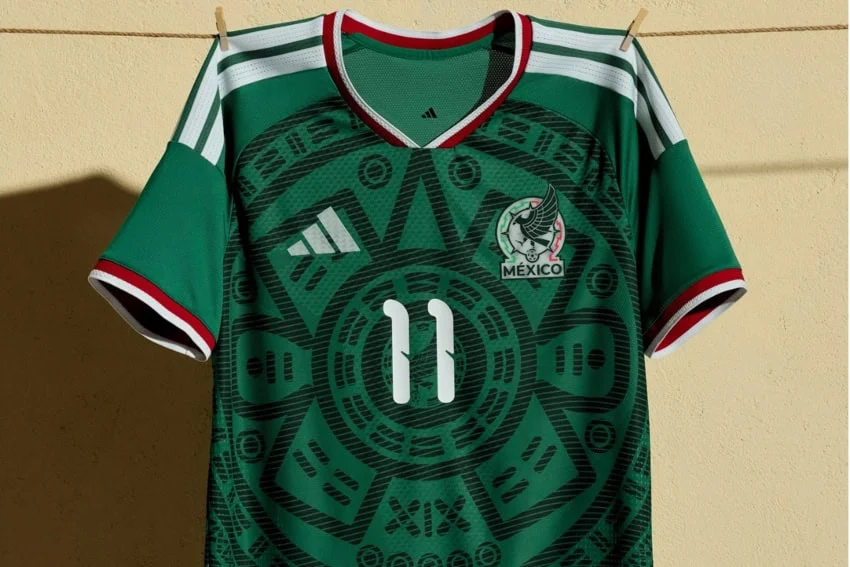
Mexico’s national team jersey is the best-selling shirt of this World Cup cycle. I don’t want to get too sociological about it, but the jersey is, above all else, a symbol. The green of our flag — which stands for hope — the sun, the graphics nodding to the Piedra del Sol (the cosmogonic centerpiece of Mexica civilization), and the eagle that recalls both our flag and the founding myth that gave Mexico its name. It’s national pride translated into performance fabric. After decades of being told to ponte la verde, the jersey became shorthand for Mexican solidarity itself.
On the left chest, opposite the crest, sits the Adidas logo. The official player version retails for around 3,000 pesos; the fan version, around 2,000. In a country where the general daily minimum wage rose to 315.04 pesos as of January 1, 2026 — roughly 9,451 pesos a month — an official jersey still represents a significant investment compared to what the lowest-paid worker earns. And the lowest-paid worker is not a marginal figure. According to the National Institute of Statistics and Geography’s first-quarter 2025 National Survey of Occupation and Employment, 40.1% of the employed population earns up to one minimum wage, and another 29.2% earns between one and two. Taken together, nearly seven out of 10 working Mexicans live on the equivalent of two minimum wages or less. When the math looks like that, counterfeits don’t appear by accident. They appear as a consequence.
Counterfeit in Mexico
As you also read here, federal authorities recently raided one of Mexico’s main counterfeit hubs, Tepito, and seized 25 tons of pirated merchandise, mostly national team jerseys. FIFA announced it would pursue legal action against vendors moving the goods, and the Mexican Institute of Industrial Property (IMPI) underscored that the operation was about protecting intellectual property.
But the numbers behind that image — stacks of green boxes piled to the ceiling — are enormous. According to the study “Piratería: Entendiendo el mercado sombra en México,” Mexicans consumed 63.262 billion pesos in counterfeit goods in 2025. A decade ago, the figure was 43 billion; it has grown nearly 50% in ten years. The damage translates to roughly 70,000 lost formal jobs, concentrated in the textile sector. According to data from IMPI, apparel (26.3%), footwear (26.3%) and accessories (24.7%) top the list of most consumed pirated goods in the country.
Zoom in on clothing alone, and the picture sharpens. The president of the National Chamber of the Textile Industry (Canaintex), Rafael Zaga, has repeatedly stated that three out of every five garments sold in Mexico come from the black market. The industry, which employs over 1.2 million people — most of them women — currently operates at only 70% of installed capacity. The remaining 30%, according to Canaintex, could be reactivated if department stores, supermarkets and government procurement prioritized Mexican-made products.
Where it enters, where it sells
Most of the counterfeit textiles sold in Mexico are not made here. They arrive, predominantly from Asia — overwhelmingly from China — through the ports of Manzanillo, Colima, and Lázaro Cárdenas, Michoacán, with secondary routes through Ensenada in Baja California and, increasingly, Nuevo Laredo, Tamaulipas, after a stop in the United States. Manzanillo is Mexico’s busiest port for containerized cargo; much of the problem passes through there.
How does it get in? Through subvaluation — declaring merchandise at a token value to dodge taxes — through route triangulation, re-labeling, “ant smuggling” (small repeated crossings) and, in the worst cases, with the complicity of customs personnel. In June 2025 alone, container abandonment at Manzanillo spiked 300%: roughly 900 containers, most of them carrying counterfeit Chinese goods, were left at port by importers who preferred to lose the cargo rather than face intensified inspections. Canaintex calculated tax evasion in the textile sector at 8.5 billion pesos in 2023 alone.

Pirate markets
Once inside the country, the merchandise flows to three main hubs that the U.S. Trade Representative (USTR) identified in its annual Notorious Markets report: Tepito in Mexico City; the Libertad market — better known as San Juan de Dios — in Guadalajara; and El Santuario, also in Guadalajara, which functions more as a wholesale warehouse than a retail point. The National Citizen Observatory has mapped at least 19 “notorious counterfeit markets” across the country, with 31.6% concentrated in Mexico City and 21% in Jalisco. Tepito alone supplies not only the rest of Mexico but, according to the USTR, also Central America.

In these markets, a pirated national team jersey sells for between 100 and 350 pesos, depending on “quality” — because, as a vendor once told me, “hay clones y hay piratería.” Canaco CDMX estimates that during the World Cup, counterfeit merchandise could account for up to 25% of informal commerce revenue in Mexico City’s Historic Center.
Who wins, who loses
It’s tempting to imagine that every peso paid for a fake jersey stays in the pocket of the woman selling it outside the market. The reality is considerably less romantic.
Losses to the Mexican textile industry, according to the sector’s own chambers, run into tens of billions of pesos. FIFA estimates that official sales drop by at least 8% due to counterfeiting. The state forgoes VAT, income tax and customs duties — money that will not be transformed into infrastructure. The 70,000 formal jobs lost have names, surnames and benefits left unpaid.
So who profits? According to federal intelligence reports cited by La Razón and Animal Político, after the year 2000 — following the split between Los Zetas and the Gulf Cartel — the counterfeit business in informal markets moved from the hands of merchant leaders to organized-crime cells. La Unión Tepito has been historically linked to controlling much of this chain, alongside networks dedicated to smuggling and extortion (cobro de piso). Counterfeiting in Mexico is not just a parallel economy: it is one of the financing mechanisms organized crime uses to launder money and hold territory. Globally, piracy generates between US $923 billion and US $1.13 trillion annually — more than the global drug trade.
The street vendors — most often women with children, according to La Razón‘s reporting from Mexico City’s Historic Center — keeps a gross margin of 200 to 300 pesos per shirt. Not nothing, for someone who needs it. But not the fortune, either. The fortune is further up the chain.
The cult of the logo
To quote the Catholic Mexican grandmothers, en el pecado llevamos la penitencia — our sin carries its own punishment. We are a class-conscious society that, like the rest of the hyperglobalized capitalist world, attaches enormous weight to logos and what they signify. Mexicans are still a long way from the “quiet luxury” aesthetic. Exhibit A: the merchant who recently showed up to a meeting with the president head-to-toe in fake Gucci. And to be clear: that’s not a critique, it’s a description.
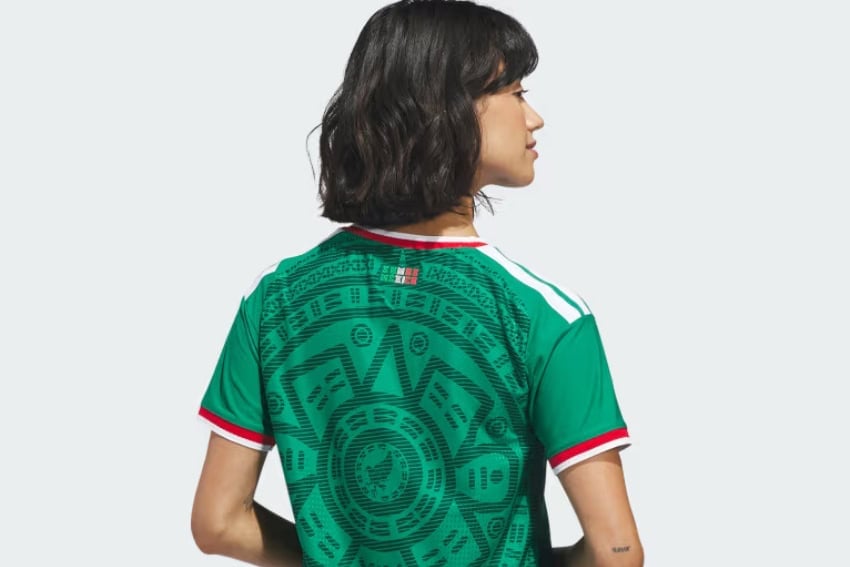
Most Mexicans are maximalists. We love color, we love whatever calls attention and, above all, we love logos. Logos signal a certain economic capacity to access “exclusive” brands, and in a society that discriminates not by race but by class, the logo becomes a symbol of social mobility. And that is exactly what the Chinese counterfeit market is reading.
False narratives
I got into a silly Instagram argument that prompted this article. The author of the video was essentially saying: “Better the money stays with the vendors than with Adidas.” The narrative is seductive, but it assumes that Adidas and the smuggling network feeding Tepito are the only two actors in the room. I tried to explain that piracy isn’t the solution — because the Mexican textile industry (not in the specific case of an Adidas-licensed jersey, but broadly speaking) also includes the maquiladoras of Puebla, the textile mills of Aguascalientes, the seamstresses of Iztapalapa, the small Mexican brands that pay VAT and the families who depend on the 1.2 million formal jobs the sector generates. It was useless: I only earned the label Whitexican for my trouble.
According to the Confederation of National Chambers of Commerce, Services and Tourism (Concanaco), 85% of Mexican companies are family-owned and there are roughly 4.5 million “micro, small and medium enterprises” (MSMEs). When we buy a 200-peso jersey from a stand, we don’t take money out of Adidas. We take it out of the family tailoring workshop, the young designer trying to launch a brand and the textile worker in Tlaxcala who sews for minimum wage and statutory benefits.
A possible way out — not banning, but reimagining
I understand the phenomenon. When it costs 28,000 pesos in paperwork just to open a small business, when the minimum wage doesn’t stretch to an official jersey, when the shirt is identity rather than caprice, asking people to skip the knockoff sounds like a sermon from someone who’s never had to choose between El Tri and the rent. Counterfeiting will not end with theatrical Tepito raids every six months, nor with moralizing columns like this one.
But maybe we can start doing something else: rethinking how and from whom we consume. Mexico has one of the richest textile traditions in the world. We have Carla Fernández taking Indigenous patterning — la raíz cuadrada — to museums like the Victoria & Albert in London and the Fashion Institute of Technology in New York, working with more than 175 artisans across 12 states. We have Boyfriend’s Shirt in Guadalajara, Sangre de mi Sangre, MANCANDY, Maison Manila and an entire generation of emerging brands — according to the National Chamber of the Clothing Industry (Canaive), 60% of new fashion brands in Mexico are independent projects — building a national proposal that doesn’t need to copy anyone.
Choosing your own symbol
We also have a domestic sportswear industry — Charly, Pirma and ABA Sports — that dresses Liga MX teams and national selections across multiple disciplines. Not to mention neighborhood workshops that screen-print jerseys to order at reasonable quality. We have options, and many are accessible.
This isn’t about canonizing consumption and demonizing the buyer of counterfeit goods. No one is in a moral position to judge another household’s paycheck. It’s about understanding that the question isn’t “Adidas or fake?” But “what economy am I feeding with each peso I spend?” If we could flip that conversation — from police operations to promoting Mexican talent; from ponte la verde as obligation to vístete de México as conscious choice — we probably wouldn’t solve the problem, but we would start building a response that could last longer than a World Cup.
At the end of the day, the jersey is a symbol. What we choose to wear is one, too.
Maria Meléndez writes for Mexico News Daily in Mexico City.
